

Last updated: July 2026 · Written by the team at Badminton House
Quick Answer: Badminton Smash Defense
Use a short, compact racket action and choose your reply by pressure: block first when you can control the shuttle, lift when you need time, and drive only when the smash is flat enough to counter.
Block
Best default: soften the smash back toward the net with almost no backswing, forcing the smasher to move forward instead of letting them keep attacking from the rear court.
Lift
Use a high, deep lift when you are late, stretched, or off balance; it buys recovery time and resets the rally, especially in singles.
Drive
Counter-drive flat and fast only when the smash is less steep or you are already set; it can turn defense into attack, but poor timing invites a drive battle.
A hard smash can make even solid club players feel late. The shuttle gets on you quickly, your grip tightens, and the panic response is usually a big swing or a desperate lift straight back to the attacker.
Good badminton smash defense is not about being stronger than the smasher. It is about reading the hit early, keeping your racket up, using a compact backswing, and choosing the right reply: a soft block to the net, a high deep lift to reset, or a flat counter-drive when the smash is loose enough.
The goal at club level is simple: stop feeding the same easy smash over and over. This guide breaks smash defense into practical decisions for singles and doubles, then gives you a routine to train faster returns.
Need a racket setup that helps you defend faster? Browse our badminton rackets for Canadian players, or ask for help choosing a frame that fits your level and playing style. Free shipping is available within Canada on orders over $200.
In This Guide
- How Do You Read a Smash Before Contact?
- Why Use a Compact Backswing, Not a Big Swing?
- Reply 1: Block the Smash Softly to the Net
- Reply 2: Lift High and Deep to Reset
- Reply 3: Counter-Drive Flat and Fast
- How Does Shot Choice Change in Singles vs Doubles?
- Practice Routine: Build Faster Smash Returns
- Which Smash Defense Should You Choose?
How Do You Read a Smash Before Contact?

Good badminton smash defense starts before the shuttle leaves your opponent’s strings. If you wait until the smash is already coming at your body, you are reacting late. Your first job is to read the opponent’s racket preparation, track the shuttle, and arrive in a balanced defensive stance before contact.
Use this simple pre-contact routine every time your opponent is set up to attack:
- Watch the racket preparation. A shorter, faster racket action often means the shuttle is coming quickly. A higher preparation with time behind the shuttle usually gives the attacker more options, so be ready for the smash, drop, or clear.
- Keep your eyes on both the shuttle and the opponent. Track the shuttle’s height and position, but also read the hitter’s body shape and racket face so you can anticipate the likely direction.
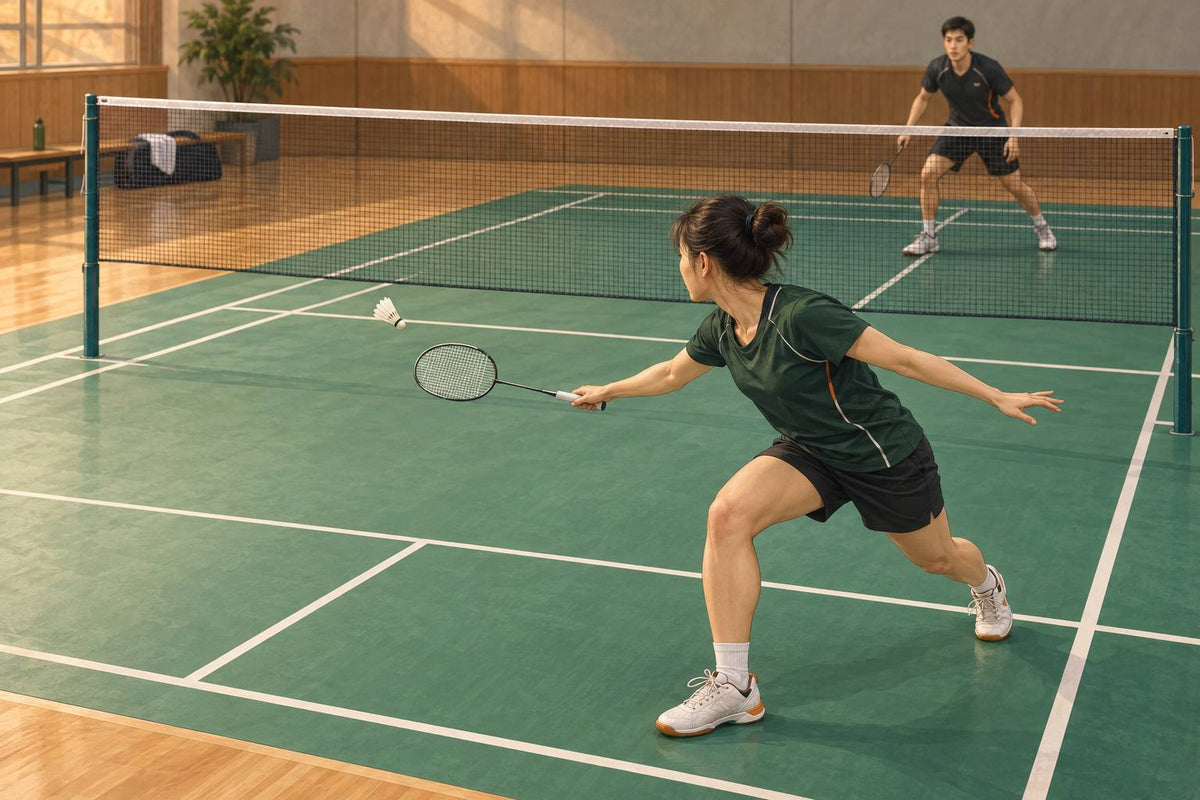
- Hold your racket up around chest height. Keep it in front of your body, not hanging down by your thigh. This shortens the distance your racket has to travel when the smash arrives.
- Start with a relaxed but ready grip. A loose neutral grip helps you change quickly into a backhand grip for body and non-dominant-side defense, or a forehand grip for your dominant side.
- Set your base wide. Stand with your feet more than shoulder-width apart, knees bent, and weight ready to move. This gives you a lower, more stable platform for blocks, lifts, and drives.
The timing cue: split-step as the opponent hits
Make a small split-step just as your opponent contacts the shuttle. That little hop preloads your legs so you can push in any direction immediately after you read the smash. If you split too early, you land flat-footed. If you split too late, the shuttle is already past your ideal contact point.
Think of it as a three-part rhythm: see the preparation, split on contact, then move the racket first. Your feet do not need to take a huge step for every smash; many returns are won by having the racket already up and the body already balanced.
If your movement base still feels slow or unbalanced, review the broader movement patterns in our badminton footwork basics guide before adding faster smash-defense drills.
Why Use a Compact Backswing, Not a Big Swing?
Good badminton smash defense is not a strength contest. When the shuttle is coming fast, a big backswing usually makes you late, opens the racket face too much, and leaves you stuck after contact. A compact backswing gives you three things that matter more: cleaner timing, better racket control, and faster recovery for the next shot.
Start from a defensive ready position with the racket up and in front of your body, around chest height. That stance is not the same one you use to receive serve, and our defense ready position guide explains how it changes with the situation. Keep the grip relaxed enough that you can change quickly, but firm enough that the racket does not wobble on impact. Think of your racket as already being “halfway to the shuttle” before the smash is hit.
Keep the Grip Loose and Neutral
Your grip should begin loose and neutral, not locked into one fixed position. If the smash comes toward your body or non-dominant side, you can turn into a backhand grip. If it comes to your dominant side, you can adjust into a forehand grip. The earlier you prepare your hand, the less you need to save the shot with a last-second wrist flick.
For many defensive returns, gripping slightly higher up the handle helps. It shortens the lever, which gives you more control on quick blocks, lifts, and drives. You give up some reach and leverage, but you gain a steadier racket face when the shuttle is already carrying pace from the smash.
| If the smash comes... | Grip response | What it helps you do |
|---|---|---|
| Into the body or non-dominant side | Switch toward backhand | Cover the body quickly without a large arm swing |
| To the dominant side | Adjust toward forehand | Present a stable face for a block, lift, or counter-drive |
| Very fast or close to the body | Grip slightly higher | Shorten the racket lever for more control under pressure |
For Blocks, Stop Swinging Through the Shuttle
The soft block is where compact technique matters most. Use a limited backswing and avoid a follow-through across the body. The smash already supplies much of the speed; your job is to control the racket face and add only a gentle push. If you swing through the shuttle, the block often floats too high, travels too far, or gives the front player in doubles an easy interception.
A useful cue: meet the shuttle, cushion it, and recover. Your racket should not finish behind your opposite hip. After contact, bring it back in front immediately so you are ready for the next smash, drive, or net follow-up.
Compact defense checklist
- Racket starts up and in front, not hanging beside your thigh.
- Grip starts loose and neutral so you can switch by placement.
- Backswing stays short; the racket face moves just enough to meet the shuttle.
- On a block, there is little to no follow-through.
- After contact, the racket returns in front of your body right away.
If you feel late even when your stance is good, your racket may simply feel slow in defense for your hand speed and playing style. When comparing racket feel, look through the badminton rackets collection and focus on how comfortably you can keep the head stable in front of you during quick blocks and drives. For grip fundamentals that make these transitions easier, see our badminton grip guide.
Reply 1: Block the Smash Softly to the Net
A soft block is a defensive return played with almost no backswing that absorbs the smash’s pace and guides the shuttle back into the front court. It is the most common and easiest way to return a hard smash, which is why it should be the first reply club players learn.

A good block changes the rally immediately: the smasher has just committed forward energy into a rear-court attack, and now they must move into the forecourt. That is why the block is so valuable. It does not win every rally by itself, but it makes the attacker cover a different part of the court instead of letting them smash again from the same comfortable position.
Think “guide,” not “hit.” Use the pace of the smash, keep the racket face stable, and add only a gentle push. If your racket feels sluggish on defensive blocks, compare weight, balance, and flex in our racket selection guide before browsing badminton rackets.
Where the Block Should Land
The common mistake is trying to make the block too perfect. If you play it very soft and loopy so it tumbles tight to the net, the shuttle stays in the air longer and gives the smasher time to charge forward. Under real smash pressure, that extra time matters.
As a practical target, aim for the shuttle to land near the short service line, which sits 1.98 m (6 ft 6 in) from the net. That keeps the block short enough to pull the attacker forward, but not so floaty that they arrive early and kill it. In fast club play, especially doubles, this “short but not hanging” target is safer than chasing a highlight-reel net shot.
How to Play It
- Start with the racket in front. If the racket drops beside your hip, the shuttle will beat you before you can control the face.
- Keep the backswing tiny. On a block, there is limited backswing and no big follow-through across the body; the smash already supplies most of the speed.
- Relax the hand, then stabilize at contact. A loose grip lets you adjust quickly, but the racket face must be steady when the shuttle hits the strings.
- Push, do not punch. Add just enough forward touch to clear the net and land around the short service line.
- Recover forward. After a good block, be ready for a net reply, lift, or loose push from the opponent.
| Block choice | When to use it | Why it works |
|---|---|---|
| Straight block | Use as your default, especially when the smash is fast or when the opponent smashes cross-court. | It is the easiest block to control because the shuttle travels on a simpler path with less angle change. |
| Cross-court block | Use after a straight smash when you have enough time and the racket face is under control. | It makes the smasher change direction and cover more distance, but it is much harder under heavy pressure. |
For most players, the straight block should be the training priority. It is simpler, safer, and works well when you are defending a sharp cross-court smash. The cross-court block is a better attacking idea after a straight smash because it sends the shuttle away from the smasher’s natural recovery line, but it demands cleaner timing and racket control.
Use the cross-court block selectively. If the smash is steep, fast, or jammed into your body, forcing a fancy angle often turns a manageable defense into an error. In that situation, a controlled straight block near the short service line is the smarter reply.
Reply 2: Lift High and Deep to Reset
The defensive lift is your reset button. Instead of trying to win the rally immediately, you send the shuttle high and deep into the opponent’s backcourt so you can recover your base, slow down the attack, and make the next smash less comfortable.
The key is height with purpose. A good lift needs enough height to buy time, but not so much height that the attacker can stand still, wait underneath it, and smash again with full balance.
Lift Placement: Choose the Reset You Need
Under pressure
Lift high and deep to the middle. This is the safest reset when the smash is steep, fast, or aimed at your body because it reduces the angle the attacker can use next.
To move them
Lift away from the smasher: if they smash straight, lift cross-court; if they smash cross-court, lift straight.
When balanced
Aim deep into the corners to make the attacker cover more ground before their next shot.
A common mistake is lifting to the same back corner every time. Once an attacker sees that pattern, they can time the next smash earlier and prepare their body before you even hit. Even if your lift is technically solid, predictable placement keeps the attack alive.
| Situation | Best lift choice | Why it works |
|---|---|---|
| Late contact or body smash | High and deep to the middle | Buys recovery time and avoids feeding an easy angle. |
| Straight smash and you are stable | Cross-court deep lift | Forces the smasher to change direction and cover distance. |
| Cross-court smash and you are stable | Straight deep lift | Sends the shuttle away from the attacker’s hitting path. |
| Attacker is waiting on your favourite corner | Change the lift target | Avoids giving them the same timing and preparation twice in a row. |
The lift is not a surrender shot. In doubles, even very strong defenders lift often because the attack can be too fast to counter immediately; the goal is to survive the fiercest smash, wait for a slower or flatter one, and then use a block or drive later in the rally. If you want help matching your equipment to a faster defensive style, compare options in our badminton rackets collection, but make the shot choice first and the gear choice second.
Technically, keep the action compact: racket in front, grip relaxed enough to adjust, and contact the shuttle with a short lifting push rather than a big scoop from behind your body. The earlier and cleaner the contact, the easier it is to send the shuttle high, deep, and away from the attacker’s strongest next smash.
Reply 3: Counter-Drive Flat and Fast
The drive is the aggressive option in badminton smash defense: instead of absorbing the smash with a block or resetting with a lift, you punch the shuttle flat and fast back across the net. When timed well, it can flip the rally immediately — the smasher expects you to defend, then suddenly has to react to a shuttle coming back at pace.
This is not a big-swing shot. The shuttle is arriving too quickly. Keep the racket in front, use a short backswing, and make contact slightly in front of your body. Think of it as a compact push-punch, not a full drive swing from the shoulder.
Best use case: counter-drive flatter smashes, especially in doubles when you can send the shuttle past the front player before they intercept.
Why the counter-drive is risky
A drive can look tempting because it feels proactive, but it also invites a drive war. That usually favours the attacker. Your defensive drive has to rise enough to clear the net; the smasher’s next drive can travel downward. If your drive sits up even slightly, you may give them the exact flat exchange they wanted.
That is why the drive is usually a selective reply, not your default smash return. Against a steep, heavy smash, blocking or lifting is often safer. Against a flatter smash — especially one aimed around your hip, body, or racket side — the counter-drive becomes much more realistic.
| Smash type | Drive decision | Why |
|---|---|---|
| Flat body smash | Good opportunity | The shuttle is already travelling on a flatter path, so a compact punch can redirect it quickly. |
| Steep smash at your feet | Usually avoid | You must lift the shuttle up over the net, which can make the reply sit up for the attacker. |
| Fast smash into your racket side | Possible if prepared | A short backswing and loose grip let you meet the shuttle early without over-hitting. |
| Doubles smash with front player hunting | Aim past the front player | The goal is not just speed; it is getting the shuttle beyond the front player’s interception zone. |
How to hit it without feeding the attack
- Start from a loose neutral grip. You need to switch quickly between forehand and backhand defence depending on where the smash comes.
- Hold the racket slightly higher on the handle. A shorter lever gives more control when the shuttle is arriving fast.
- Keep the racket head in front of your chest or body line. If the racket drops behind you, the drive becomes late and floaty.
- Use the smasher’s pace. You are redirecting speed, not creating all of it yourself.
- Finish short. A long follow-through slows your recovery and makes the next shot harder to cover.
In doubles, aim with a clear purpose: through the gap, at the rear attacker’s body, or past the front player’s racket shoulder. A drive straight into the front player’s hitting zone is not a counterattack — it is a setup for their kill.
In singles, use the drive more sparingly. Singles smash defense is often more about placement and recovery than matching speed. If your drive does not put the opponent under immediate pressure, you may be better off blocking to the forecourt or lifting high and deep to reset.
For players working on faster hands, grip comfort matters. A slippery or bulky handle makes compact defensive changes harder, so keep your grip fresh and sized properly; this badminton grip guide explains the main grip types. If you are comparing racket feel for defence and counter-driving, browse the badminton rackets collection and choose based on control, speed, and your actual playing style rather than smash power alone.
How Does Shot Choice Change in Singles vs Doubles?
The same three replies still apply — block, lift, and drive — but the best choice changes with the format. In singles, smash defense is usually more about placement and recovery time. In doubles, the shuttle comes at you faster and more often, so positioning and compact reactions matter even more.
| Format | Main defensive problem | Best shot-choice mindset |
|---|---|---|
| Singles | The smasher can move you around the full court, so placement hurts more than pure speed. | Use blocks to pull the attacker forward, and use the high, deep reset lift when you need time to recover. |
| Doubles | The attack is faster, and the front player is waiting to intercept loose replies. | Hold your side-by-side defensive base, then look for blocks and flat drives when the smash is not too steep. |
In singles, do not feel guilty about lifting. A good lift can buy the recovery time you need before the next shot, especially when you are stretched or late. The key is to avoid becoming predictable: if every smash return is a safe lift, the opponent can settle into repeated attack.
In doubles, blocks and drives become bigger weapons. A soft block can force the attacking pair to move forward, while a flat drive can counter a flatter smash and try to get the shuttle past the front player. But doubles defense only works if the pair is set up properly first; for the side-by-side defensive shape, see our badminton doubles positioning and rotation guide.
Practical rule for Canadian club nights
- Singles: choose the reply that gives you court control again — often a well-placed block or a recovery lift.
- Doubles: choose the reply that survives the front player — often a tight block, a fast drive, or a lift when the attack is too strong.
- Under heavy pressure: lifting is still common even at world level because defenders are waiting for a smash that is a little slower, less steep, or less well placed before they counter.
If your defensive returns keep popping up, fix the contact and positioning before blaming the racket. When you are ready to tune your setup, browse our badminton rackets collection for Canada-wide shopping, with free shipping within Canada on orders over $200.
Practice Routine: Build Faster Smash Returns
Good badminton smash defense improves fastest when you train the whole defensive habit, not just the final shot. Every rep should start the same way: wide stance, knees bent, racket up in front around chest height, loose neutral grip, eyes on the shuttle and the hitter, then a split-step as the opponent contacts the shuttle.
From there, rotate through the three main replies: block, lift, and drive. The goal is to stop defaulting to one safe but predictable answer. If you only lift, stronger opponents keep smashing. If you only block, the front player in doubles starts hunting. If you only drive, you invite a flat exchange that the attacking side may win. Train all three so your first instinct becomes choice, not panic.
Defense tip: Pair this routine with the attacking cues in How to Improve Badminton Smash. Understanding how a smasher prepares helps you read the racket face, body rotation, and contact point earlier.
The simple smash-defense routine
Use a feeder or rally partner if you have court access. The feeder does not need to hit full-power winners; controlled, repeatable smashes are better for building clean technique. Start each rep from your ready stance and split-step on contact, then play the assigned reply.
| Phase | What to practise | Quality cue |
|---|---|---|
| Ready stance | Wide base, bent knees, racket up and in front, loose neutral grip. | You should feel ready to move to either side without dropping the racket head. |
| Split-step | Make a small split-step as the hitter contacts the shuttle. | You should land balanced, not flat-footed, and react immediately to the smash direction. |
| Block | Use a compact racket movement and guide the shuttle softly forward. | The block should not float too high; a useful target is near the short service line. |
| Lift | Send the shuttle high and deep to reset, especially when under pressure. | Under heavy pressure, lift high and deep through the middle; when you can, lift away from the smasher or into the deep corners. |
| Drive | Counter flat and fast when the smash is flatter or easier to meet in front. | Keep the swing short. In doubles, aim to get the shuttle past the front player, not straight onto their racket. |
| Random choice | Have the feeder vary smash direction and steepness, then choose block, lift, or drive based on the shuttle you receive. | You are improving when your reply changes naturally instead of becoming the same high, floaty shot every time. |
Use compact technique on every rep
The feeder’s smash already brings pace. Your job is not to take a big swing; it is to meet the shuttle early with a stable racket face. Keep the backswing short, grip lightly until impact, and recover the racket back in front after each shot.
- For backhand-side and body smashes: start from neutral and switch quickly into a backhand grip.
- For forehand-side smashes: turn the racket face with a small grip change instead of reaching with a locked wrist.
- For extra control: hold the racket slightly higher on the handle during defensive work to shorten the lever.
- After every reply: bring the racket back to the front before watching the result of your shot.
Wall-reflex drill for home or quiet gym time
When you cannot book a court, the wall-reflex drill is a useful way to sharpen reactions and grip transitions. Stand in your ready stance and hit a shuttle against a wall repeatedly, trying to keep the racket up and the swing compact. The drill works best when you alternate between forehand and backhand contacts instead of letting one grip do all the work.
Wall-Reflex Checklist
Racket up
Default habit: keep the racket in front at chest height so the next contact is short and fast.
Loose grip
Stay relaxed enough to change grip quickly, then tighten briefly at contact.
Short swing
Use the shuttle’s rebound and a small push. Big swings make the next contact late.
Reset
After every hit, return the racket to the middle instead of admiring the shot.
How to know the routine is working
Your smash returns are improving when the first contact feels calmer. You split-step on the hitter’s contact, the racket stays up, and your replies become lower, cleaner, and more varied. In singles, that may mean a deeper lift that buys time or a block that forces the smasher forward. In doubles, it may mean absorbing the first steep smash, then driving a flatter one past the front player or following your block toward the net.
Shop Badminton Rackets in Canada
Free shipping on $200+ in Canada · 14-day returns · Canadian badminton specialty shop
Which Smash Defense Should You Choose?

For most players, the safest decision tree is simple: block when you can take the smash early and controlled, lift when you are late or under heavy pressure, and drive only when the smash is flat enough that you can meet it cleanly in front of your body.
| Situation | Choose | Why it works | Key cue |
|---|---|---|---|
| You are balanced, racket is up, and the smash is reachable in front | Block | The block is the most common and easiest smash reply, and it forces the smasher to move into the forecourt. | Use a limited backswing and aim near the short service line rather than floating it too softly. |
| You are late, stretched, or facing a very steep attack | Lift | A high, deep lift resets the rally, gives you recovery time, and can disrupt the next attack. | Under pressure, lift high and deep to the middle; when you can pressure movement, lift away from the smasher. |
| The smash is flatter, slower, or poorly placed | Drive | A flat, fast counter-drive can turn defense into attack, especially in doubles when you can get the shuttle past the front player. | Use it cautiously: your drive must rise over the net, while the attacker’s reply can travel downward. |
| Opponent smashes cross-court in singles | Straight block | Straight blocks are the easiest option and are the best choice against a cross-court smash. | Keep the racket face stable and avoid a big follow-through. |
| Opponent smashes straight in singles | Cross-court block if controlled; lift if not | A cross-court block makes the smasher change direction and cover more distance, but it is substantially harder against a fierce smash. | If the smash is too heavy, choose the safer high, deep lift. |
| You are defending in doubles | Lift patiently, drive flat smashes, follow blocks forward | Doubles defense faces more speed, so even elite defenders lift often while waiting for a slower, less-steep, or less well-placed smash to counter. | Good positioning matters; if you block in doubles, be ready to follow the shuttle toward the net. |
Gear note for faster defense. A compact swing and stable grip matter more than buying a “defensive” racket, but racket balance still changes how quick the frame feels. If you are comparing options, browse the Badminton Rackets collection; the Yonex Astrox 100 ZZ and Yonex Astrox 100VA Game listed there are head-heavy Astrox frames, so treat them as attack-biased examples rather than automatic picks for quick defensive blocks.
Get new badminton guides by email
Join the Badminton House list for occasional emails with new guides, technique tips and news from our club in Moncton.
By subscribing, you agree to receive Badminton House emails and can unsubscribe anytime.
Smash defense gets easier when your footwork, grip, and racket setup all support the same goal: react early, stay compact, and choose the right reply under pressure. We play badminton too, so if you are not sure whether your current racket, strings, or grip are helping your defense, contact us and we will point you in the right direction.
Build a faster, cleaner defensive game with gear that fits how you actually play.
Shop Badminton RacketsFree shipping within Canada on $200+ · 14-day returns · Canadian badminton specialty shop


Leave a comment
This site is protected by hCaptcha and the hCaptcha Privacy Policy and Terms of Service apply.