
Last checked: August 2026 · Written by the player-led team at Badminton House
Quick answer: badminton fall injuries
A fall is a stop-play moment. Make the space safe, do not pressure the player to stand or test the joint, and get qualified help when the warning signs below are present. This guide helps with that decision; it cannot identify the injury.
Default
Stop the rally: keep other players, rackets and loose shuttles away while the person stays where they are most comfortable.
Escalate
Call emergency services for an emergency warning sign. Use the venue’s first-aid process for a potentially serious fall.
Next time
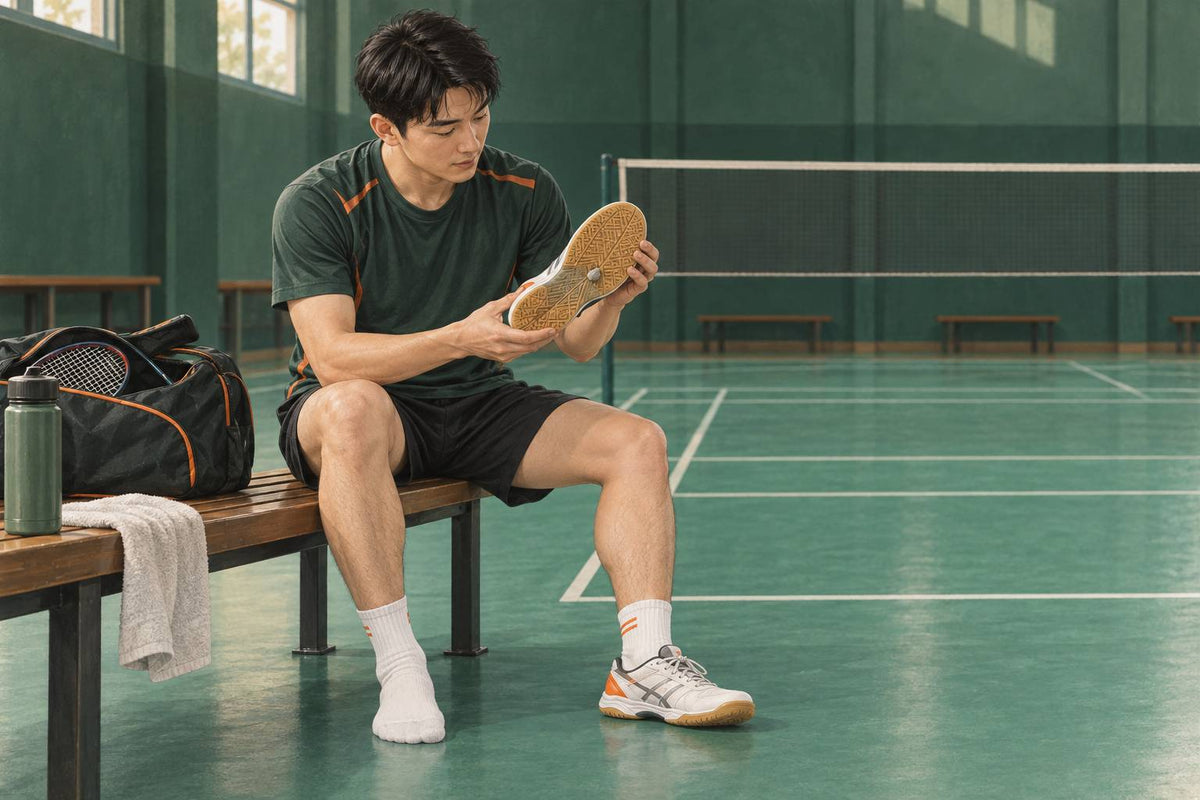
Before play, check the court is dry and clear, then look at the soles you will use on it.
A player can lose balance in any fast indoor sport. The useful response is not to guess whether a wrist, elbow, knee or shoulder is “only” sore. It is to stop the point, avoid adding force or movement, notice the warning signs, and bring in the right help. That keeps an ordinary club response calm and gives the injured player room to describe what they feel.
Why a planted hand needs caution
When a fall ends with an outstretched hand on the floor, force can travel through the wrist and elbow. That mechanism does not reveal what is injured, but it is enough reason to stop the session and avoid asking the player to prove they can grip, push up or swing again.
It is tempting to label a fall by the body part that first hurts. Resist that shortcut. A hand planted to break a fall can load more than the hand itself, and pain can be unclear in the first minutes. The American Academy of Orthopaedic Surgeons identifies a fall onto an outstretched arm as the most common cause of a distal-radius fracture (AAOS on broken wrists). Its elbow guidance also describes an outstretched-hand fall as a route for force to reach and turn the elbow.
That is mechanism evidence, not a badminton diagnosis or a prevalence claim. A lunge slip, a forward dive and a backward fall can look very different. The immediate decision stays the same: end the rally, make room, and avoid loading the painful arm or asking the player to get up by pushing through it.
Club-side rule: do not pull a player up by the arm or ask them to “shake it off.” Ask what hurts, keep the court clear, and involve the venue’s first-aid contact.
What to do at the court after a fall
Start by protecting the scene and the person, not by testing the injury. Check that no one will collide with them, stop the next rally, and ask the player simple questions only if they are awake and able to answer. Do not ask them to move a painful area.
- Stop play and create space. Call “stop,” move shuttles and rackets away, and ask nearby players to give the person room. If the floor itself is wet, dusty or damaged, keep play out of that area and tell the organiser.
- Check for immediate danger. If the player is unresponsive, not breathing normally, has life-threatening bleeding or another obvious life-threatening condition, activate local emergency services and follow the dispatcher or trained responder.
- Do not create a second injury. If there is any concern about the head, neck or back, do not ask the player to move. The 2024 American Heart Association and American Red Cross first-aid guidance says a person with a suspected spinal injury should remain as still as possible unless safety requires movement (2024 AHA and Red Cross first-aid guidance).
- Hand over clearly. Tell the first aider or emergency responder what happened, where the person first reported pain, whether they hit their head, and whether anything changed while you waited. Stay with them if it is safe to do so.
This is intentionally conservative. It does not teach a lift, roll, tuck, joint reduction or a self-treatment routine. A floor-side article cannot decide how to move a person or what a particular injury needs. If you regularly organise sessions, a current first-aid course and a clear venue emergency plan are much more useful than improvised handling.
When to seek urgent or emergency help
A fall needs urgent assessment when pain is very severe or worsening, swelling or bruising is large or worsening, the player cannot bear weight or walk more than a few steps, or movement is very stiff or difficult. Those are reasons to stop the session and arrange prompt medical assessment rather than waiting for another game.
| What you notice | Decision |
|---|---|
| Very severe or worsening pain; large or worsening swelling/bruising; cannot bear weight or walk more than a few steps; marked stiffness or difficulty moving. | Seek urgent medical assessment. Do not send the player back into the session. |
| A crack was heard; a body part looks deformed or sits at an odd angle; numbness, tingling, blue/grey skin or coldness. | Treat it as an emergency and activate local emergency services. |
| Loss of consciousness, worsening headache, vomiting, altered behaviour or alertness, seizure, vision change, or scalp swelling/deformity after a head impact. | Activate emergency services. Keep the person from returning to play while care is arranged. |
The limb warning signs follow the NHS guidance for sprains and strains (NHS urgent and emergency injury signs). The head-warning examples come from the 2024 American Heart Association and American Red Cross first-aid guidelines. They are warning signs, not a way to name the injury from courtside.
Do not use a player’s willingness to continue as the test. People may want to finish a game, especially in a close match or a busy club night. The safer club decision is to stop, document what happened for the handover, and let a qualified professional decide what the symptoms mean.
A simple pre-play floor and shoe check
No check can guarantee that you will not fall, but a brief look at the floor and shoe soles can catch obvious hazards before the first rally. Treat this as an editorial club habit: if the court or sole looks questionable, pause and fix or report the problem rather than trying one fast lunge to find out.
- Scan the court. Look for damp patches, residue, loose tape, debris, damaged flooring or a cleaning area that is not dry. Keep play away from a questionable patch and alert the organiser or facility staff.
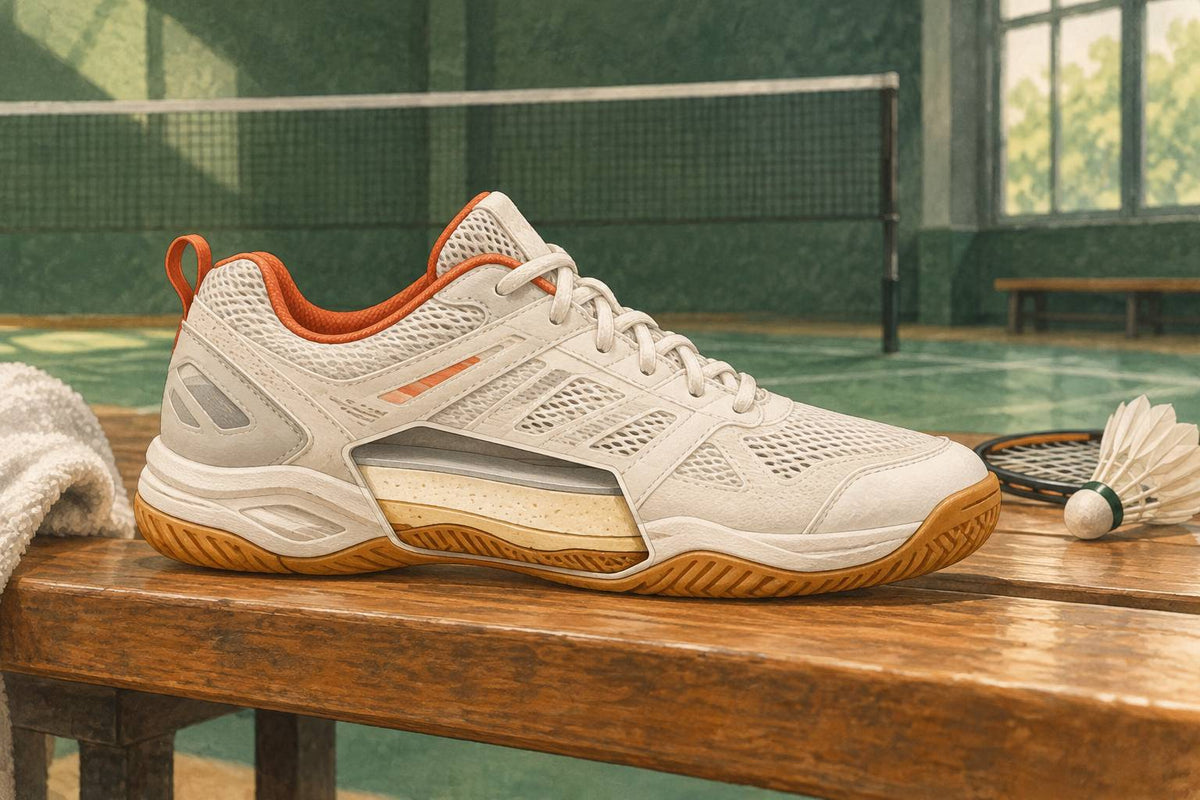
- Look under both shoes. Remove anything visibly stuck in the tread. Notice if the sole is badly worn, separating or unusually smooth compared with the other shoe.
- Use the decision, not bravado. If the surface or shoe condition gives you doubt, sit out until the area is made safe or use another suitable court. Do not ask a partner to test it at speed.
This check is grounded in general slip-prevention guidance: the UK Health and Safety Executive notes that damp smooth floors can be extremely slippery, contamination is implicated in almost all slip accidents, and footwear tread can clog or lose slip-resistance properties with wear (HSE on slip hazards). Those points do not certify any particular court shoe or surface; they support stopping for an obvious hazard instead of playing through it.
There is no self-taught “safe fall” technique that makes a hard landing harmless. If a qualified coach or clinician includes fall-related work in a supervised programme, follow their sport- and person-specific instruction. This article deliberately does not prescribe rolling, tucking or repeated floor drills: the first priority after an unexpected fall is assessment, not practising through it.
Make the next club response easier
The best preparation is a shared, simple response: everyone knows to stop play, clear the court, call the venue contact, and avoid unnecessary movement. That turns a frightening moment into a quieter handover and prevents well-meant teammates from crowding or testing a painful arm.
Before your next session, find out where the venue keeps its first-aid supplies, who is responsible for incidents and how to contact emergency services from the building. Agree that anyone can call a safety stop. Then give the court and soles the short visual check above. These small choices do not replace medical care, but they make it easier to protect a player when a fall happens.
Keep the response language simple enough to use under pressure: “Stop play. Give space. Do not move the painful area. Get the first aider.” A teammate does not need to solve the medical question to make that helpful first decision. Calm, clear information is more useful to the player and to the person taking over their care.
For the wider lower-limb context, read our guide to badminton ankle-sprain prevention. It is a separate topic from a fall response, but it can help a player plan their court preparation with a clinician or coach.

Leave a comment
This site is protected by hCaptcha and the hCaptcha Privacy Policy and Terms of Service apply.