
Last checked: August 2026 · Written by the player-led team at Badminton House
Quick Answer: badminton shoe midsole
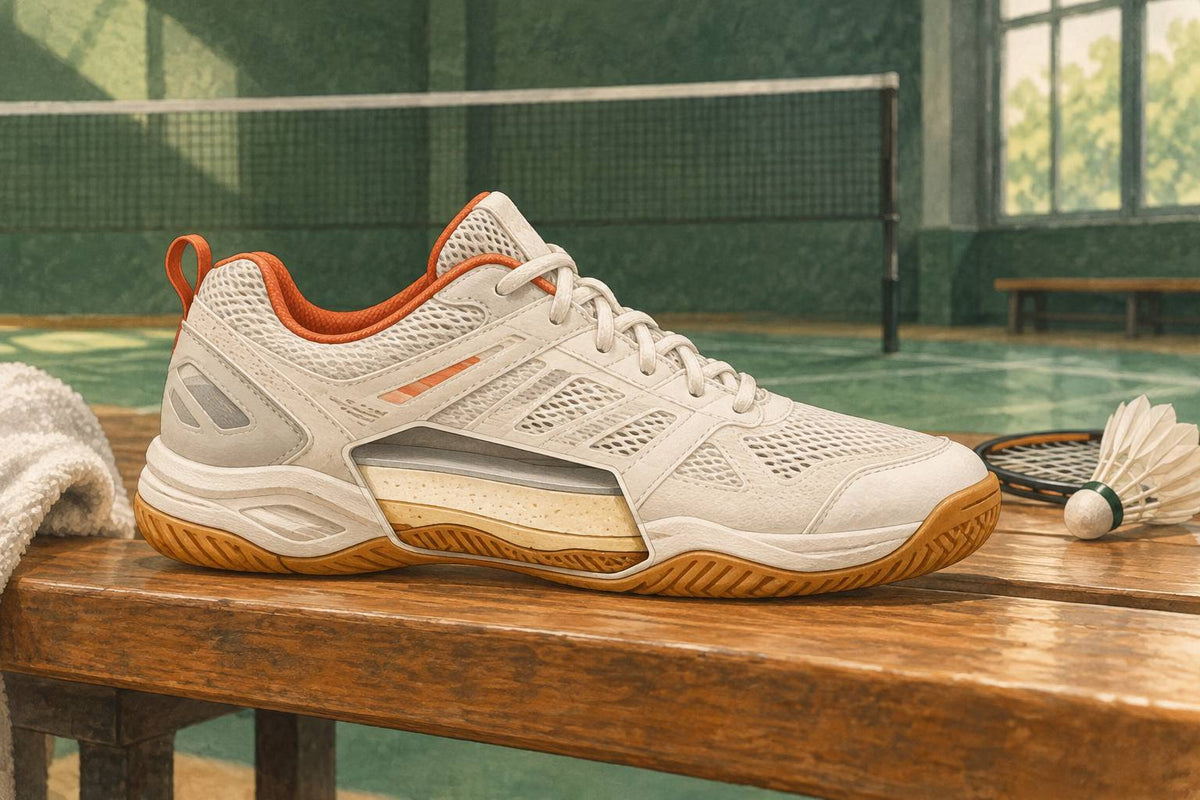
A midsole spec is a description of one part of a shoe, not a verdict on comfort, stability or performance. Use it to form a question, then compare the complete shoe: fit, upper hold, outsole and midsole work together.
Default
Read the whole build. A foam name or a millimetre number cannot predict your experience by itself.
Density
A material parameter, not a universal firmness or rebound score.
Stack/drop
Two separate dimensions: overall material underfoot and heel-versus-forefoot difference.
Product pages often make a shoe sound solved by listing foam, an insert, a stabiliser and a few measurements. Those details are useful. They tell you what a maker chose to put into the midsole. They do not, on their own, tell you how the shoe will fit, move with your foot or behave during a badminton session.
This guide is a decoder, not a ranking. It explains what each label describes and gives you a neutral comparison process. It does not recommend models, retailers or a single “best” midsole.
What do foam density and dual-density actually describe?
Foam density describes mass per unit volume; dual-density means a shoe uses two foam zones or materials rather than one uniform layer. Neither label tells you, by itself, how soft, lively, durable or stable the finished badminton shoe will feel, or which complete shoe will suit you.
“Foam” is not one fixed material experience. EVA is a common sports-footwear midsole material, yet laboratory work shows that changing an EVA formulation can change compressive strength, dynamic stiffness, rebound behaviour, abrasion resistance and fatigue retention. That is why “EVA” on two product pages is not a fair comparison on its own. The underlying EVA materials research is a mechanics study, not a badminton comfort test, but it shows why material names need context.
A density value can be useful only when a maker provides a meaningful comparison within the same shoe family, with the same test method. Across brands, it is incomplete information. Geometry, thickness, cell structure, additives, the sockliner and the rubber outsole all sit between that number and your foot. If density is listed without units, location or comparison point, treat it as a product detail rather than a decision rule.
Dual-density is similarly descriptive. It tells you that the maker intentionally used more than one midsole zone. It does not reveal which zone is firmer, where it sits, how thick it is, or why it was chosen unless the product page says so. A clear listing names the location and its stated job. A vague listing leaves you with a useful question for the seller, not a missing fact you should fill in from marketing language.

| Spec phrase | What it safely tells you | What it cannot settle |
|---|---|---|
| Foam density | A material property of a stated foam or zone. | Your perceived firmness, durability or court feel. |
| Dual-density | At least two midsole zones or materials are used. | Which choice is better without zone, geometry and fit details. |
Read construction language from the outside in
A useful spec normally has three parts: the component, its location and the maker’s stated purpose. Read them in that order. “Foam” names a material category. “Forefoot foam insert” adds a location. “Forefoot foam insert intended for cushioning” adds the claim the maker wants you to consider. Each extra part makes the description more specific, but none turns it into an independent result.
Location words deserve the most attention because they prevent unlike comparisons. Full-length, heel, forefoot, midfoot, arch, lateral side, medial side, core and perimeter do not describe interchangeable placements. If one listing names a heel component and another names a forefoot component, the two feature badges are not competing answers to the same construction question. Put each item in the correct location column before comparing it.
Also separate layers that sit above, within and below the midsole. A removable sockliner is not automatically the same thing as an insert embedded inside the foam, and an outsole feature is not a midsole feature merely because the product image places them close together. When a diagram uses colour without labels or a listing never states which layer contains the feature, record the location as unknown.
Four questions for any construction badge
- What physical component is being named?
- Where in the shoe does the listing place it?
- Is the stated effect a dimension, a laboratory result or a manufacturer claim?
- What information is still missing?
What are heel and forefoot inserts, and what is a stabiliser?
An insert is a local piece placed in part of the midsole; a stabiliser is a structural feature a maker says is intended to manage support or stiffness. Their names locate a design idea. They do not prove a cushioning, stability or injury-prevention result for every player, and they do not replace a fit check.
A heel insert means the component is under or around the rearfoot. A forefoot insert means it is placed under or near the front of the foot. The label does not specify the material, depth, size, compressibility or how it connects to the surrounding foam. Those omitted details matter. There is no sound general rule that a heel insert is “softer,” that a forefoot insert gives faster push-off, or that either arrangement necessarily improves a badminton landing.
The same restraint matters for a “stabiliser,” “shank” or TPU piece. These names generally signal a firmer structural component, often visible around the midfoot or arch. A manufacturer catalog, for example, says that its TPU midsole unit helps increase midfoot stability. That is the maker’s feature claim, not an independent finding that every shoe with a similar-looking part will feel more stable for you. Read the stated location and purpose, then assess the full shoe rather than assigning the component a universal job.
The practical comparison is simple: if two shoes fit equally well, note whether each listing explains where the local component sits and what the maker claims it does. Specific information is more useful than a badge or proprietary name. It still cannot substitute for trying the shoe because the upper and heel hold change how the same midsole is loaded.

What a laboratory result can and cannot answer
Before carrying a study result into a buying decision, check three things: what was tested, what task was performed and what outcome was measured. The EVA study tested material formulations and mechanical properties. The landing study tested basketball shoes during a controlled step-off task. The thickness study tested side-step cuts and measured selected forces, timing and kinematics. None asked badminton players which complete shoe they preferred during normal play.
That does not make the research irrelevant. A material test can show that two formulations bearing the same broad material name need not behave identically. A controlled shoe study can test whether a particular change affected a defined measurement in that setup. Those are useful limits on overconfident marketing interpretations.
The result cannot silently change categories on the way to the product page. Mechanical rebound is not automatically perceived responsiveness. A force measurement is not automatically comfort, protection or reduced muscle load. A change in joint angle during one controlled task is not automatically an injury outcome. Keep the study’s object, task and measured outcome attached to the finding, then use it only for the question it actually answered.
How should you read stack height and heel-to-toe drop?
Stack height is the amount of shoe material under the foot; heel-to-toe drop is the height difference between heel and forefoot. They are separate measurements, so a high-stack shoe and a low-stack shoe can share the same drop. Neither measurement is a complete badminton stability or comfort rating.
That distinction is worth making before any feel claim. An official manufacturer explainer defines drop as the difference between heel and forefoot height and demonstrates that it does not follow from stack height alone. Its heel-drop definition is clear; its running-specific advice is not treated here as badminton evidence.
A taller stack means more physical material separates foot from floor. It does not establish that a shoe is more cushioned, less stable or more likely to cause an ankle roll. In a controlled study of 15 athletes performing side-step cuts in shoes with varied midsole thicknesses, selected ankle and foot kinematics changed while braking and propulsive force did not significantly change. That side-step evidence is useful precisely because it resists a simple story: thickness can interact with that task without proving a badminton safety verdict.
For an online comparison, write heel stack, forefoot stack and drop on the same line when all three are published. If only one number appears, do not infer the other two. If the seller does not state a measurement method, treat close numerical comparisons cautiously. Different brands may measure at different points or include different layers.

Compare like with like, in a fixed order
Start with fit-compatible options in the same intended shoe category and size. Then compare disclosed construction in a fixed sequence: full-length foam, local heel or forefoot components, structural pieces, heel and forefoot stack, and finally drop. This order stops a prominent feature badge from outweighing missing information elsewhere in the build.
Use one row per shoe and one column per field. Copy the listing’s wording without upgrading it. “Stated to support the midfoot” stays a manufacturer claim; it does not become “more stable.” A blank remains “not stated”; it does not become “none.” When units or measurement methods differ, do not rank small numerical gaps as though they came from one controlled comparison.
After the fields are aligned, look for the smallest meaningful difference between the two candidates. If several major features change at once, the spec sheet cannot isolate what produced an in-store impression. That is still a useful conclusion: you can compare the complete shoes, but you cannot credit one foam, insert or dimension with the difference.
A neutral 30-second comparison for the complete shoe
The useful question is not “which midsole spec wins?” It is “which complete shoe gives me the clearer, more secure fit for the movements I expect to make?” This 30-second check is an editorial comparison process, not a validated performance or injury test.
- Read the listing once. Mark what it actually discloses: midsole material, local insert location, structural component location, stack numbers and drop. Leave blanks as blanks.
- Put both shoes on and secure them normally. Compare heel hold, midfoot hold and toe-room first. A midsole cannot compensate for a shoe that moves around your foot.
- Stand, shift gently side to side and take a few controlled steps. Notice only your own immediate observations: pressure spots, heel movement, whether the shoe feels awkwardly tall, and whether the upper stays aligned with your foot.
- Use the specs to explain a difference, not predict it. If one pair feels different, see whether the listing identifies a changed stack, local component or foam construction. Do not assume that one attribute caused the experience.
- Choose the clearer fit when the information is otherwise tied. It is the comparison result you can actually observe, while many midsole claims are indirect or manufacturer-specific.
This restraint is supported by the midsole-density evidence. In a step-off landing study of nine healthy male college athletes wearing basketball shoes, soft, normal and hard midsoles produced some force and acceleration differences, but no significant differences in kinematics or energy absorbed through lower-extremity extensors; the authors reported limited evidence that the soft midsole delivered an impact-attenuation benefit. Read the controlled density study as a reason to avoid translating “soft” straight into “less load” or “more protection.” Its population, shoes and landing task cannot settle a badminton choice.
Online versus in-store: keep the checks separate
| Online check | In-store check |
|---|---|
| Record the exact material and component names. | Confirm heel, midfoot and toe-room fit. |
| Mark each feature’s stated location and purpose. | Notice pressure, heel movement and upper alignment. |
| Copy heel stack, forefoot stack and drop separately. | Compare candidates under the same brief, controlled movements. |
| Leave unstated details blank and note measurement differences. | Write observations without assigning an unproven cause. |
Online work is for verifying what the construction sheet actually says. In-store work is for observing the complete shoe on your foot. Combining the notes is useful; swapping one for the other is not. A detailed product page cannot confirm fit, and a brief try-on cannot reveal an unstated material property.
When the issue is movement rather than a spec sheet
A shoe comparison cannot diagnose a movement problem. For the separate question of improving your on-court movement, read how to break an intermediate badminton plateau.
For online shopping, save the product page alongside your notes. A later comparison is much easier when you can see exactly what a listing said, rather than relying on a remembered badge or a general impression from a thumbnail.
The best use of midsole language is modest: it helps you ask sharper questions, spot missing product information and compare two otherwise suitable shoes more carefully. It does not let a spec sheet promise a feeling, prevent an injury or replace a proper fit check.



Leave a comment
This site is protected by hCaptcha and the hCaptcha Privacy Policy and Terms of Service apply.