
Last checked: August 2026 · Written by the player-led team at Badminton House
Quick answer
BWF includes starting after a signal and reacting into different directions, with progression from predictable to less predictable practice. A partner-cued first movement is a coach-designed activity, not a validated first-step test.
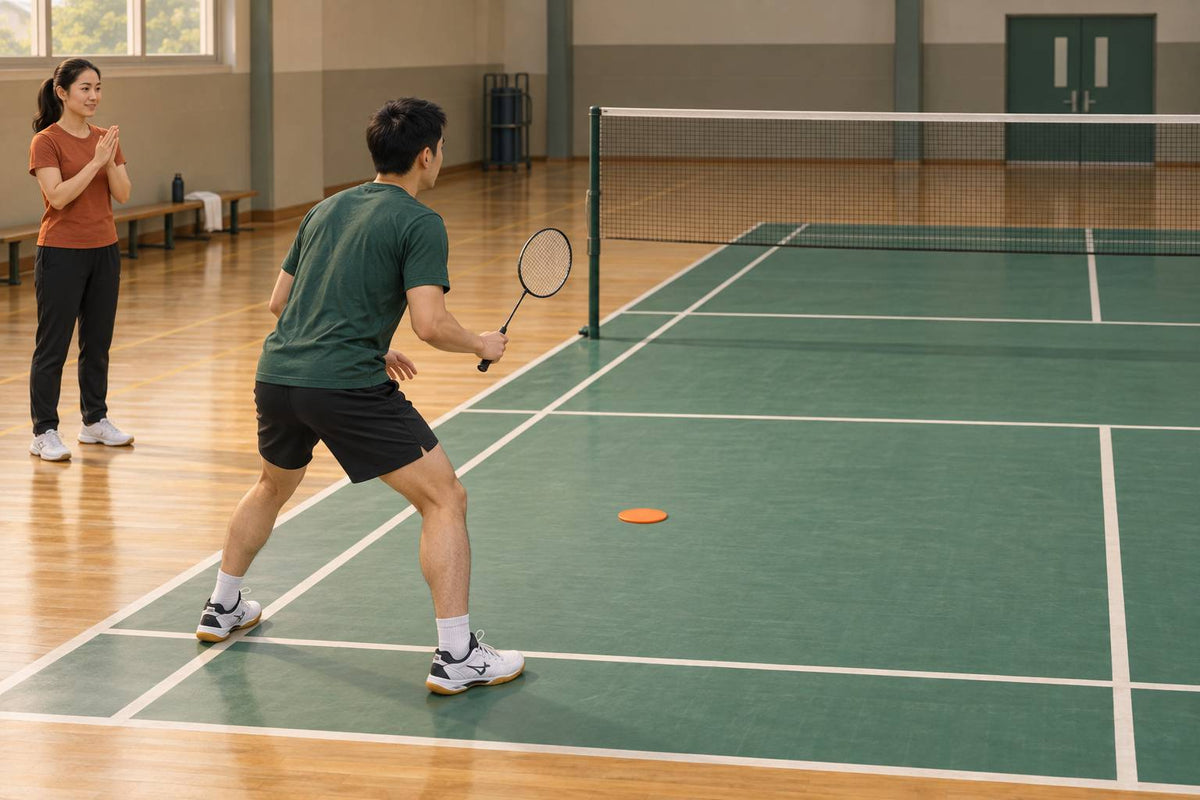
Start with a signal and one known first movement
Use a signal-led start to practise one named first movement from a ready position, not to produce a timing score. The cited BWF material includes starting after a signal and progressing from predictable to less predictable directions; the local activity keeps the cue, movement, recovery, and one-variable progression explicit.
- Set a ready position and agree one clear partner signal for one known first movement.
- On the signal, move once to the named area, recover to the starting position, and pause to describe the cue.
- When the start is clear, vary one feature such as the direction, cue type, or recovery location.
- Keep any timing or quality judgement local; the cited materials do not validate this activity as a first-step test.
Related reading: Badminton Split Step: Move Faster on Court — for a separate split-step timing topic.
Use a signal to begin a known first movement
BWF Shuttle Time includes moving on the spot, starting after a signal, and reacting quickly into different directions. Start a local practice version with one signal and one known first movement; the source does not prescribe a test or timing cutoff. BWF Shuttle Time Manual

The Shuttle Time entry is part of a Schools Badminton teachers’ manual. Its reaction-time activity combines moving on the spot with starting after a signal, and it gives sound cues such as a clap, stamp, or whistle. That is evidence of a teaching option, not a stopwatch protocol or an adult-player test. In a local pair activity, record the exact cue and starting position so the group knows what it practised without treating the note as a first-step score.
Move from predictable cues to variable cues
BWF coaching progression is simple to complex, slow to fast, and predictable to unpredictable, with progression after reasonable competence. The Level 1 manual states these sequencing principles. Exact local practice choices remain outside the manual’s scope. BWF Level 1 Manual

Level 1 says a practice should retain a tactical context: players should be able to see a link between the skill being learned and its use in the game. It names explanation, demonstration, and experimentation as ways to provide that context. Its progression framework then moves from predictable, slow, simple work toward unpredictable, faster, complex work. Those are sequencing principles, not a prescribed cue set, recovery location, repetition count, or success threshold for this first-movement activity.
Treat partner-cued starts as practice design, not timing tests
Within the cited manuals, a partner-cued first movement is a local coaching activity; the manuals do not validate it as a first-step test. The sources do not provide a measured first-step test, latency definition, or intervention outcome. Coaches can adapt the sequence to the group and session. BWF Shuttle Time Manual and BWF Level 1 Manual

The Level 1 manual says not to progress until players are reasonably competent at each level, and notes that people in one group may work at different practice levels for the same skill. It does not define reasonable competence with a latency value. A local group can therefore leave one player with a known cue while another uses a less predictable cue; that is differentiation of coaching activity, not a comparison of players or a test result.
Use one local practice card
Record five fields: ready position, visible signal, one known first movement, recovery point, and the single field to alter next. It records what was practised, not reaction time or match transfer.
- Keep the first version stable enough for the player and observer to name the cue, movement, and recovery before the next attempt.
- When the version is clear, change one field only: the cue, first movement, or recovery point.
- Keep the note descriptive. It can show what the pair practised without creating a latency score, a transfer claim, or a universal first-step standard.
Build a readable first movement
| Version | Cue | What changes |
|---|---|---|
| V1 | Known starting position and known first movement | Nothing else |
| V2 | Same position and recovery | Only cue variability increases |
- Start from one known position with one clear signal.
- Name the first movement and recovery target before the first repetition.
- Add one less-predictable cue only after the first version remains clear.
- Treat the drill as local practice, not as a timed assessment or transfer guarantee.
Questions the cited sources do not settle
- A tested drill set with prescribed repetitions, rest, or a cutoff for being late.
- A promise of first-step speed, court coverage, match transfer, or injury prevention.

Leave a comment
This site is protected by hCaptcha and the hCaptcha Privacy Policy and Terms of Service apply.