

Last checked: August 2026 · By the player-led team at Badminton House
Quick answer: badminton fitness self-test
Use the same six-minute check before training: easy movement, controlled court travel, then a few relaxed hits. It tells you how to adjust today's session, not whether you are fit or medically cleared.
Default
Green: movement feels normal and controlled, so use the session you planned.
Amber
Stiff, flat, or poorly coordinated? Keep the session, but lower speed, jump volume, or game intensity.
Red
Pain, a new limp, dizziness, or loss of safe control means stop the check and do not force the planned hard work.
A badminton fitness self-test is most useful when it changes one decision: train normally, simplify the session, or stop. This is an editorial readiness check for ordinary indoor practice, not a scorecard and not a diagnosis. If pain is changing how you move, do not try to pass it with a faster test.
Use a separate test when you want a training baseline. For jump, movement, recovery, serve accuracy, and balance measures you can retest over time, use our badminton fitness test. This page is for deciding what today's session should look like.
Run the six-minute check in the same order
Keep the sequence easy enough that you can notice quality. The exact timings below are an editorial starting point: use the same court, shoes, and sequence often enough that you recognise what normal feels like for you.
| Minute | Do | Notice |
|---|---|---|
| 0–2 | Walk, side-step, and make small arm circles. | Can you move evenly without guarding one side? |
| 2–4 | Make six relaxed centre-to-corner-and-back trips at a conversational pace. | Are starts, stops, and direction changes controlled? |
| 4–5 | Repeat the route a little quicker, with no jumping. | Does speed make your footwork noisy, late, or uneven? |
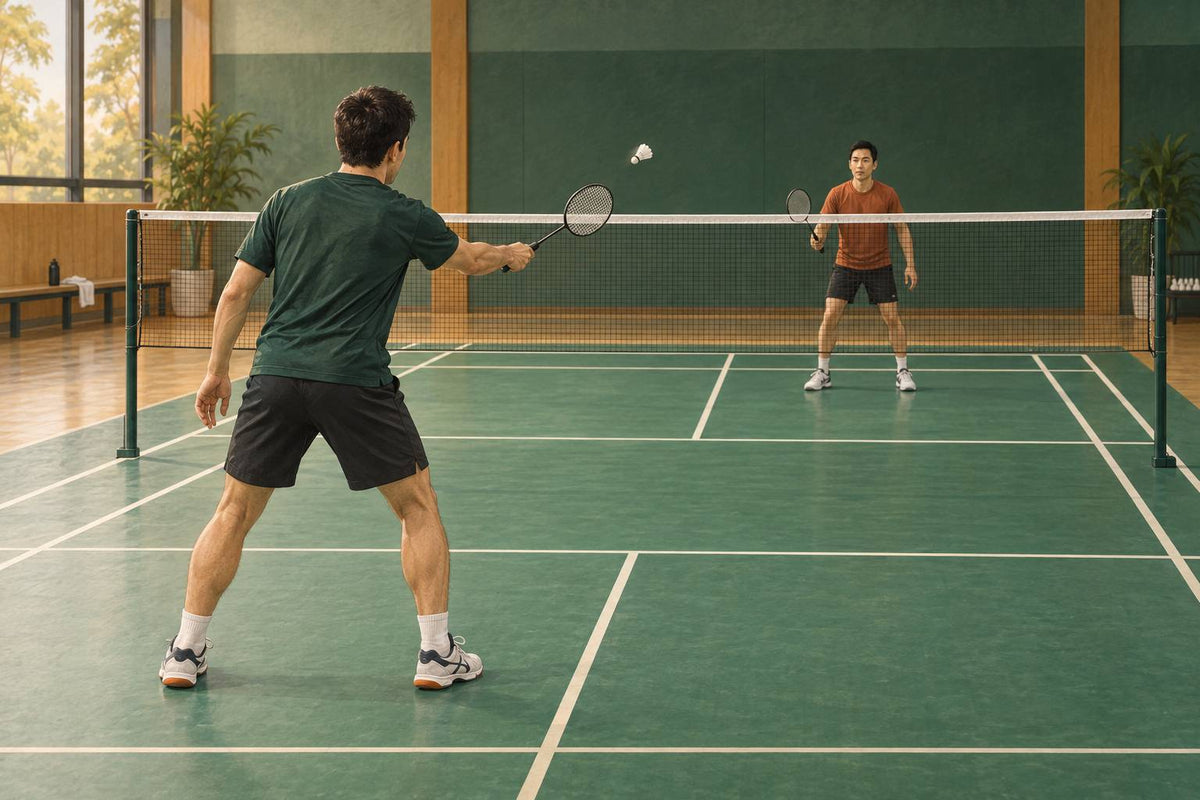
| 5–6 | Exchange easy clears and net shots, or shadow the same movements if you are alone. | Can you split, reach, hit lightly, and recover without forcing it? |
Court-specific movement is a sensible thing to observe. In a 2022 youth-player study, a badminton-specific on-court change-of-direction test showed strong repeatability and related to acceleration, change-of-direction, and jump measures. That supports using a controlled court route to notice your own pattern; it does not create a universal score or a complete measure of badminton ability. Read the study summary.
Make one green, amber, or red choice
Do not try to turn every sensation into a statistic. Compare today with your usual movement, then make one proportionate training choice. These traffic-light rules are editorial: they are a way to protect quality, not a medical assessment.
- Green — train as planned: your movement feels familiar, you can brake and change direction cleanly, and relaxed hitting does not make you compensate.
- Amber — keep a smaller version: reduce jump-smash repetitions, fast multi-shuttle volume, or all-out games. Use footwork, technique, cooperative rallies, or a shorter game block instead.
- Red — stop the hard plan: do not push through sharp or worsening pain, a new limp, dizziness, or a repeated loss of safe balance. End the check and choose an appropriate next step for your situation.
A useful note is short: date, green/amber/red, what changed, and how you adjusted. After a few weeks, that gives you more useful context than pretending a single quick check can explain fatigue, recovery, skill, or health.
Turn the check into your warm-up
If the check is green or amber, do not reset to zero. Continue from easy movement into your normal warm-up, then add more demanding court work only when it feels controlled. The Badminton Leaders Handbook puts warm-up and warm-up rallying before practice and games, and frames lesson progression around safe, progressive experiences. See the handbook.
For a fuller court-side sequence, use our badminton warm-up exercises. Keep the self-test deliberately modest: its job is to help you choose a session, not to prove that you deserve one.
The practical rule
If you need to bargain with yourself to ignore a warning sign, the session is already asking for more than this check can settle. Scale it down or stop; you can test fitness on a day when normal movement is back.

Leave a comment
This site is protected by hCaptcha and the hCaptcha Privacy Policy and Terms of Service apply.