
Last updated: July 2026 · Written by the team at Badminton House
Quick Answer: Badminton Grip Size
For most Canadian buyers, start with G5 if it is available: it is easier to build a smaller handle up with grip layers than to make a thick handle smaller.
G5
Best default: a practical starting point for many adults because it keeps the handle quick in the fingers and can be built up toward a fuller feel with an overgrip.
G4
Choose this if you already know you like a thicker handle, have larger hands, or tend to lose the racket in your grip; Yonex’s 2026 Japanese catalogue gives nominal circumferences of 84 mm for G4 and 81 mm for G5.
G6
Choose this for smaller hands, juniors, or players who want a slim handle and plan to customize the finished handle with grip layers.
Badminton grip size looks simple until you try to buy a racket: G4, G5, G6, millimetres, inches, brand charts that do not quite match, and product pages that only list certain sizes. If you are shopping in Canada, the practical question is usually not “what does every grip size mean?” but “which badminton grip size should I actually order, and can I adjust it if it feels wrong?”
This guide explains grip size in player terms: how G4, G5 and G6 compare, why Yonex, Victor and Li-Ning sizing can differ slightly, how to check your hand fit, and why many Canadian players are better off starting slightly smaller and building up the handle with grip layers.
Shopping for a racket in Canada? Check current specs in our badminton rackets collection. Badminton House ships across Canada.
In This Guide
- What G4, G5 and G6 Mean on a Badminton Racket
- G4 vs G5 vs G6: Yonex, Victor and Li-Ning Are Not Identical
- Why Do Some Grip Size Charts Disagree?
- How to Measure Your Hand for Badminton Grip Size
- When in Doubt, Choose Smaller and Build Up
- Which Grip Sizes Do Badminton House Rackets Come In?
- Quick Grip Size Recommendations for Canadian Buyers
- Which Badminton Grip Size Should You Choose?
What G4, G5 and G6 Mean on a Badminton Racket
Badminton grip size is written as the letter G plus a number. The sizing system typically runs from G1 to G6, and the key detail is that the numbers work in descending handle thickness: G1 is the thickest, while G6 is the thinnest. Yonex’s 2026 Japanese catalogue lists nominal grip circumferences of 84 mm for G4, 81 mm for G5 and 78 mm for G6; it also lists a thinner G7 at 75 mm.

| Grip size | What it means | Typical fit note |
|---|---|---|
| G1 | Thickest common badminton grip label | May suit players with larger hands who want a fuller handle |
| G2 | Thick grip size | Another option for larger-handed players |
| G3 | Medium-thick grip size | Less common as the default market size today than G4 and G5 |
| G4 | Common current market size | Often chosen by adult players who prefer a slightly fuller handle |
| G5 | Common current market size | Often chosen by players who want more finger control or plan to build up with grip layers |
| G6 | Thinnest size in the usual G1–G6 range | Often useful for children or players who strongly prefer a slim handle |
In practical Canadian buying terms, you will most often be choosing between G4 and G5, with G6 showing up on some models for players who want a thinner starting point. Children often need thinner G6 or G5 grips, while larger-handed players may need thicker G1 or G2 grips.
Grip size is not the same as racket weight. A listing such as 4U G5 combines two separate specs: 4U describes the racket weight category, while G5 describes the handle size. If weight labels are also confusing, see our 3U vs 4U vs 5U badminton racket guide.
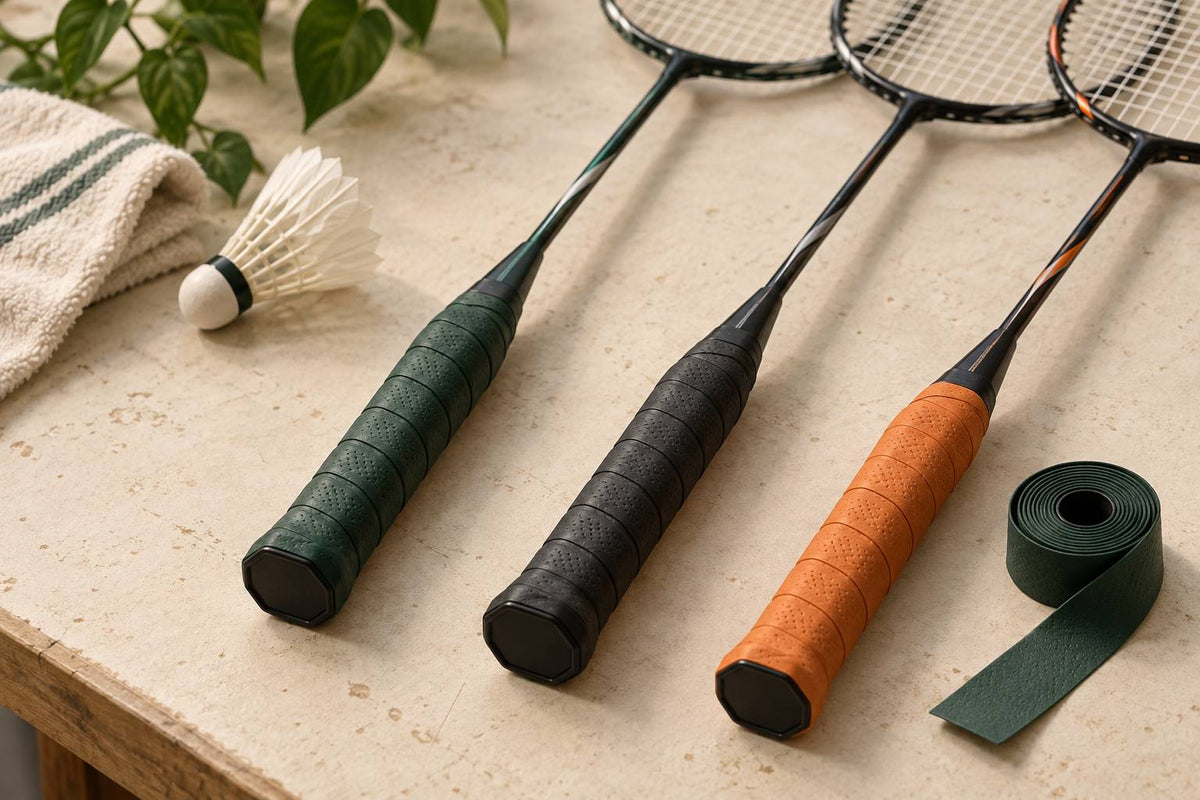
One more important detail: the G-number describes the handle size before your final grip setup. The finished feel can change once you add a replacement grip, towel grip, or overgrip, so treat G4, G5, and G6 as the starting point, not the entire fit decision. For the grip layers themselves, see our overgrip vs replacement grip vs towel grip guide.
G4 vs G5 vs G6: Yonex, Victor and Li-Ning Are Not Identical
A badminton grip size label is not perfectly universal across brands. A G5 label does not establish one circumference across every brand or finished grip setup.
For cross-brand comparison, use the millimetre chart first. It is more useful than inch-based charts because it shows the small differences that players actually feel once they move between Yonex, Victor and Li-Ning.
| Brand / system | G4 | G5 | G6 | Practical note |
|---|---|---|---|---|
| Yonex | 84 mm | 81 mm | 78 mm | Nominal grip circumferences in Yonex’s 2026 Japanese catalogue. |
| Victor | Check model | Check model | Check model | Check the specific model’s current specification and finished grip feel. |
| Li-Ning | 86 mm | 83 mm | 80 mm | Published in Li-Ning’s regional grip-size guide; these values differ from Yonex’s nominal figures. |
| Legacy Li-Ning S sizing | S2 = 86 mm | S1 = 83 mm | — | Older Li-Ning listings may use S numbers instead of G numbers, so check the millimetre spec when available. |
The published Yonex and Li-Ning figures differ, so compare the brand’s own chart and then check the finished grip. Legacy Li-Ning S1 and S2 correspond to 83 mm and 86 mm in its regional guide.
Li-Ning can be the confusing one when you are shopping older models or reading older spec sheets. The older Li-Ning S system ascended from S1 upward, while the newer G system descends from G1 to G6. In practical terms, legacy Li-Ning S1 corresponds to 83 mm and S2 corresponds to 86 mm in the chart above.
If you are switching racket brands after getting comfortable with a handle size, re-check the actual millimetre measurement and test the finished grip feel after your base grip or overgrip is installed. For a broader racket-brand comparison, see our Yonex vs Victor vs Li-Ning guide.
Why Do Some Grip Size Charts Disagree?
You may see badminton grip size charts online that convert every G-number into inches: G1 as 4 in, G2 as 3.75 in, G3 as 3.5 in, G4 as 3.25 in, G5 as 3 in, and G6 as 2.75 in. The problem is that those generic inch charts do not line up cleanly with brand-specific millimetre charts.
Yonex’s nominal G4 circumference of 84 mm converts to about 3.31 in; G5 at 81 mm converts to about 3.19 in. Generic charts that call these 3.25 in and 3 in are not exact conversions of those manufacturer figures.
Practical rule: use the brand-specific millimetre chart first, then judge the finished handle feel after the factory grip, replacement grip, or overgrip is installed.
The safest way to read grip sizing is to treat the G-number as a brand label, not as one universal measurement. The brand table above is more useful than a generic inch chart because it shows the actual millimetre sizing used by the racket maker.
- If a listing gives millimetres: prioritize the millimetre number over a rounded inch chart.
- If a listing gives only G4, G5, or G6: check which brand the racket is from before assuming the handle will feel the same as your current racket.
- If you are between sizes: remember that the finished grip can change once you add an overgrip or change the base grip.
How to Measure Your Hand for Badminton Grip Size

The simplest badminton grip size test is the handshake fit test. Hold the racket the way you would shake someone’s hand: relaxed fingers, thumb resting naturally, and no squeezing. In that position, the tip of your ring finger should not touch your palm. If it digs into the palm, the finished handle is likely too small. If there is a large gap and the racket feels hard to rotate with your fingers, it may be too large.
- Hold the racket correctly. Use a neutral forehand grip, not a panhandle grip and not a full fist squeeze.
- Check the ring finger. Look at the space between the tip of your ring finger and your palm while holding the handle naturally.
- Test racket rotation. You should be able to make small finger adjustments without the handle feeling unstable or bulky.
You can also use a ruler as a starting point. Measure from the tip of your ring finger down to the second line on your palm, then compare that measurement with the manufacturer’s grip size chart for the racket you are considering. This is most useful when you are choosing between listed sizes online, but it should not replace how the racket feels in your hand.
Important: measure the finished grip, not just the label.
A G5 handle with a thick factory grip or overgrip can feel closer to a larger size in play. A bare size chart tells you the handle circumference, but your hand only feels the final build: wood handle, factory grip, replacement grip, overgrip, and how much the grip overlaps.
For most players, the best approach is to combine both methods: use the ruler measurement to narrow your choice, then use the handshake test to confirm whether the finished handle lets you stay relaxed, change grip quickly, and control the racket with your fingers.
When in Doubt, Choose Smaller and Build Up

If you are between two badminton grip size options, the safer buying rule is simple: choose the thinner handle. A thin grip can be built up with extra grip layers; a handle that already feels too thick is much harder to make thinner without removing the factory grip or changing the handle feel completely.
Practical takeaway: for most Canadian buyers choosing between G4, G5 and G6, it is usually better to start smaller and build up with grip layers from the accessories collection than to buy a handle that already feels bulky.
| Grip setup | What changes | Best use |
|---|---|---|
| Bare factory grip | Closest to the racket’s listed G-size feel. | Players who already like the handle size and only need normal traction. |
| One overgrip | Increases the finished circumference; the amount depends on material thickness and overlap. | Players who want a G5 handle to feel closer to G4, or a G6 handle to feel closer to G5. |
| More overlap while wrapping | Makes the finished handle thicker because more material is layered over itself. | Players who want extra cushioning or a slightly fuller palm feel. |
| Less overlap while wrapping | Keeps the build-up thinner; some overgrips can be overlapped only 2–3 mm instead of much more. | Players who want fresh grip feel without adding too much circumference. |
That adjustability is why a smaller base size is so useful. Overgrips can be applied over the factory grip, and the amount of overlap lets you fine-tune the result: a light overlap keeps the handle slimmer, while a heavier overlap makes it feel fuller. The finished handle matters more than the printed G-number on its own.
If you are not sure whether you need an overgrip, replacement grip or towel grip, read our separate badminton grip guide. It explains the difference between adding material on top of the existing grip and replacing the base layer entirely.
Which Grip Sizes Do Badminton House Rackets Come In?
Badminton House’s current badminton racket collection lists two Yonex Astrox models, and both product pages show G5 and G6 as the grip size options. The important takeaway: if you are shopping our current Yonex racket selection, do not assume a G4 option is available.
| Racket | Listed grip sizes |
|---|---|
| Yonex Astrox 100 ZZ Kurenai / Dark Navy | G5, G6 |
| Yonex Astrox 100VA Game Grayish Beige | G5, G6 |
Badminton House ships across Canada, so check the collection page for current stock before you order.
Practical fit tip: for our current Yonex options, treat G5 as the safer default for most adults who are unsure, then build up the handle if you want a thicker G4-like feel. Choose G6 if you prefer a very thin handle, want more finger control, or are buying for a junior player with smaller hands.
If you already know you like a thicker handle, it is usually easier to start with the smaller listed size and add grip layers than to buy a handle that is too large. You can also pair a racket purchase with our stringing service and ask for help setting up the finished handle feel.
Before ordering, check the product page for the live size selector and stock status. If you receive a racket and the grip size feels wrong, review the Returns & Exchanges policy before removing factory packaging or customizing the grip.
Quick Grip Size Recommendations for Canadian Buyers
For most Canadian buyers, grip size is less about hand size alone and more about how the racket behaves once the grip is finished. A smaller handle can support more finger control and wrist action, while a larger handle may feel better for players with large hands or players who tend to lose their grip during rallies.
Use these situational checks before you order, especially if you are buying online or switching between Yonex, Victor and Li-Ning.
| Buying situation | Practical recommendation |
|---|---|
| You mostly play fast doubles | Some players prefer G5 for doubles because the smaller handle can help with finger control, quick changes and wrist action. Treat this as a starting point, not a rule. |
| You mostly play singles | Some players prefer G4 for singles, where a slightly fuller grip may feel more stable. Re-check the feel if you add a thicker replacement grip or towel grip. |
| You are switching brands | Do not assume the same G-number will feel identical. Yonex, Victor and Li-Ning sit in the same general range, but their measured circumferences are not identical, so re-test your preferred size when changing brands. |
| You are ordering online | Read the product’s listed grip options carefully and remember that the finished handle matters more than the bare G-number once a base grip or overgrip is installed. If the size turns out wrong, check the Returns & Exchanges policy for next steps. |
If you are still narrowing down the rest of the racket spec, grip size should be considered alongside weight. A G5 handle on a 3U racket can feel very different from the same handle size on a faster 4U or 5U frame, so your next useful read is our 3U vs 4U vs 5U badminton racket weight guide.
Which Badminton Grip Size Should You Choose?
Use this as the short version after you have checked the brand chart above. Grip size labels are useful, but the finished handle matters once the factory grip or overgrip is on the racket.
| Choose | Best if... | Practical takeaway |
|---|---|---|
| G5 | You want the safest modern starting point, especially in North American retail where G4 and G5 are common. | Default choice for many Canadian buyers: small enough to adjust upward, but not as thin as G6. |
| G6 | You prefer a very thin handle, want more finger control, or are choosing for a junior player. | Best when you are comfortable building the handle up if it feels too small. |
| G4 | You already know you like a fuller handle, have larger hands, or tend to lose your grip during play. | Do not assume every brand’s G4 feels identical; compare it against the brand chart above. |
| G1–G3 | You specifically need a much thicker handle. | Less common in today’s market than G4 and G5; choose only if you are confident in that preference. |
Badminton House note: our current Yonex Astrox racket options are listed in G5 and G6, so Canadian buyers who want a G4-style feel should start smaller and build up. See the Badminton House grip options section above for the current racket examples.
Get 10% off your first order
Join the Badminton House list and we’ll email you a 10% welcome code, plus subscriber-only restock alerts, giveaways, and honest gear advice from players.
By subscribing, you agree to receive Badminton House emails and can unsubscribe anytime.
Grip size is personal, but it should never be a guessing game. We play badminton ourselves, so if you are choosing between G5 and G6, trying to build toward a G4 feel, or buying for a junior player, contact us and we will help you think through the fit before you order.
Need a racket that fits your hand and your game?
Browse Badminton RacketsFree shipping in Canada · 14-day returns · Canadian badminton specialty shop


Leave a comment
This site is protected by hCaptcha and the hCaptcha Privacy Policy and Terms of Service apply.