

Last checked: August 2026 · Written by the player-led team at Badminton House
A hamstring strain is only one of three lower-body injuries a deep badminton lunge can cause, and it has its own location, trigger and grading that are easy to confuse with a hip, groin or calf strain. This guide separates the three by where and when they hurt, explains why the rear court loads the hamstring specifically, and lays out a six-stage ladder back onto the court with a pass test for each stage.
Related reading: Badminton Hamstring Strain: The Deep Lunge Mechanism — once you know it's the hamstring, that guide walks through a four-stage bodyweight rebuild plan in more depth.
Hamstring, Hip/Groin or Calf: How to Tell Them Apart
Deep badminton lunges load three different lower-body muscle groups. Pain location can describe the problem, but it cannot reliably distinguish these injuries or establish a diagnosis: a hamstring strain is felt in the back of the thigh, a hip or groin strain in the groin or inner thigh, and a calf strain in the back of the lower leg.
| Site | Where it hurts | Typical badminton trigger |
|---|---|---|
| Hamstring | Back of the thigh, near the sit bone | Reaching or pushing out of a deep rear-court lunge at full stretch |
| Hip / groin (adductors) | Groin or inner thigh | A wide lunge or a sudden change of direction chasing a wide shot |
| Calf (gastrocnemius) | Back of the lower leg (posteromedial) | A hard first push off the back corner, or landing with the ankle bent up and the knee straight |
The hamstring's injury pattern is documented at the proximal muscle-tendon junction, near the sit bone, per a 2016 review in Current Sports Medicine Reports. A groin or adductor strain, by contrast, is "severe, located in the groin region or medial thigh," provoked by "sprinting, kicking, and a sudden change in direction," according to StatPearls' reference entry on adductor strain. A calf strain sits lower still: pain "develops on the posteromedial part of the calf" after a few steps, typically from a push-off that combines a straight knee with the ankle bent up, per StatPearls' entry on gastrocnemius strain.
This table is a starting point, not a diagnosis. Severe pain at the moment of injury, an audible pop, or bruising down the back of the thigh point to a more serious tear at any of the three sites. Get that assessed by a physiotherapist or doctor rather than guessing your way through it. If the differential above actually points to your groin or calf, our dedicated guides go deeper: Badminton Hip and Groin Strain and Badminton Calf Strain.

Why the Rear Court Loads the Hamstring
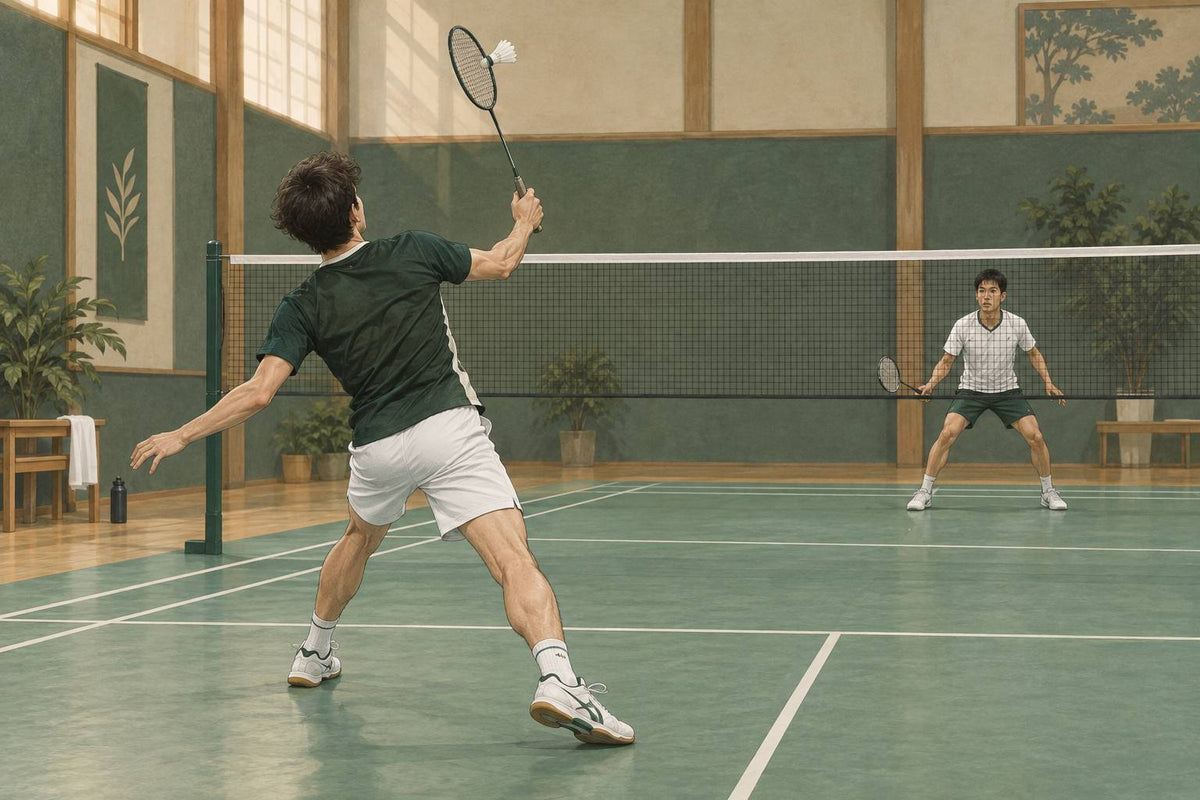
The lunge is the single footwork movement most often linked to lower-body injury in badminton. No study has measured hamstring load in badminton directly, but the mechanics point toward deceleration rather than sprinting: the front leg reaches into a deep stretch while braking your bodyweight, not while accelerating.
A 2025 systematic review in BMJ Open Sport & Exercise Medicine, pooling 21 studies on badminton injuries, found that among footwork movements linked to lower-body injury, "the lunge was the footwork movement with the highest risk to the lower body," accounting for roughly a third of the cases the review could attribute to a specific movement. Putting that alongside the general medical picture of how hamstring strains occur, the likelier trigger is not the sprint between rallies but the single deep reach into the back corner, where the front leg decelerates your weight at end range.
The same review found that a previous injury to a body region is "a major risk factor for future (re)injury to the body region in question," and that risk climbs with level of play. That matters more for the hamstring than it might for a first-time injury elsewhere: research on hamstring strains specifically reports that almost one in three recur, with many reinjuries happening within the first two weeks of returning to sport. In other words, the biggest risk after your first hamstring strain is not the initial injury. It is coming back too fast and straining it again before the tissue is actually ready.
The Return-to-Court Ladder: Six Stages, One Pass Test Each
Getting back on court safely means passing a test at each of six stages, not counting days on a calendar: walk-jog, shadow footwork, half-speed rear court, full-depth lunges, controlled doubles, then match play. Move up only once the current stage is completely pain-free, because most hamstring reinjuries happen in the first two weeks back.
- Walk-jog. Pass test: walk at a normal pace with zero pain, then jog at a very low, easy speed with zero pain, and hold a gentle bent-knee heel press (isometric contraction) against a towel or a partner's hand without pain. This mirrors the earliest return-to-movement checkpoint used in staged hamstring rehab, which requires the athlete to "walk normally without pain, jog at very low speeds without pain and able to perform pain-free isometric hamstring contraction," per Current Sports Medicine Reports.
- Shadow footwork. No shuttle, no full lunge depth. Repeat split-step and short lunge patterns on an empty court at gradually increasing speed. Pass test: a full session of this with no favoring of the injured leg and no pain that lingers afterward.
- Half-speed rear court. Fed shuttles into the back corners, lunging to roughly half depth and half speed. Pass test: you can jog forward and backward at about half your maximum speed without pain, and a single maximum-effort isometric contraction is pain-free, the same checkpoint a staged rehab protocol uses before allowing faster work.
- Full-depth lunges. Fed shuttles into your weakest corner at full speed and full reach. Pass test: the lunge is pain-free and repeatable on demand across a full session, not just possible once when you're fresh.
- Controlled doubles or rotation drills. Game-like movement without scoreline pressure. Pass test: a full session of rally movement with no guarding, no shortened stride, and no conscious avoidance of the back corners.
- Match play. Pass test: no pain on palpation of the injury site afterward, full strength without pain, and no hesitation committing to a full-speed lunge. That combination (full concentric and eccentric strength without pain, "no kinesiophobia," and sport-specific movement at near-maximum speed without pain) is the standard return-to-play bar in hamstring rehab literature.
The same principle (objective criteria, not a calendar) applies across all three strain sites from the table above. Adductor strains follow it too: acute cases often clear in four to eight weeks, but return should be "guided by an objective assessment of strength, flexibility, and functional performance," not a fixed date, according to StatPearls.
Preventing the Next One: Eccentric Strength and Deceleration Practice
Eccentric hamstring strength and controlled deceleration practice are the two habits most likely to keep this injury from coming back, on top of not skipping stages in the ladder above. Neither is a stretching routine. Both are about training the muscle to control a lunge under load, not just lengthening it.
Eccentric loading belongs in the middle of a rehab or prehab plan, not on day one. Staged hamstring protocols introduce it once low-speed movement is already pain-free: the middle phase "involves increase in the intensity and range of motion of the exercises, initiation of eccentric resistance exercises, and neuromuscular training at faster speeds." A simple version for badminton is a slow single-leg hip hinge (a bodyweight Romanian deadlift pattern): hinge at the hip with a soft knee, lower under control for a slow count, then stand back up, keeping the range small until it stays completely pain-free.
Deceleration practice is the badminton-specific half of prevention, since the lunge itself, not sprinting, is the movement most tied to lower-body injury on court. That means deliberately practicing controlled lunges into the back corners during warm-up, building depth and speed gradually, rather than going straight from a light jog into full-speed rear-court retrievals. The same badminton injury review that flagged the lunge as the highest-risk footwork movement also concluded that badminton's high share of overuse injuries "require a systematic injury prevention programme that considers mobilisation, strength training and other aspects of the treatment and prevention of overuse injuries," not stretching on its own. Since a previous injury is one of the clearest predictors of a future one, this work matters most in the months right after a first hamstring strain, when the temptation is to skip straight back to full-speed rallies.
If you think you've just strained your hamstring
- Stop playing and note whether the pain is in the back of the thigh, groin or calf; do not use this table to diagnose the injury.
- Rest the leg for the first 48 hours and avoid pushing through pain.
- See a physiotherapist or doctor if the pain was severe, you felt or heard a pop, or bruising appears, because these features may indicate a more serious injury.
- Once cleared to move, work through the six-stage ladder above one pain-free stage at a time. This article is general information, not medical advice for your specific injury.

Leave a comment
This site is protected by hCaptcha and the hCaptcha Privacy Policy and Terms of Service apply.