
Last updated: July 2026 · Written by the team at Badminton House
Quick Answer: Mains × Crosses Tension
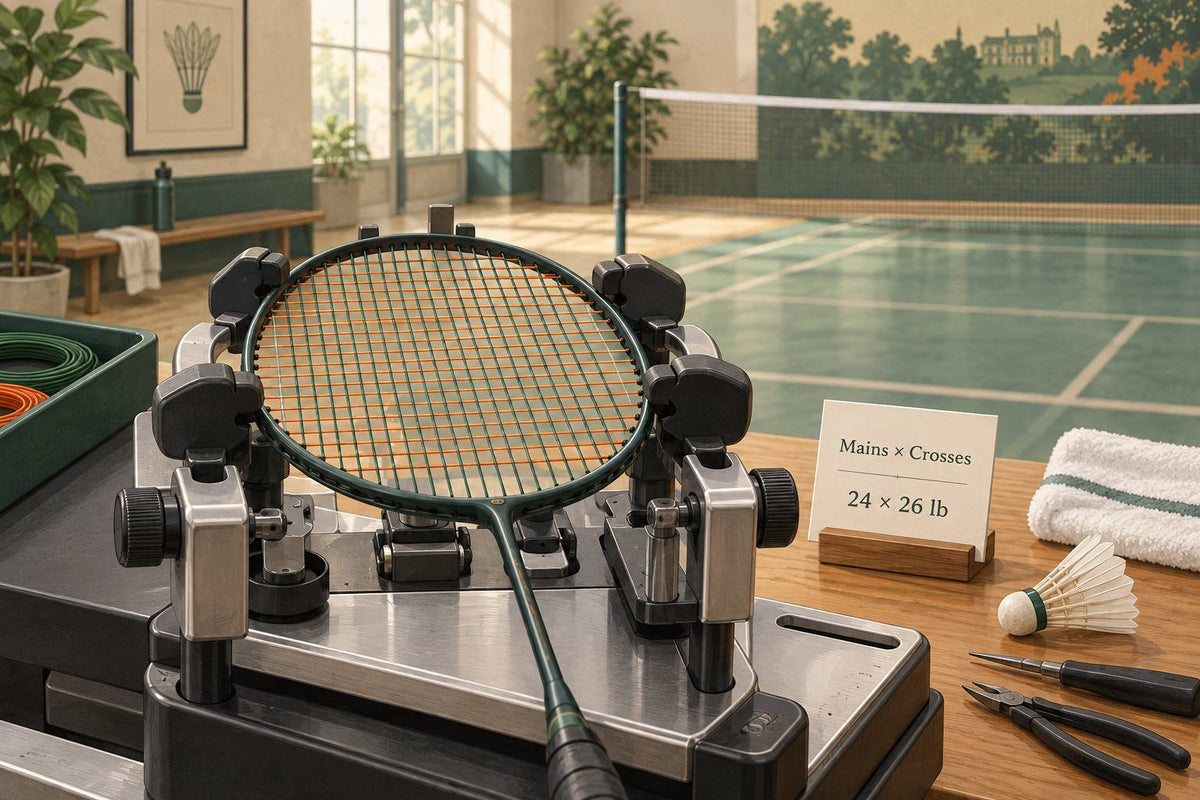
If your ticket says 24×26, read it as mains first, crosses second; the tighter crosses are usually intentional, not a mistake.
Default
Best choice: Confirm the racket’s model-specific pattern and tension limit, then agree both reference tensions with your stringer; a roughly 10% cross increase is one common practice, not a universal requirement.
Flat
Equal reference tensions can also be appropriate; frame shape depends on the complete stringing method, mounting and racket.
Custom
Choose a smaller or larger gap only if your stringer recommends it for your racket, pattern, or preferred feel.
If your stringing ticket says 24×26 instead of one number, it is not a typo. In badminton, mains are the vertical strings and crosses are the horizontal strings; many stringers pull the crosses higher, often by about 10%, because the cross pull behaves differently once it weaves through the mains. For players, the practical question is simple: should you ask for equal tension, accept the stringer’s usual method, or specify a differential setup? This guide explains why badminton mains and crosses use different tension, how frame shape affects the decision, and when the common rule of thumb should be adjusted for feel.
In This Guide
Mains, crosses, and what 24×26 actually means

If you are comparing badminton mains crosses different tension setups, start with the vocabulary: mains are the vertical strings that run from the top of the racket head toward the handle, while crosses are the horizontal strings woven across them.
On a stringing ticket, a single number such as 26 lbs usually means one requested reference tension. A two-number notation such as 24×26 lbs means mains × crosses: the mains are pulled at 24 lbs and the crosses at 26 lbs. The first number is not the left side of the racket, and the second number is not the right side; it is vertical strings first, horizontal strings second.
Before worrying about whether your crosses should be higher, choose a sensible overall tension range for your level and string. If that is still unclear, start with our badminton string tension guide, then use the mains × crosses notation to communicate the exact job to your stringer.
Why stringers often pull crosses about 10% tighter

A common rule of thumb is to pull the cross strings about 10% higher than the main strings. So if the mains are pulled at 30 lbs, the crosses would be pulled at 33 lbs. That does not mean the racket will simply feel like two unrelated tensions; the two string directions work together once the bed is complete.
The practical reason is that crosses are woven through the mains, so they pass through many intersections during installation. Those intersections create friction, and friction can reduce how cleanly the pulled tension is transferred across the string bed. By pulling the crosses a little higher, the stringer helps the crosses settle firmly against the mains and lock them in place. For the player, the result can feel closer to a crisp, higher-tension setup than the lower main number alone would suggest.
The frame-shape reason behind differential tension

Differential tension is not only about feel; it is also a racket-protection choice. Many badminton rackets are strung with a two-piece, four-knot approach, with mains and crosses installed separately, because that method helps protect the integrity of the racket head during stringing.
Raising the crosses is another way to help the frame finish closer to its intended shape. A 26×26 lbs job is not automatically a deformation risk. The finished shape depends on the frame, mounting, pattern and tensioning process; different string lengths alone do not prove that equal reference settings will warp it.
That shape issue matters beyond cosmetics. Manufacturers care about minimizing racket deformation, and a visibly deformed racket after stringing can affect warranty claims. In practical terms, the tighter-cross method gives the stringer one more tool to balance the forces pulling on the frame.
Why your stringer may follow a brand method

Sometimes the tension difference is not just a stringer’s personal habit; it is built into the method they use. The Yonex YY four-knot method is a split-string approach: the mains and crosses are cut and tensioned separately, then finished with four knots. That separation makes it straightforward to pull one tension on the mains and a different tension on the crosses without turning the job into a workaround.
The current Yonex stringing instructions specify model-dependent string paths and tie-offs. They do not state a universal 10% increase or final-five-cross tension rule, so confirm those choices rather than presenting them as a manufacturer requirement. For players, the practical takeaway is simple: if your stringer suggests something like 24×26 instead of 25×25, they may be following a frame-protection method rather than chasing a harsher feel.
Is 10% tighter always the right choice?

No. The 10% cross-tension increase is a common guideline, not a fixed law for every racket, string, machine, or player. Some players prefer a smaller gap because they want a slightly softer, more even response. Others like a bigger gap because a tighter cross bed can feel crisper and more locked-in at impact.
Durability usually is not the main reason to avoid the extra cross tension. Cross strings usually break less often than mains, so raising the crosses modestly does not tend to have a large impact on overall string life. The bigger question is whether the finished feel suits your timing, touch, and comfort.
If the 10% calculation lands between available pulling tensions, many stringers round up rather than aim for an awkward fraction — for example, mains at 27 lbs would push the crosses to 30 lbs rather than 29.7.
Which tension split should you choose?
Treat the split as an instruction to your stringer, not as a separate playing-level badge. If you like a 26 lb feel, record the complete job and compare its feel; 24×26 is not a guaranteed equivalent to a uniform 26 lb reference.
| Choose | Best fit |
|---|---|
| 10% tighter crosses | A common stringer practice when appropriate for the frame, machine and pattern; keep both settings within the model’s limit. |
| Uniform tension | A valid option when suitable for the racket and stringing method; check the finished result. |
| Less or more than 10% | Use when you are fine-tuning feel with an experienced stringer; players do vary the split by preference. |
| Brand method | Follow the exact model’s current pattern and tension limits. |
Get 10% off your first order
Join the Badminton House list and we’ll email you a 10% welcome code — plus training guides, technique advice, and badminton updates.
By subscribing, you agree to receive Badminton House emails and can unsubscribe anytime.
Stringing is part science, part feel, and we approach it as players first. If you are unsure whether to ask for flat tension, 24×26, or a proportional setup, send us your racket, string, usual tension, and playing level through our contact page—we’ll help you choose a sensible request for your next restring.
Need stringing gear or fresh grips?
Check live availability for strings, grips, and racket-care accessories in one place.
Check AccessoriesFor setup questions, contact us before you order.


Leave a comment
This site is protected by hCaptcha and the hCaptcha Privacy Policy and Terms of Service apply.