
Last updated: July 2026 · Written by the team at Badminton House
Quick Answer: Junior Badminton Growth Plate Injury
If knee or heel pain lasts beyond a few days, treat it as a load-management problem and get medical advice before more hard training.
Pause
Best choice: stop painful jumping, lunging, and sprint work; use rest and professional assessment instead of playing through symptoms.
Modify
For mild soreness that settles quickly, reduce weekly load, add recovery days, and reintroduce court intensity gradually.
Emergency
Any red-flag sign (see the decision guide below) means same-day medical care, not a wait-and-see approach.
When a junior player suddenly complains of heel or knee pain, do not file it under “just growing.” Badminton asks young legs to brake, lunge, jump, and land repeatedly, and during a growth spurt the soft growth areas near bones can be more vulnerable than mature tissue. Osgood-Schlatter at the knee and Sever’s at the heel are well-established overuse problems in adolescent athletes; this guide applies that pediatric sports-medicine knowledge to intensive junior badminton training, where lower-limb loading is a real part of the sport.
Check the player first, gear second. If your junior is pain-free but you’re reviewing shoe fit, cushioning, or court readiness, ask us for badminton-specific gear guidance — not medical diagnosis.
In This Guide
- Why Growth Plates Matter in Junior Badminton
- What a Junior Badminton Growth Plate Injury Can Look Like: Knee and Heel
- Warning Signs Parents and Coaches Should Not Ignore
- Training Load, Recovery, and Prevention Habits During Growth Spurts
- When to See a Professional — and Where Gear Fits
- Decision Helper: Keep Playing, Modify, or Stop?
Why Growth Plates Matter in Junior Badminton

Growth plates are the softer, weaker areas near the ends of growing bones where growth happens; in young athletes, they are often the “weak link” compared with mature bone, muscle, or ligaments.
That matters in badminton because juniors repeat lunges, jumps, reaches, heel landings, and sharp recoveries for long sessions. The lunge alone can make up 15% or more of movements in a game, and badminton lunging can create impact loads as high as 2.5 times body weight. Badminton injury literature also points to heavy lower-limb demand: overuse injuries are reported as roughly three times more frequent than traumatic injuries, with about 58% of injuries occurring in the lower limb. For broader context, see our guide to common badminton injuries and prevention.
What a Junior Badminton Growth Plate Injury Can Look Like: Knee and Heel

Two common overuse patterns in active youth are Osgood-Schlatter disease at the knee and Sever’s disease at the heel. Both tend to show up around growth spurts, often ages 11–15 for girls and 12–16 for boys, when bone length changes faster than the attached tendons can comfortably adapt. The result is a traction problem: repeated pulling where tendon meets immature bone at the growth plate.
Osgood-Schlatter usually means pain and swelling just below the kneecap, especially after running, jumping, stairs, or harder sessions. Sever’s disease is heel pain in young athletes, commonly ages 8–15, often linked with calf tightness and pain after a sudden increase in activity. These conditions are common in active kids and often settle once the growth plates close, but they are not something to simply “play through.” Pain that keeps returning is a load-management signal, not a toughness test.
Warning Signs Parents and Coaches Should Not Ignore

A junior badminton growth plate injury does not always announce itself dramatically. The early signs can be subtle, and because they may be described as general aches, they can be mistaken for “growing pains.” Treat patterns seriously, especially during a growth spurt or after a jump in training volume.
- Pain that keeps returning or does not improve like a typical mild sprain.
- Pain or swelling just below the kneecap, especially with running, jumping, stairs, or hard lunges.
- Heel pain after running, jumping, or repeated court movement.
- Limping, guarding one side, or avoiding push-off on one foot.
- Unusual fatigue, reduced court speed, or a clear drop in performance.
- Discomfort that lasts more than a few days after activity.
Do not rely on a clear X-ray alone for reassurance: growth plates are not solid bone, so some injuries may not show clearly. Persistent symptoms deserve early medical assessment and activity modification.
Training Load, Recovery, and Prevention Habits During Growth Spurts

Prevention is not about avoiding training; it is about matching stress with recovery while a young athlete is growing. This framework applies general pediatric overuse guidance to badminton’s repeated lunges and jumps: treat sudden changes as the danger zone. More court hours, extra tournaments, harder footwork sessions, or a jump-smash phase all add load. A practical rule is to increase total weekly training by no more than 10% to 20%, then watch how the athlete feels over the next few days.
- Plan at least one full day off each week, not just an easier practice.
- Avoid year-round single-sport pressure too early. Early specialization is linked with higher overuse and burnout risk, while multi-sport participation before puberty is associated with fewer injuries and longer participation.
- During growth spurts, keep stretching, landing mechanics, lunge technique, and age-appropriate strength work in the plan so muscles and tendons adapt to longer bones.
For session planning, pair this with a simple warm-up and scheduled deloads from the badminton recovery guide.
When to See a Professional — and Where Gear Fits

Use this section as triage, not diagnosis. The decision guide below spells out the exact red flags and timelines; as a general rule, obvious emergencies need same-day care, while pain that lingers past a few days of basic home care is your cue to book a proper assessment rather than hoping the next tournament goes better.
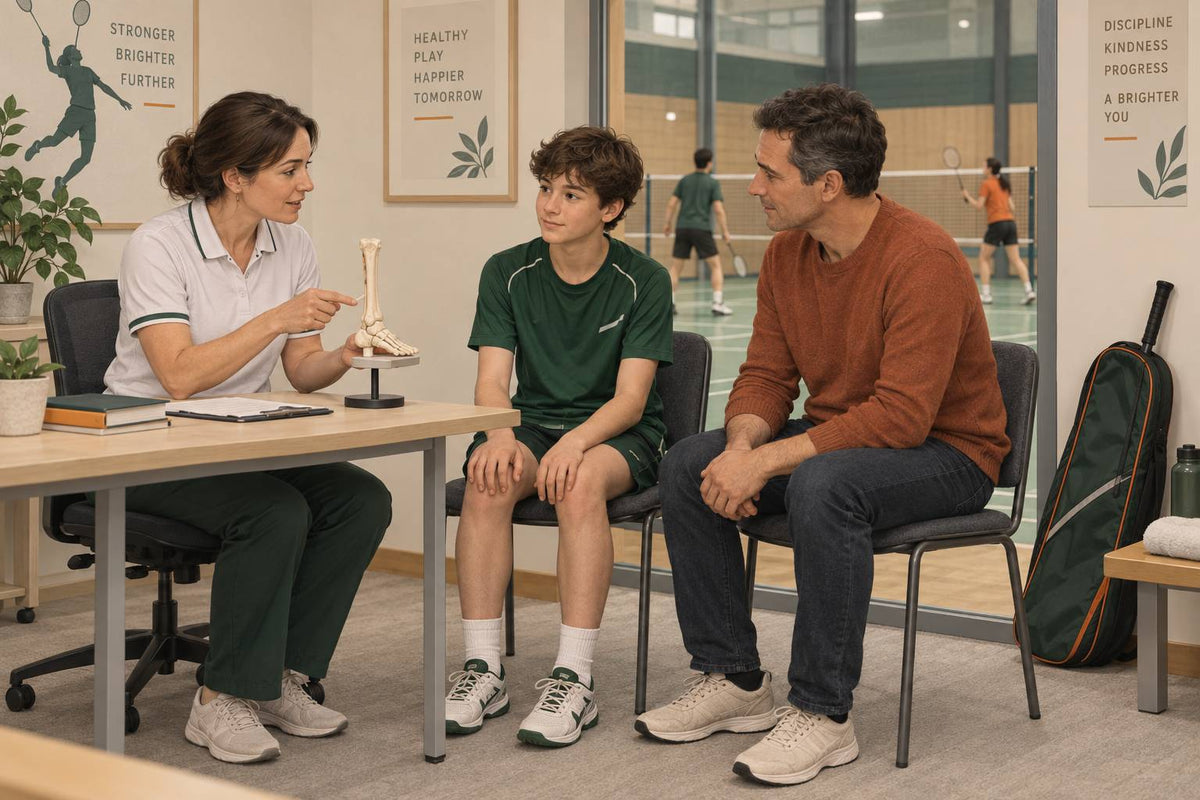
Osgood-Schlatter disease and Sever’s disease are not conditions to “tough out.” Early diagnosis, load reduction, and activity modification usually matter more than pushing through another practice, especially during a growth spurt.
Gear can support comfort, but it cannot treat a growth plate injury. Properly fitting, cushioned court shoes and shock-absorbing insoles may play a minor load-management role for lower-limb or heel comfort; they are not a cure or medical advice. For fit help, contact us.
Decision Helper: Keep Playing, Modify, or Stop?
| Choose this | If you see this | Best next step |
|---|---|---|
| Emergency care | Obvious deformity, head injury with confusion, or inability to use a limb. | Do not test it on court. Seek urgent medical care. |
| Medical evaluation | Knee or heel pain near a growth-plate area that does not improve after 2–3 days of rest, ice, and over-the-counter relief. | Book an assessment; ongoing joint or growth-plate pain may need imaging or specialist review. |
| Modify training | Mild soreness appears during a growth spurt but settles quickly and does not change movement. | Reduce jumping and lunging volume, keep at least one full rest day weekly, and avoid sudden weekly load jumps above 10–20%. |
Get 10% off your first order
Join the Badminton House list and we’ll email you a 10% welcome code — plus training guides, technique advice, and badminton updates.
By subscribing, you agree to receive Badminton House emails and can unsubscribe anytime.
As badminton players, we care about keeping juniors on court for the long term — not just getting through the next session. If you are unsure how training volume, shoe fit, or court movement might be affecting a young player, contact us and we’ll help you think through the badminton side of the setup.
For juniors who train often, start with court shoes that fit securely and feel cushioned under repeated lunges.
Check Live Footwear Availability

Leave a comment
This site is protected by hCaptcha and the hCaptcha Privacy Policy and Terms of Service apply.