
Last updated: August 2026 · Badminton House
Quick answer
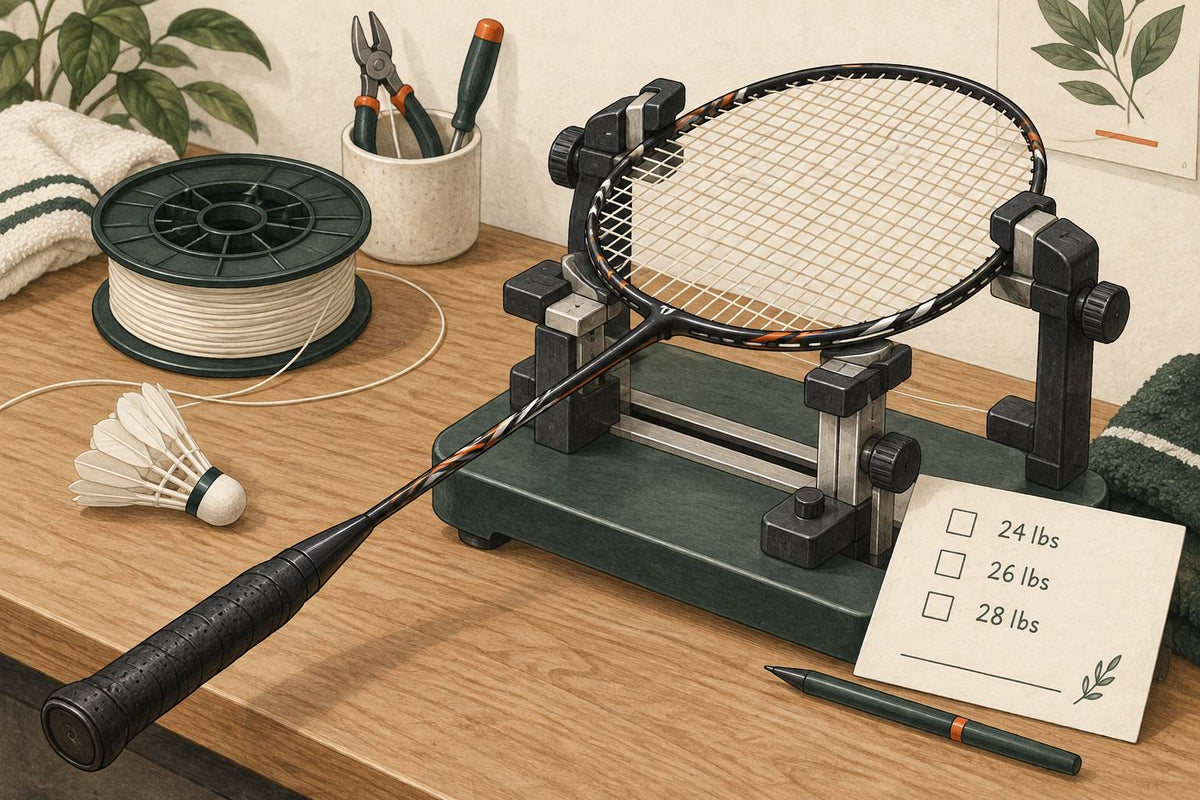
Start with a tension within your exact frame’s guidance and compare it with your current setup. The 20–32 lb figures below are reference settings and force conversions, not skill thresholds or a promise of how every racket will play.
Higher tension does not automatically mean more power or control. The string, frame, impact and player all matter. Use a small, documented setup change to compare response instead of treating tension as an upgrade ladder.
What Each Tension Actually Feels Like
These rows help decode requested settings. They are comparison notes, not manufacturer recommendations for every player or frame; kilogram figures refer to kilogram-force equivalents.
| Tension | kgf | Comparison note | Check before trying |
|---|---|---|---|
| 20 lbs | 9.1 | A lower reference setting; the response still depends on the complete setup. | Confirm the frame’s lower limit and whether this setting suits the current string. |
| 22 lbs | 10.0 | Compare with your current setup; 2 lb does not guarantee better placement. | One possible comparison setting within suitable frame guidance. |
| 24 lbs | 10.9 | May feel firmer than a lower setting in the same setup; precision is not guaranteed. | Check the exact frame and your preferred response, not an assumed skill level. |
| 25–26 lbs | 11.3–11.8 | Compare contact feel and repeatability across your normal shots. | Not a requirement for competitive club play. |
| 27 lbs | 12.2 | A higher reference setting; assess response across central and off-centre contact. | Confirm the frame range and a reason for the change. |
| 28 lbs | 12.7 | Not inherently more precise or unplayable; response is setup-specific. | Use only within the exact frame’s guidance; no fixed skill classification applies. |
| 29–32 lbs | 13.2–14.5 | Above the published range of many individual models; verify yours explicitly. | A professional’s setting is not a recommendation for your racket. |
Is 26 lb good? It can suit some setups, but it is not automatically right for an established player or wrong for a beginner. Stay within the frame’s range and compare response.
Is 24 lb too high for a beginner? The label “beginner” cannot answer that alone. Compare a suitable starting setup with a stringer and the frame’s guidance.
Is 20 lb too low? It can be appropriate for a frame and player, but it is not a universal factory setting or a skill judgement.
What Tension Is Your Racket Already At?
A pre-strung racket’s original setting depends on its model and stringing history. Ask for the supplied string and reference tension when available; do not assume it is currently 20 lb.
A first restring can help you establish a repeatable setup. Record the frame, string, tension and date instead of assuming a guaranteed improvement over a more expensive racket.
Your Racket Has a Maximum. Find It First.
Find the exact manufacturer’s stringing guidance, including weight class and generation, before choosing a setting. Do not infer a safe range from frame material alone, and have damage assessed before restringing.
Manufacturer examples below are model-specific: Nanoflare 001 Feel, Astrox 99 Pro 3AX99-P, and Astrox 100ZZ in the 2026 catalogue.
| Racket | Manufacturer stringing advice |
|---|---|
| Yonex Nanoflare 001 Feel (beginner frame) | 20–27 lbs |
| Yonex Astrox 99 Pro | 20–28 lbs (4U) / 21–29 lbs (3U) |
| Yonex Astrox 100ZZ | 20–28 lbs (4U) / 21–29 lbs (3U) |
| Aluminum or steel budget frames | Check the exact manufacturer’s guidance; material alone does not set a limit |
The examples show why you need the exact model and weight class. A beginner, carbon, aluminium or steel label does not establish the permitted tension.

Why Higher Tension Does Not Mean More Power
This is the most persistent myth in badminton, and it is worth being precise about.
A stringbed deforms during impact, but tension alone does not determine energy return, shuttle speed or placement. Frame, string construction, contact and swing all affect the result; a trampoline analogy cannot quantify the trade for every player.
Lower tension gives you
A softer response to compare in the same setup; power, placement and lifespan are not guaranteed
Higher tension gives you
A firmer response to compare in the same setup; no automatic control gain or steeper angle
Treat a tension change as a trial. Keep the frame, string and grip consistent when possible, then compare repeatable shots rather than one impressive hit.
Compare the Actual Playing Conditions
Nylon shuttles: compare the setup with the shuttle you actually use. There is no universal 2–3 lb adjustment, and nylon does not inherently have a heavier base; BWF dimensions specify the same base range.
Cold halls: strings and shuttles both behave differently in a cold gym — the shuttle flies shorter, so people often blame their tension. Play a few rallies before deciding your setup is wrong.
Tension Loss: Your Racket Is Not at the Number You Asked For
Reference tension is a machine setting, not a permanent measurement of the finished stringbed. Settling and later change vary with string, method, storage and use; no fixed first-week drop applies to every setup.
If a setup felt good after several sessions, record that history and discuss it with the stringer. Do not infer an exact current tension from feel or automatically add pounds to compensate.
A changed response can warrant checking the stringbed, but one poor session does not isolate tension loss from timing, shuttles or conditions.
When Should You Restring?
Use a regular condition check rather than a fixed yearly formula. Calendar suggestions are planning aids; wear, changed response and actual use decide whether service is due.
Inspect the setup when you notice a persistent change, and stop using a broken stringbed. Useful reasons to ask the stringer for a check include:
- A string has snapped, obviously
- The bed feels dead and you have started hitting long or short without changing anything
- Strings have visibly shifted out of their grid and you keep pushing them back
- You can see fraying where the mains and crosses meet
Do not wait for a break when the stringbed is visibly worn or its response has persistently changed. Stop playing with a broken stringbed and arrange service. If breaks are frequent, our guide to the most durable badminton strings helps you review the string, setup and wear pattern.
Mistakes Worth Avoiding
| Mistake | Why it costs you |
|---|---|
| Copying a professional’s tension | Their racket, string, preparation and preferences can differ from yours; the number is not a personal recommendation. |
| Adding tension every restring | Tension is not a ladder to climb. Move up only when the current setup feels too soft in matches, not on principle. |
| Changing string and tension together | Changing one variable makes the comparison easier to interpret. |
| Chasing your frame’s maximum | The published range is a constraint, not a target; the maximum alone does not identify a suitable setting. |
| Judging a restring on the first session | Record how the setup responds over several comparable sessions before judging a small change. |
Common Questions
Is 26 lbs a good badminton string tension?
It depends on the frame, string and player. 26 lb is a reference setting to compare within the permitted range, not a standard club or beginner threshold.
What does 26 lbs mean on a badminton racket?
It is the reference pulling force applied by the stringing machine, expressed here in pounds-force. A setting of 26 lbf is approximately 11.8 kgf; it is not a direct measurement of the whole finished stringbed.
Does higher tension mean more power?
No automatic relationship guarantees your power or control from tension alone. Compare the same shots with one setup variable changed.
26 lbs vs 28 lbs — which should I pick?
Choose from your current setup and the exact frame range. A 2 lb increase is not a guaranteed precision gain and should have a clear reason to test.
How long does string tension last?
Settling and later tension change vary by string, stringing method, storage and use. Assess wear and response rather than assuming a fixed first-week loss.
What tension do beginners use?
No number fits every beginner. Discuss a suitable starting setup within the frame’s range; the original factory tension may be unknown.
Not sure what to ask for? Tell us your level, your racket and whether you play feather or nylon through our stringing service, and we will suggest a tension rather than sell you the highest one.
Next: pick the string itself. Our string selection guide covers gauge and construction, and the BG65 vs BG66 Ultimax vs Aerobite comparison uses Yonex’s own ratings.

Leave a comment
This site is protected by hCaptcha and the hCaptcha Privacy Policy and Terms of Service apply.