
Last checked: August 2026 · Written by the Badminton House player-led team.
Quick answer: use four versions of the same badminton drill
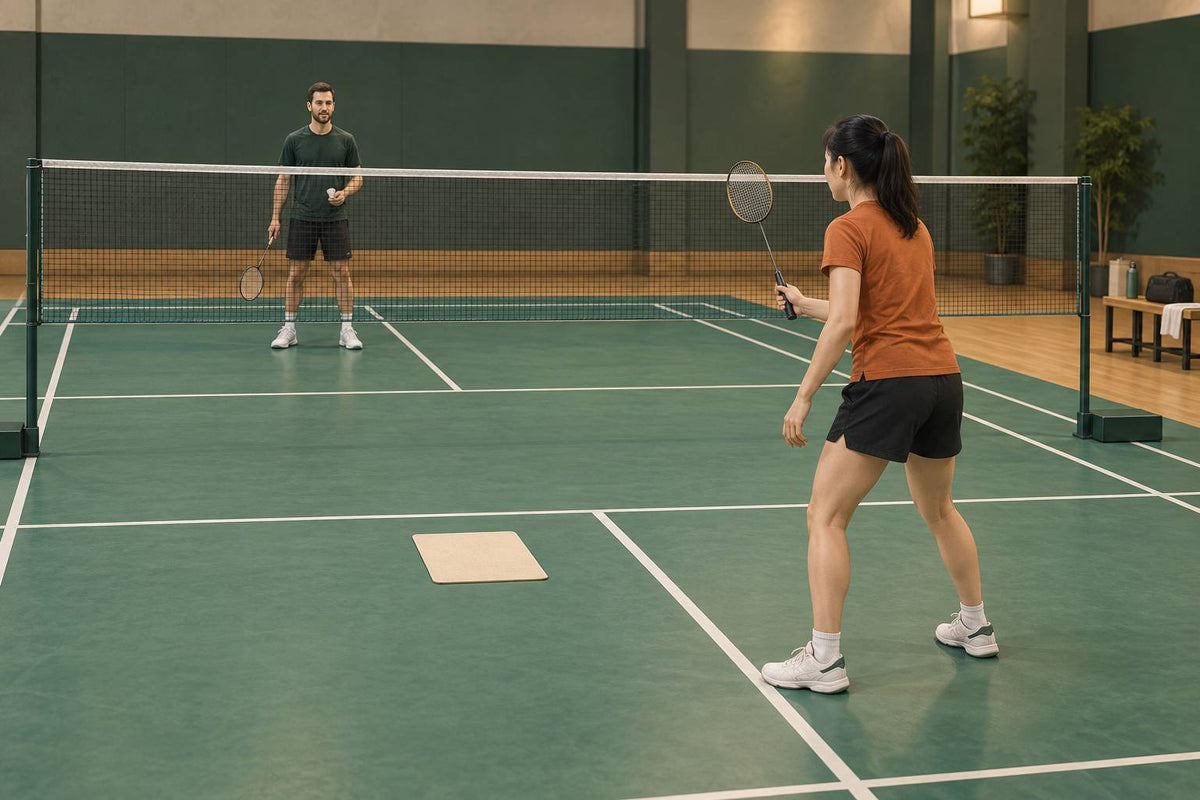
Start with one known feed, add a choice between realistic feeds, add the approach and recovery, then place the skill inside a scored rally. Move up only while contact, balance, and the intended outcome stay recognizable; remove one demand when they do not.
Fixed
Learn the action: one known feed, one target, and one technical cue.
Choice
Use a varied version of one skill or select between two different replies from an unpredictable feed.
Moving
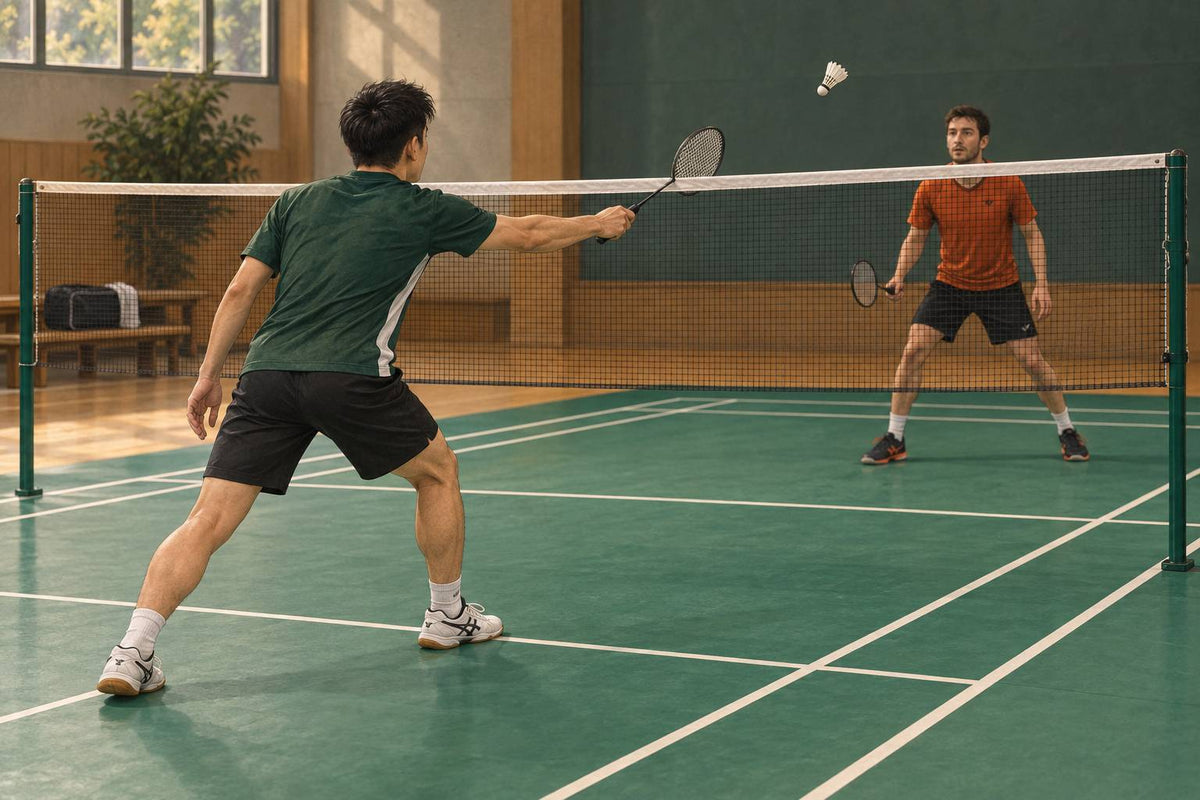
Add the approach, contact, and recovery that the stroke needs in a rally.
Match
Reward correct selection and execution inside a rally; do not force the stroke on the wrong shuttle.
A drill can look perfect because the player knows exactly where the shuttle is going. The match asks a harder question: can the player read the feed, reach it in balance, choose the stroke, and recover for a reply? A useful progression connects those two jobs without jumping straight from ten easy feeds to an unrestricted game.
Changing repetition itself? Our drill variety versus repetition guide helps decide when to stay with one task and when to mix it. This page shows how to build game demands around one chosen skill.
Build the four-step ladder around one outcome
Write the rally job before choosing feeds. “Hit a clear” is an action; “create time from a late rear-court position” is a game job. The job determines the realistic feed, target, movement, and final scoring condition.
BWF's Level 1 manual recommends progressing from simple to complex, slow to fast, and predictable to unpredictable. Its example pathway moves from shadowing and isolated feeds through movement, predictable and unpredictable rallies, then a rally played to completion or a bonus-point game. It also says to keep a tactical context and not advance before the player is reasonably competent at the current level. Read the BWF Level 1 progression guidance.
| Stage | Keep stable | Add now | Do not add yet |
|---|---|---|---|
| 1. Fixed | Feed, starting position, target, tempo | One cue and immediate outcome feedback | Disguise, multiple strokes, fatigue |
| 2. Choice | One skill or a defined reply set at a manageable pace | A varied version of one skill or an unpredictable choice between different replies | Every court corner and every reply |
| 3. Moving | The same read and intended outcome | Split step, approach, contact, recovery | Long exhausted sets that change technique |
| 4. Match | Normal rally decisions and rules | A bonus for the skill creating its intended advantage | A rule that demands the stroke on an unsuitable shuttle |
The labels are a coaching tool, not a law of motor learning. In BWF terminology, changing only the direction, height, pace, or starting position of one skill is varied practice; random practice mixes different skills. This article uses “random” only when the feed order is unpredictable and the player must select between different replies. For some skills, adding a small movement before uncertainty is more useful. The controlling principle is simpler: change one main demand, observe the response, and keep a clear route back.
Use a quality gate instead of a timer
A timer tells you how long the player practised, not whether the current task is stable. Choose three observable markers before the set: shuttle outcome, contact or body shape, and recovery. For a defensive block, for example, they might be “lands in the front service court,” “racket prepared in front,” and “balanced for the next shot.”
Badminton House promotion rule
Use five measured attempts. Move up after four meet all three markers, then repeat that result once. If two consecutive attempts lose the same marker after a new demand is added, remove that demand or reduce its pace. This five-attempt rule is an editorial coaching choice, not a validated universal threshold.
Record the failed marker, not only “miss.” A clear that lands short because contact became late needs a different regression from a clear that reaches the target but leaves the player falling backward. The BWF Level 2 manual separates review—describing what occurred—from evaluation—deciding whether the goal was achieved. Read the BWF practice-structure and review sections.
A clean fixed set is useful but incomplete. The Level 2 manual describes blocked practice as useful for a narrow early focus and random practice as closer to badminton when changing replies require decisions. It also distinguishes varied practice—different versions of one skill—from random practice that mixes different skills. That supports adding height, direction, or pace before throwing every stroke into the same drill.
Apply the ladder to a clear, net kill, and defensive block
| Skill | Fixed | Choice | Moving | Match |
|---|---|---|---|---|
| High clear | Known rear-court feed to a deep straight target | Varied: feed to either rear corner; player clears straight | Start at base, move, clear, recover | Bonus when a clear from pressure restores a neutral rally |
| Net kill | Loose known feed above tape; compact downward contact | Random: feed is killable or below tape; choose kill or net reply | Split, step in, strike or control, recover safely | Bonus only when the player attacks a genuinely high net reply |
| Defensive block | Controlled straight attack to one block target | Varied: attack to forehand or backhand side | Base, split, defend, recover to cover the next attack | Bonus when the block forces the attacker to lift or move forward late |
Make every feed safe and useful. BWF defines feeding as delivering the shuttle to create realistic practice opportunities and advises a safe feeder position, a game-like flight path, enough flight time for the learner, and racket feeding when realistic pace is required. Do not stand where a player's racket or follow-through can reach you, and do not accelerate the feed until the receiver controls contact and landing.
Regress one demand without restarting the skill
When quality breaks, identify what changed. If the read is late, return from two possible feeds to one. If the movement makes contact late, keep the approach but slow the feed. If the scored game makes the player force the stroke, change the bonus so it rewards the intended rally effect rather than the mere appearance of the shot.

- Keep the skill, remove uncertainty: useful when selection is the failure.
- Keep movement, reduce pace: useful when spacing or balance disappears.
- Keep the rally, remove scoring pressure: useful when the player forces the target stroke.
- Stop the set: appropriate when the feeder cannot maintain a safe position or the player loses landing control.
The goal is not to reach the match stage every session. It is to know exactly which version the player can solve today and what single demand comes next.


Leave a comment
This site is protected by hCaptcha and the hCaptcha Privacy Policy and Terms of Service apply.