
Last checked: August 2026 · Written by the player-led team at Badminton House
This three-lesson badminton PE plan takes a class from racket control to a short serve, then gives students a first overhead-clear experience and a conditioned game. It fits 25–30 students on two or four indoor courts, but it is an editable teaching plan—not an official BWF sequence or a universal curriculum.
Need more runway? Use our six-lesson badminton PE unit when your timetable allows more practice and review.
What this three-lesson unit can—and cannot—do
Treat the unit as a short introduction with observable checkpoints. Students should leave with safer spacing, two usable grips, more controlled contacts, a way to start a rally, and a first look at an overhead action. Three lessons are not enough to promise one technique standard for every class.
The distinction matters because the BWF-authored Shuttle Time lesson plans contain 22 lessons. Their Starter section puts grips and basic racket skills before net play and introduces the overhead clear much later, in Lesson 13. BWF also says teachers may select and adapt material instead of following every lesson in order.
| Lesson | Main outcome | Simple exit check |
|---|---|---|
| 1. Control | Change between forehand “V” and backhand thumb grips and make controlled contacts. | Show both grips and complete a short self-tap or partner sequence. |
| 2. Start | Send a backhand short serve toward the diagonally opposite service area and prepare for the reply. | Land several controlled attempts in a generous target, then play serve plus one reply. |
| 3. Send deep | Explore a balanced overhead-clear action from a controlled feed and use it in a shortened game. | Explain one clear cue and send at least one shuttle high and toward the rear court. |
This progression is a Badminton House compression, not “BWF Lesson 1–3.” BWF’s Coach Education Level 1 overview includes planning and delivery of progressive sessions; here, progression means watching the class and repeating a stage when control is not yet there.
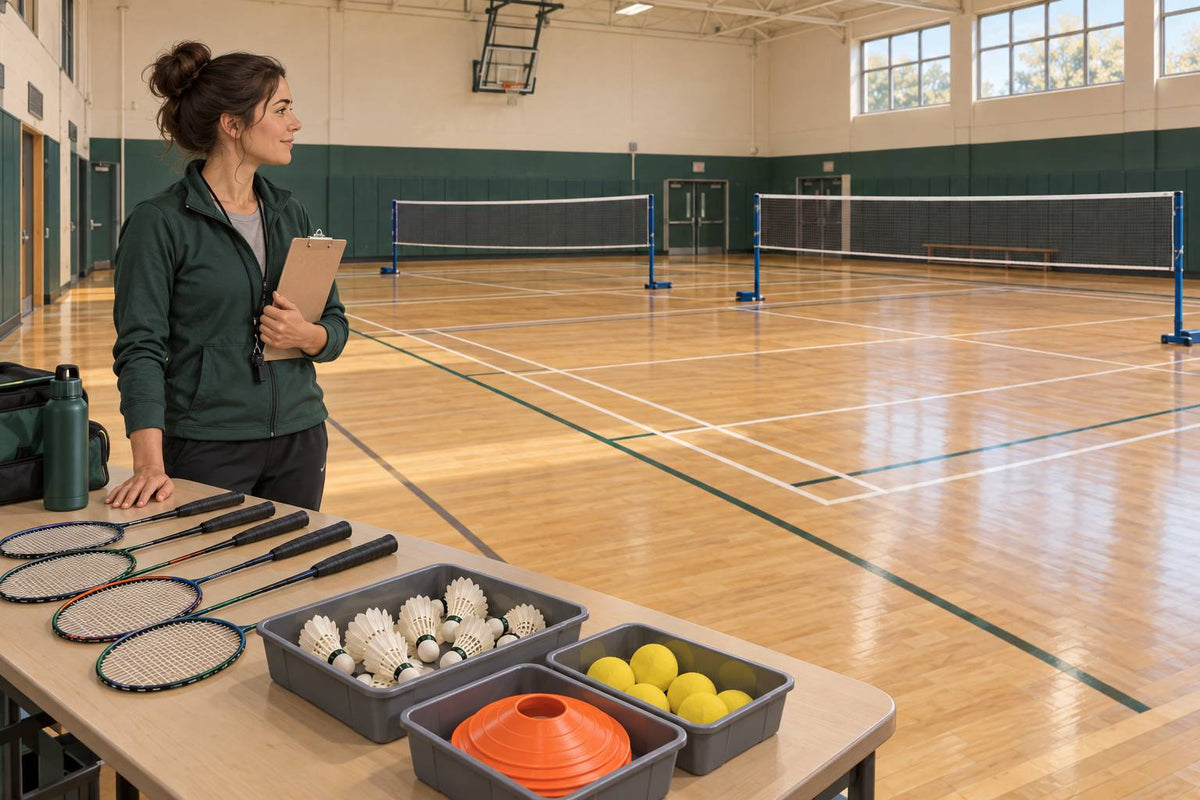
How to place 25–30 students on two or four courts
Make five fixed groups: five students per group for 25, or six per group for 30. Keep the groups for all three lessons so transitions become routine. Use five eight-minute rotations inside a 55-minute class, with the demonstration and exit check outside those blocks.

| Facility | Five-zone layout | How students rotate |
|---|---|---|
| Two courts | Use the four longitudinal half-court lanes as Zones 1–4. Zone 5 is a no-net control, shadow, movement, or approved-wall station. | One full group is assigned to each zone, but only one pair or trio is active in a half-court lane at a time. In a group of six, two trios alternate; in a group of five, a trio and a pair alternate. Waiting students stay in a teacher-marked area outside the swing lane; roles change only after play stops. |
| Four courts | Zones 1–4 use one court each; Zone 5 remains no-net. Divide each court into half-court tasks so more pairs are active. | Four groups practise on court while one rehearses off court. All five move one zone on the same signal. |
A workable clock is five minutes for entry and safety, five for the new demonstration, 40 for five rotations, three for collecting shuttles, and two for the exit check. Put transition time inside each eight-minute block. If the class needs longer instructions, run four rotations and continue the cycle next lesson.
- Mark swing lanes with court lines: every swing stays inside its lane; nobody enters a live lane.
- Collect on one signal: feeders stop, rackets go down, then everyone retrieves. Loose shuttles are a floor hazard.
- Keep bags and spare rackets outside the run-off: the playing and transition routes stay clear.
- Use the wall only when approved: it must be unobstructed and separated from traffic. Otherwise, use shadow swings and catch-after-contact work.
The spacing and collection controls reflect Shuttle Time’s repeated instructions to keep groups well spaced and watch for shuttles on the floor. Apply your school’s own facility, supervision, accessibility, and emergency procedures as the controlling policy.
Lesson 1: grips, contact, and cooperative control
The first lesson rewards soft, repeatable contact rather than distance. Demonstrate the forehand “V” grip and backhand thumb grip, then let students discover how small grip changes alter the racket face. Finish with a rally challenge in which control matters more than winning.
| Time | Task | Teacher cue |
|---|---|---|
| 0–5 | Entry, boundaries, collection signal, racket-spacing check. | “Racket down before feet move into another lane.” |
| 5–10 | Show both grips and one relaxed forehand/backhand change. | “Turn the handle with the fingers; do not make a giant arm swing.” |
| 10–50 | Five rotations: self-taps; forehand hand-feed; backhand hand-feed; tap-and-catch control; short cooperative half-court or no-net rally. | “Reach toward the shuttle, make a small contact, and recover the racket in front.” |
| 50–53 | Stop, lower rackets, collect by zone. | One zone moves at a time if routes cross. |
| 53–55 | Partner grip check and one-sentence exit answer. | “Which grip gave you the straighter racket face on that side?” |
Make it easier: allow tap-catch-reset, shorten the feed, or have the feeder toss slowly from close range. Make it harder: alternate forehand and backhand, change height, count a sequence only when the hitter stays inside the lane, or require a balanced recovery after contact.
Lesson 2: short serve, ready position, and first reply
The second lesson turns a serve into the start of play, not an isolated accuracy test. Students first aim into a broad diagonal service target, then add a receiver and one controlled return. Keep the task cooperative until both players can begin without stepping into another lane.
Shuttle Time Lesson 7 also combines backhand short-serve target work with frontcourt rallying and offers a low-or-no-net variation. This plan borrows that teach-then-play idea without claiming to reproduce the official lesson.
| Time | Task | Teacher cue |
|---|---|---|
| 0–5 | Safety and grip-change recap. | Show the thumb grip without a swing. |
| 5–10 | Demonstrate hold, compact forward action, diagonal target, and ready racket. | “Start balanced, contact cleanly, then bring the racket back in front.” |
| 10–50 | Five rotations: serve to broad target; serve to narrower target; receiver catch/soft block; serve plus one reply; no-net serve-shape and accuracy rehearsal. | “Accuracy first; add speed only when the shuttle keeps entering the target.” |
| 50–53 | Collect by zone and reset equipment. | No collection while another pair is serving. |
| 53–55 | Serve plus one reply for the exit check. | Observe target, balance, and readiness—not a class-wide success percentage. |
Make it easier: enlarge the target to the whole opposite service area, shorten the distance for a skill task, or remove the net while preserving the diagonal aim. Make it harder: narrow the target, alternate left and right targets, or award a point only when the server is ready for the receiver’s soft reply.
Lesson 3: introduce the overhead clear, then play
The final lesson introduces the shape and purpose of a clear without demanding a jump or full-court power. Begin with a shuttle throw and shadow action, move to a predictable feed, then use a shortened game where a high, deep shot creates space rather than serving as a technique exam.
| Time | Task | Teacher cue |
|---|---|---|
| 0–5 | Clear floor, check overhead spacing, rehearse stop signal. | Nobody feeds until the hitter faces an empty swing lane. |
| 5–10 | Demonstrate side-on preparation, high reach, and balanced finish. | “Reach high, send it high and long, then regain balance.” |
| 10–50 | Five rotations: shuttle throw; shadow clear; close predictable feed; depth target; half-court rally or game with a bonus for a controlled shot reaching the rear target area. | Use one cue per turn. A clean, balanced contact counts before distance. |
| 50–53 | Collect and restore the hall. | Feeders verify the lane is stopped before moving. |
| 53–55 | Students name one useful cue and choose their next practice need. | Choices: contact, direction, height, distance, or recovery. |
Make it easier: use a throw, permit a catch between exchanges, feed from closer range, remove the net, or score direction instead of depth. Make it harder: recover to a base marker already on the court, alternate feeds, aim into a smaller rear-court target, or play the next shot after the clear.
A club player can work on target accuracy, a less familiar side, or recovery while classmates use the base task. They can model one repetition or give one agreed cue, but do not turn the same student into a permanent demonstrator. That preserves their practice time and keeps peer feedback specific.
Before the first class
- Make five group lists and sketch the two-court or four-court rotation.
- Choose one stop signal, one collection signal, and the safe routes between zones.
- Prepare one easier and one harder version of every station.
- Decide what you will actually observe at each exit check; repeat a stage when the class needs it.

Leave a comment
This site is protected by hCaptcha and the hCaptcha Privacy Policy and Terms of Service apply.