
Last checked: August 2026 · Written by the player-led team at Badminton House
Quick Answer: Badminton Shoe Outsole Patterns
No visible pattern name proves grip by itself. Read geometry, rubber description, court surface and outsole condition as one system.
Default
Choose the complete shoe: compare it on your clean indoor surface. Pattern, compound, floor and wear all affect the result.
Shapes
Herringbone, hex, dots and blades: useful visual descriptions, not a standardized badminton performance ranking.
Gum
Material language: gum is not a tread shape, and outsole colour does not reveal a measured friction or durability result.
Separate question: if your venue asks for non-marking footwear, use our non-marking badminton shoe guide. Non-marking eligibility does not settle the pattern-and-surface comparison here.
What Do Herringbone, Hex, Radial, Pivot and Gum Mean?
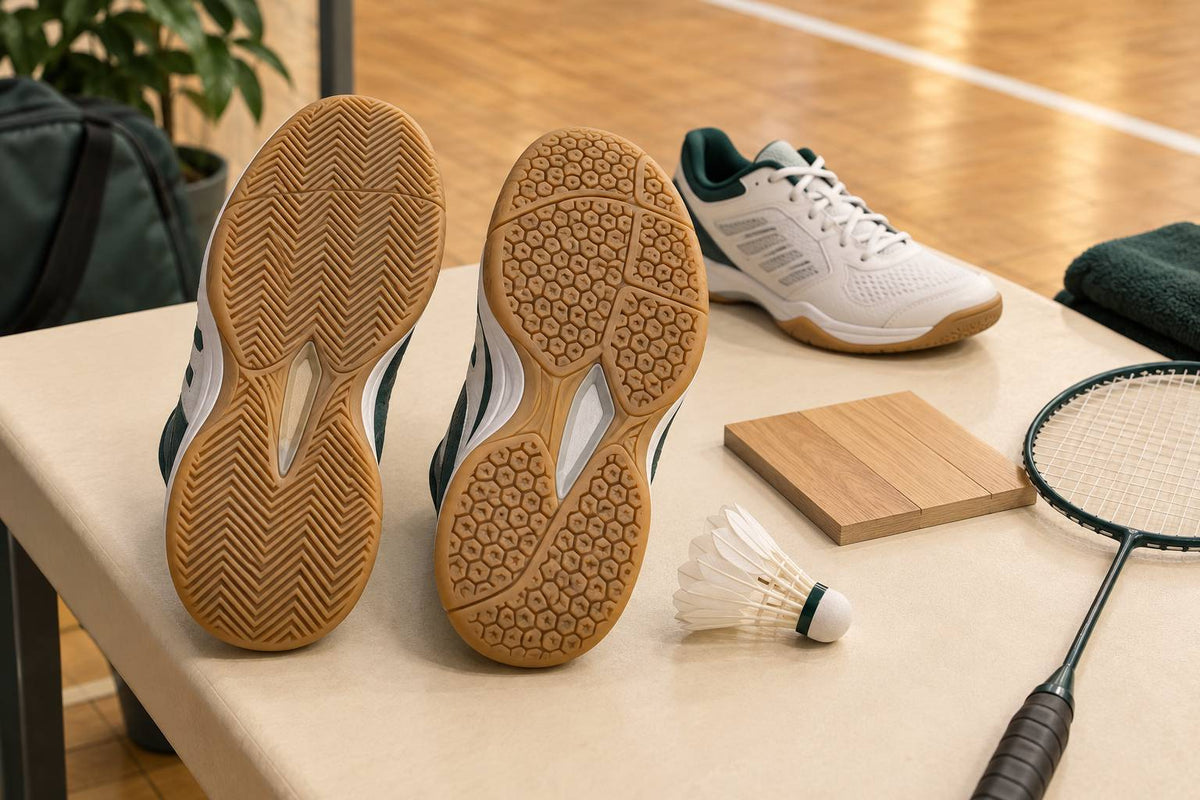
The labels do not all describe the same layer. Herringbone, hex, dots, blades and circular zones describe geometry. Rounded edges and one-piece construction describe outsole architecture. Gum and rubber descriptions concern material or finish. Compare each label only with others in its own category before judging the complete shoe.

| Label you see | What it describes | What it does not prove |
|---|---|---|
| Herringbone / chevron | Alternating V-shaped or angled grooves. | That the shoe has superior multi-directional grip on badminton floors. |
| Hex / dot | Repeated polygonal or rounded cells and lugs. | That every hex or dot sole rotates more smoothly or grips better. |
| Radial / blade | Bars or channels arranged across several directions. | That an untested blade pattern beats another geometry on your court. |
| Circle-shaped forefoot zone | A localized circular groove or lug arrangement under the forefoot. | Improved turning, a better forehand pivot or lower injury risk. |
| Rounded / one-piece / segmented | Perimeter shape and how rubber sections are joined. | A universal traction or lateral-support result. |
| Gum / coloured rubber | Material, formulation or appearance language rather than geometry. | Compound hardness, friction, abrasion life or court suitability from colour alone. |
A current 2026 badminton footwear catalog illustrates the right level of caution. It says one proprietary radial pattern is intended to increase traction in vertical, horizontal and diagonal movements, and describes one named hex sole as a lightweight material intended to provide greater grip. Those are manufacturer claims for named technologies, not general laws about every blade or hexagon.
The same catalog gives intended smooth-footwork and contact-area benefits for rounded and semi one-piece constructions. Again, the claim belongs to that construction. A similar-looking edge on another shoe does not inherit the same evidence.
Why Pattern, Compound and Floor Must Be Read Together
Tread can channel or interrupt contact, compound supplies the rubber behaviour, and the floor supplies the opposing surface. Dust, wear and cleaning change that interface again. A pattern photo therefore cannot predict the complete result, especially when the same player moves between sprung wood, vinyl and court mats.
General official slip-resistant footwear guidance says both tread pattern and sole compound matter. It notes a general indoor tendency toward softer compounds and close-packed tread, then says the only sure way to tell is to trial footwear in the actual environment. This is workplace guidance, not a badminton-shoe ranking, so keep the limitation attached.
Why gum colour is not a specification
If an outsole is described as gum, the word alone does not give you a durometer, friction test, formulation or wear result. Compare the manufacturer's actual outsole description and the complete shoe on court; do not use colour as a shortcut for softness, durability or grip.
Why a test label needs a scope
A generic “slip resistant” phrase is incomplete without the test, surface and condition. For example, ISO 13287:2019 is explicitly a test method for personal protective equipment footwear. It is not a badminton-shoe standard and does not rank herringbone, hex or gum soles for court movement.
The practical rule is simple: named technology can tell you what a manufacturer intended; a relevant test can tell you what was tested; your controlled indoor trial tells you whether the complete shoe and court combination is predictable for you. None of those steps is an injury guarantee.
Which Outsole Pattern Fits Each Indoor Court Surface?
There is no verified one-pattern answer for each floor in the sources reviewed. Use the surface table as a diagnosis order: check court condition, sole condition and whole-shoe behaviour before comparing visual geometry. A shoe that changes only when the venue changes points you toward the surface interaction first.
BWF court-mat certification itself treats flooring as an engineered variable. Its flooring overview uses EN 14904 friction or DIN 18032.2 slip-resistance criteria for specified approval grades. That approval concerns the mat/floor system, not the player's shoe pattern.
| Indoor setting | Check first | Pattern decision |
|---|---|---|
| Clean sprung hardwood | Dry, clean finish; clean intact outsole; predictable easy stops. | Compare complete indoor shoes. No verified evidence here makes herringbone, hex or radial the universal winner. |
| Rolled vinyl or court mat | Mat condition, seams, cleanliness and venue requirements. | A floor approval does not approve your shoe. Trial the complete shoe on that surface at controlled speed. |
| Dusty rented gym | Dust on both floor and sole; whether the surface is being maintained. | Do not buy a shape as a dust cure. Clean the sole correctly, report the floor and reassess before changing shoes. |
| Abrasive indoor multi-use surface | Growth of smooth patches, missing rubber, cracks or peeling edges. | Do not infer wear life from gum colour or pattern name. Inspect the actual outsole after ordinary sessions. |
General official contamination guidance includes dust and warns that even small contamination can matter on smooth vinyl or varnished wood. That supports the diagnosis order; it does not quantify badminton traction or promise that one cleaning pass fixes the venue.
If a sole is consistently predictable on one maintained surface and unpredictable on another, do not diagnose the pattern in isolation. Compare the floor condition, recent cleaning, visible sole contamination and wear before deciding that the shoe design is wrong.
How Should You Inspect and Test an Outsole?
Start with a clean, intact sole and a maintained indoor court. Read the outsole material and named geometry, then use controlled movement before normal play. If grip is inconsistent, stop the test and separate shoe contamination, shoe wear and floor condition rather than escalating speed to force an answer.
Five-step outsole check
- Read the actual specification: outsole material, indoor-court use and any named pattern technology.
- Clean before judging: dust can hide tread and change the shoe-floor contact.
- Inspect loaded areas: look for a smooth patch, missing rubber, cracks or an edge beginning to separate.
- Check the court: dry surface, secure mat and no visible debris or contamination.
- Begin under control: easy walking, side steps and gentle stops first. Do not use a full-speed lunge as the first traction test.
The general footwear-and-surface guidance from CCOHS explains why this separation matters: slips involve too little friction or traction between footwear and the surface, and no footwear has anti-slip properties for every condition. The source is not badminton-specific, so it supports caution rather than a product verdict.
If dust or grime is the issue, follow the full slippery badminton sole cleaning guide. If the clean outsole has a growing smooth patch or damage, use our badminton shoe wear-pattern inspection guide. Pattern selection cannot restore missing or deteriorated rubber.
Final verdict: choose outsole patterns by evidence order, not folklore. Verify indoor use and material, inspect condition, assess the court, then trial the complete shoe. Herringbone, hex, radial and gum labels are useful descriptors; none is a traction or injury guarantee.

Leave a comment
This site is protected by hCaptcha and the hCaptcha Privacy Policy and Terms of Service apply.