
Last checked: August 2026 · Written by the player-led team at Badminton House
Quick answer
No study sets a required shot count for a badminton session. Badminton House's own working targets are about 700 shots in 60 minutes, 1,000 in 90 minutes and 1,300 in 120 minutes, split across serves, overheads, net play, drives and defence, with target hits recorded separately from total attempts.
Related reading: Badminton Practice Session Plan for Busy Players — the goals-and-time-blocks structure this shot-count table plugs into.
How many shots should a session include?
No published study sets a required shot count for a badminton session; the research that exists measures rally counts inside matches and how fatigue changes a stroke; it does not measure training volume. Badminton House's own working targets below split roughly 700 to 1,300 shots across a 60 to 120 minute booking, weighted toward overhead strokes.
| Session | Total shots | Serves | Overheads | Net shots | Drives | Defence |
|---|---|---|---|---|---|---|
| 60 min | 700 | 100 | 250 | 150 | 100 | 100 |
| 90 min | 1,000 | 140 | 350 | 200 | 150 | 160 |
| 120 min | 1,300 | 180 | 450 | 260 | 200 | 210 |
Treat this table as a starting split. It is not a target pulled from a study. Overheads (clears, drops and smashes) get the largest share because they are the most technically demanding strokes and the ones club players drill least on their own. If your weak stroke sits somewhere else, such as the net or the backhand corner, shift 15 to 20 percent of the overhead total there instead.
What a real match actually involves
A pooled systematic review of badminton match-play data puts average shots per rally at 8.9 in men's singles, 6.9 in women's singles, 9.5 in men's doubles and 11.8 in women's doubles. Those category averages fall on both sides of 10, so the data do not support a flat 10-shot rule of thumb for every category.
The same review reports average points played per full match: 77.0 in men's singles, 42.3 in women's singles, 88.1 in men's doubles and 84.5 in women's doubles. Under the current BWF Laws of Badminton, each scoring rally normally starts with a serve. Ignoring lets and penalty points, a two-game 21-19, 21-19 match contains 80 scoring rallies and 80 serves, which sits close to the real 77-point men's singles average.
Multiply men's singles shots per rally by points per match and the whole contest totals roughly 685 shots between both players, around 340 for one player. A single 90-minute session hitting the table above delivers close to three matches' worth of shots in one booking, which is the practical case for drilling: match play alone rarely repeats any one stroke often enough to fix it.
Order the blocks: precision first, retrieval last
Run initiating strokes, the ones where you choose the target, before reactive strokes, the ones where the first job is simply keeping the shuttle alive. Fatigue erodes accuracy far faster than it erodes power, so the strokes that live or die on placement belong in the fresher half of the session.
A badminton smash fatigue study tracking 24 national-level players found that from baseline to severe fatigue, smash speed fell by 10.6 percent while smash accuracy fell by 46.1 percent, and the researchers concluded accuracy is far more fatigue-sensitive than speed. Under moderate to severe fatigue, speed and accuracy also traded off against each other: tired players who swung hard lost placement, and players who protected placement lost pace.
Block A, the first half of the session, covers serves and overhead clears, drops and smashes aimed at a specific zone. Block B, the second half, covers net exchanges under time pressure, drive rallies and defence or retrieval work, where getting the shuttle back in play matters more than hitting a precise spot. This is not a claim that defence matters less; it is a claim that defensive reps tolerate the fatigue a session accumulates, while precision reps do not.

Count attempts and landing accuracy separately
Record every attempt as training volume, then record how many land in the target zone as a separate measure of accuracy. Use a fixed batch of shuttles in a basket instead of a clicker.
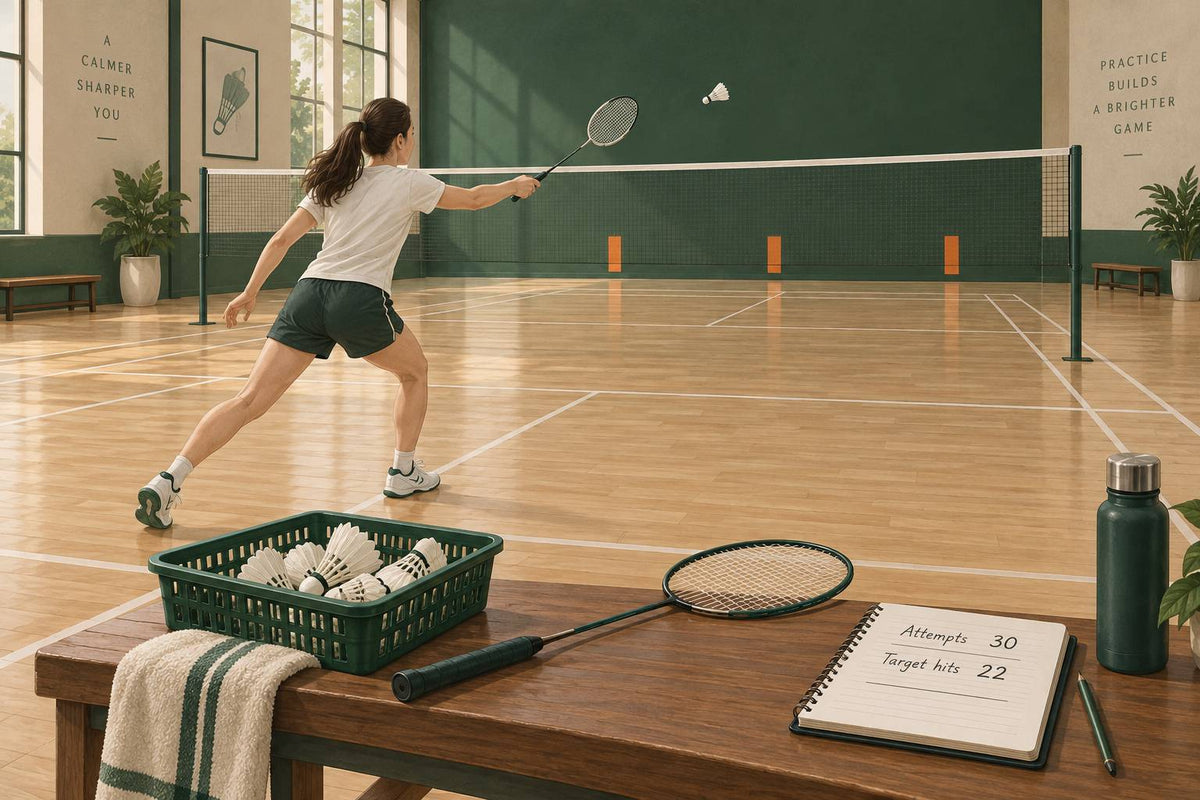
Put 30 shuttles in a basket for a target-zone drill, such as clears landing beyond the doubles long service line but inside the baseline. After the batch, record both attempts and target hits: 22 out of 30 is a 73 percent hit rate. Compare accuracy between similar sets without ignoring the physical work of missed shots.
For example, 350 target hits at a 73 percent rate would require 350 ÷ (0.73 × 30), or about sixteen 30-shuttle batches; that is arithmetic, not a reason to exceed the planned attempt count. If accuracy falls sharply, stop the set and review the task before adding volume. For how long to run each continuous feeding set, our guide to multifeed drill set length covers the work and rest timing that helps preserve movement quality within each batch.


Leave a comment
This site is protected by hCaptcha and the hCaptcha Privacy Policy and Terms of Service apply.