

Last updated: July 2026 · Written by the team at Badminton House
Quick Answer: Badminton Practice Session Plan
The best badminton practice session plan for busy players fits one clear goal into a 60–90 minute booking: a 15–20 minute warm-up, focused drilling for roughly 60% of court time, then a game-like finish so the skill transfers into rallies.
Default
Best choice: Pick one match-relevant goal, warm up before hitting hard, drill one or two priority skills, then finish with a restricted game or pattern that forces you to use the same skill under pressure.
Solo
Use shadow footwork, serves, wall work, or self-feeding with a small batch of shuttles when you cannot book a partner; this is useful for consistency, footwork precision, and shot control.
Group
With two to four players, use half-court feeding, rotating stations, or single-shuttle mini-games so everyone gets purposeful reps instead of waiting through random games.
Most busy Canadian players do not need a longer practice. They need a tighter one. If your court time turns into a few clears, a few smashes, then random games until the booking ends, it is easy to feel sweaty without actually fixing the shot or movement pattern that keeps costing you points.
A good badminton practice session plan gives every block a job: a clear goal, a focused drill, enough repetition to make the skill stick, and a game-like finish so the work transfers into rallies. The point is not to train like a national team. It is to make your next club night, lesson, league match, or drop-in session feel more deliberate.
Planning a high-rep practice? Check the shuttlecocks collection before your next session. For Canadian players and clubs stocking up, Badminton House offers free shipping within Canada.
In This Guide
- Set One Clear Goal Before You Start Hitting
- Warm Up, Then Use the Knock-Up as Skill Rehearsal
- Choose Focused Shot Blocks Instead of Random Hitting
- Use Feeding Drills When You Need Fast Repetition
- Finish with Game-Like Transfer
- Solo vs Small-Group Practice Formats
- Sample Time-Boxed Plan and Gear Setup
- Which Practice Format Should You Choose?
Set One Clear Goal Before You Start Hitting

The fastest way to waste a booked court is to start with “let’s just rally” and hope improvement happens by accident. A useful badminton practice session plan starts before the first shuttle is hit: decide what you are training, why it matters in a match, and how you will know whether the block worked.
For busy Canadian players squeezing practice between work, school, commuting, winter driving, and club court times, this matters even more. If you only have 60 or 90 minutes, every block should connect to a real match situation: returning a low serve, lifting under pressure, recovering after a smash, playing a tighter net shot, or moving from defence into attack. Random hitting feels active, but it often repeats the habits you already have.
Keep the goal narrow. Pick one main theme for the session, or at most two small technical changes. Trying to fix grip, footwork, timing, shot choice, and fitness in the same hour usually means none of them become automatic.
A good goal is not “get better at doubles” or “hit harder.” Make it SMART: specific, measurable, attainable, relevant, and time-bound. In practice, that means the goal should name the shot or situation, include a simple way to count success, and fit the level of the player on court that day.
| Weak goal | Better practice goal | Match situation it trains |
|---|---|---|
| Improve my net play | Land 7 out of 10 forehand net shots below tape height during a 10-minute block | Forcing a lift after a tight net exchange |
| Smash harder | Hit 3 sets of controlled smashes while recovering to base after each shot | Attacking without getting stuck at the back court |
| Play better doubles | Practise first three shots after serve: low serve, push return, third-shot reply | Winning the opening exchange instead of lifting too early |
| Move faster | Complete a focused footwork block while maintaining balance before the stroke | Arriving early enough to choose the shot, not just reach the shuttle |
Once the goal is clear, build the session around it. If the goal is a tighter net shot, the warm-up knock-up can include gentle net exchanges instead of only clears. The focused block can isolate the forehand net shot. The feeding block can add movement into the front court. The final game-like block can require the rally to start with a net exchange before open play begins.
That kind of structure also helps one week build on the last. Week one might be “make the net shot consistent.” Week two might be “recover after the net shot.” Week three might be “use the net shot to create a lift.” The work stays connected, and progress becomes easier to notice than if every session is a new mix of clears, smashes, drops, games, and whatever someone feels like doing that night.
"Random hitting feels active, but it often repeats the habits you already have."
Before you start, answer these three questions out loud with your partner or group:
- What situation are we training? For example: defending a smash, attacking a lift, returning serve, or turning a loose net shot into pressure.
- What is the success cue? For example: shuttle lands in a target area, recovery happens before the next feed, or the racket is prepared early.
- How long are we giving it? A short time box keeps the block focused and prevents one drill from taking over the whole court booking.
The point is not to make practice complicated. It is to make it deliberate. When each block has a purpose, you can still enjoy rallies and games, but the session has a thread running through it. You are not just hitting more shuttles; you are training a specific decision, movement, or shot pattern that shows up when the score is tight.
If you are newer to structured training, start with one goal for the whole session. If you are more experienced, use one main goal plus one supporting goal, such as “better doubles serve return” with “recover forward after the push.” Keep it simple enough that everyone on court can remember it between points.
Warm Up, Then Use the Knock-Up as Skill Rehearsal
The first part of a good badminton practice session plan is not “start rallying and hope the body wakes up.” Begin with a real warm-up, then treat the knock-up as the bridge between general movement and the main training block.
A proper badminton warm-up should take about 15–20 minutes. Start with light activity to raise blood flow, then move into mobility and dynamic movement, then activation, and only then into badminton-specific on-court rehearsal. Do not go straight from sitting at work, school, or in the car to smashing: stretching or hitting hard with cold muscles is less effective and increases injury risk.
Want the full routine? Use our detailed badminton warm-up exercises guide before your next club night or training session.
| Phase | Time | What to do | Why it matters |
|---|---|---|---|
| Pulse raiser | 3–5 min | Light jogging, skipping-style movement, side steps, or easy court movement. | Raises blood flow before you ask your legs, hips, shoulders, and wrists to move quickly. |
| Mobility and dynamic stretches | 3–4 min | Dynamic movements through the ankles, hips, trunk, shoulders, and wrists. | Prepares the ranges of motion you actually use in lunges, jumps, reaches, and rotations. |
| Activation and movement prep | 4–5 min | Split-step rhythm, controlled lunges, recovery steps, and short directional changes. | Switches the body from general movement into badminton-ready footwork. |
| On-court skill rehearsal | 5–6 min | Cooperative clears, drops, net shots, lifts, drives, or defence patterns that match the session goal. | Bridges the warm-up into the technical work so the first focused block is not wasted. |
Make the knock-up specific, not automatic
Most players knock up by hitting whatever comes back: a few clears, a few drives, a rushed smash, then random rallying. That is better than standing still, but it is not the best use of limited court time.
Instead, make the knock-up rehearse the same skill theme you set for the session. If the day’s goal is better clears, use the knock-up to check contact height, recovery, and depth. If the goal is net control, spend part of the knock-up on soft net touches and lifts. If the goal is doubles defence, add cooperative drives and blocks, keeping the racket in front rather than swinging wildly.
- Start cooperative. The knock-up is not the time to win the rally; it is the time to find timing, footwork rhythm, and clean contact.
- Build from low intensity to sharper movement. Let the first few minutes prepare your body before you add faster exchanges.
- Connect it to the main block. If your first drill is net shots, rehearse net movement before the drill begins. If your first block is clears, rehearse overhead timing before feeding starts.
- Save static stretching for later. Long static holds fit better in a cooldown than in the middle of a warm-up where you need dynamic, badminton-specific movement.
This opening sequence makes the rest of the session cleaner: your body is ready, your footwork is awake, and your first drill already has a purpose.
Choose Focused Shot Blocks Instead of Random Hitting
Random hitting feels useful because you are moving, sweating, and touching the shuttle. The problem is that it rarely gives you enough clean repetition on the thing you actually need to improve. A better badminton practice session plan uses two or three focused shot blocks, each tied to a match situation you see often.
Keep the session simple: choose one or two technical changes at a time, then organize your court time so roughly 60% is deliberate drilling and 40% is match play or game-like transfer. The drill portion builds the skill; the play portion checks whether it survives pressure.
Simple rule for busy players
Pick fewer blocks and do them with more intent. Two sharp blocks connected to real rally problems will usually beat 40 minutes of casual clears, drops, and smashes with no target.
Start with the match situation, then choose the shot
Do not start by saying, “Let’s hit smashes.” Start by asking what match problem you are trying to solve. Are you losing the net? Getting trapped by flat drives? Struggling to clear deep enough when late? Once the situation is clear, the shot block becomes obvious.
| Shot block | Match situation it trains | Main cue |
|---|---|---|
| Net touches | You reach the forecourt but lift too often instead of keeping pressure at the tape. | Soft hand, early racket preparation, and a clear target. For technique detail, see the badminton net shots guide. |
| Pushes | Your opponent plays a loose net shot or mid-court shuttle and you need to move them without overhitting. | Compact swing, controlled pace, and recovery after contact rather than admiring the shot. |
| Clears | You are late in the rear court and need time to recover without giving up an easy attack. | Hit with enough height and depth to reset the rally, then recover toward your base. |
| Drives | You get pulled into a flat exchange in doubles and need to stay ready for the next shuttle. | Make the rally cooperative, not a hitting contest: short swing, contact out in front, racket ready again immediately. |
| Smashes | You earn a lift but your attack breaks down through poor timing, contact point, or recovery. | Prioritize clean contact and repeatable mechanics before maximum power. For more detail, use the badminton smash technique guide. |
Build each block from controlled to harder
The first version of a block should be easy enough that both players can repeat the pattern cleanly. Once the quality is stable, increase the speed or intensity gradually. That progression keeps the drill challenging without turning it into chaos.
- Level 1: cooperative accuracy. Both players know the shot and target. The goal is clean contact, stable timing, and repeatable recovery.
- Level 2: add movement. Start from base, move into the shot, then recover. This makes the block feel more like a rally without losing control.
- Level 3: increase pace or intensity. Feed slightly faster, drive flatter, clear from a later position, or ask for a stronger smash only after the base version is reliable.
- Level 4: add a decision. For example, the feeder can alternate between a net feed and a lift, or the hitter can choose between a straight push and a lift based on shuttle height.
This controlled-to-game-like sequence is the difference between a drill that looks good and a skill that actually appears in matches.
Example: three blocks for one practice
For one session, avoid trying to cover every shot in badminton. A practical three-block setup might look like this:
- Block 1 — net touch to lift recognition: practise taking the shuttle early at the tape, then lifting only when the shuttle is too low to pressure.
- Block 2 — mid-court push and recover: practise pushing into open space after a weak reply, then returning to a ready position instead of drifting forward.
- Block 3 — clear or smash from the rear court: practise choosing between a resetting clear and an attacking smash based on balance and contact height.
That gives you a front-court block, a mid-court block, and a rear-court block without turning the session into random hitting. If the group is short on time, cut one block rather than rushing all three.
Keep the drive block cooperative
Drives are where many club practices lose their purpose. Two players start with a useful flat exchange, then within 30 seconds both are swinging harder, getting later, and learning very little. The point of a drive block is not to win the drill; it is to build a fast, repeatable exchange.
Use a short racket swing, meet the shuttle out in front, and stay ready for the next shot. If the shuttle keeps flying too high or both players are taking contact beside the body, slow the exchange down until the timing comes back. Speed is the progression, not the starting point.
Use Feeding Drills When You Need Fast Repetition

Feeding is the efficiency engine of a badminton practice session plan. In open rallying, the shot you want might appear once every few rallies. In feeding, you can repeat the same target movement again and again: first step to the forecourt, split step into rear-court scissor kick, block defence from the body, or a recovery pattern after a smash.
Multi-feeding drills have been shown to create greater internal and external training loads than simulated match play, with large effects. In plain language: a well-run feeding block can be physically and technically demanding, even though it looks controlled. That is why it belongs in the middle of the session, after the warm-up and focused shot work, not as the very first thing you do after sitting all day at work or school.
When feeding beats rallying
- You need repetitions fast: grooving one footwork pattern, contact point, or recovery habit.
- Your group has limited court time: hand-fed drills can run on half a court, so two small groups can work at once.
- The mistake is predictable: for example, late forehand defence, weak net recovery, or clears landing short.
- You want measurable progress: count successful targets, clean recoveries, or quality contacts instead of just counting minutes.
Set the court before you start feeding
The simplest upgrade is to mark the court. A structured multifeeding setup uses hitting-zone markers, a fixed feeder position, and defined running paths so the player knows exactly where to move and recover. You do not need fancy equipment: flat court markers, spare shuttle tubes placed safely outside the landing path, or clear verbal targets can all work.
| Setup piece | How to use it | Why it helps |
|---|---|---|
| Hitting-zone marker | Place one clear target where the shuttle should land or where the player should contact it. | Turns “hit better” into a visible, measurable task. |
| Running path | Define the start position, movement route, contact point, and recovery point before the first feed. | Prevents lazy footwork and makes each repetition match the session goal. |
| Feeder position | Keep the feeder in a consistent spot until the player can repeat the movement cleanly. | Removes unnecessary randomness while the skill is being built. |
| Shuttle supply | Keep a small stack beside the feeder and collect between sets, not after every miss. | Maintains rhythm and makes short court bookings more productive. |
Use half-court feeding for small groups
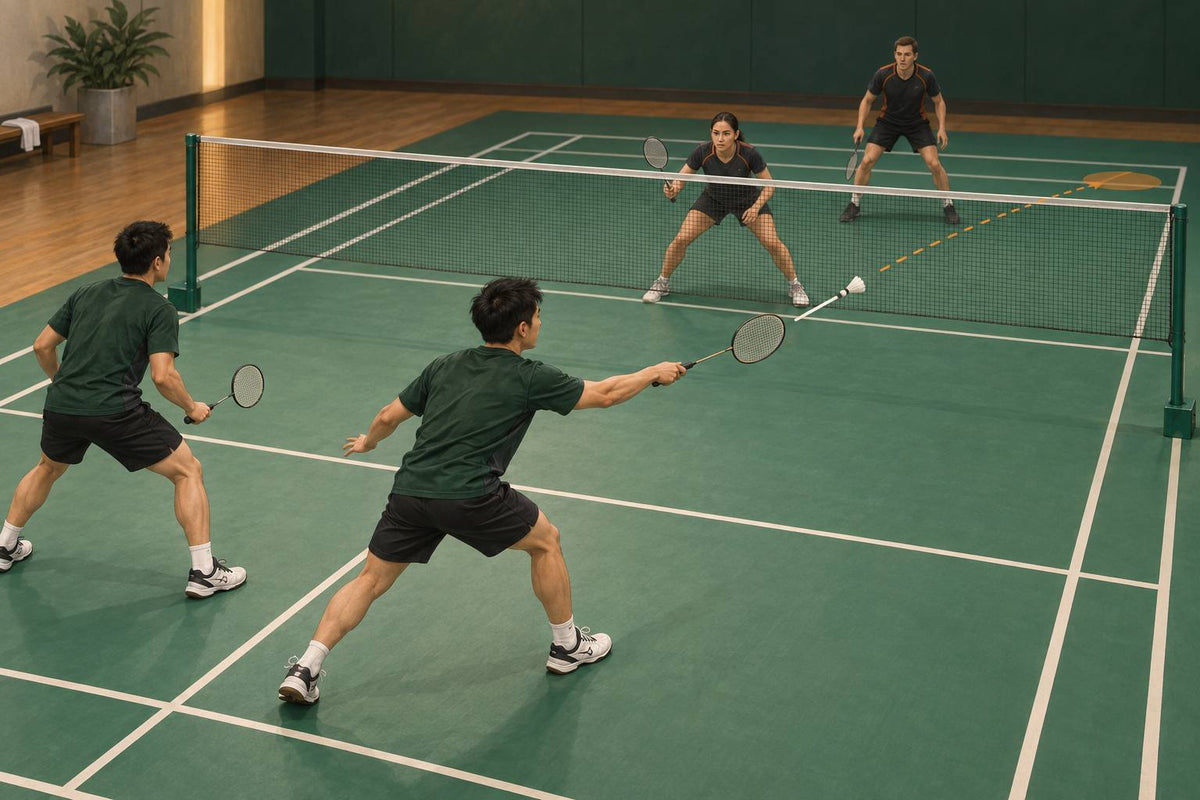
Hand-fed drills are especially useful for busy Canadian players sharing one booking after work. On half a court, one feeder can work with one defender while another pair uses the other half. A common example is a half-court defence block: the feeder hits aggressively down at a defender, and the defender starts in a ready stance with the racket out in front in a backhand grip.
That format is efficient because the worker gets the same decision repeatedly: read the feed, stay compact, contact in front, then recover. If the goal is smash defence, connect this block with the habits in Badminton Smash Defense and Badminton Defense Ready Position rather than turning it into random survival hitting. To make those fast blocks and flat drives sharper, add the drills in our reflex training guide for faster hands.
A simple feeding block you can drop into a 60-minute session
Keep the block short, specific, and repeatable. For most recreational and club players, one clean feeding theme is better than trying to train net kill, rear-court smash, defence, and recovery all in the same ten minutes.
Example: rear-court recovery block. Feed 8–12 shuttles to the rear forehand corner. Worker hits clear or drop, recovers to base, then resets. Rest 45–60 seconds, switch roles, and repeat for 3–5 rounds.
- Technical goal: contact the shuttle early and recover before watching the shot land.
- Movement goal: use the same first step and recovery path every repetition.
- Scoring goal: count only clean reps where the player contacts in balance and returns to base.
- Progression: start with predictable feeds, then slightly vary the height, speed, or landing zone once the movement is stable.
For high-volume feeding, durable practice shuttles make the session easier to run because you are not stopping constantly to protect your best match shuttles. You can browse current options in the Shuttlecocks collection; availability can change, so plan the drill around the number and type of shuttles you actually have on court.
Build the load gradually
Because feeding lets you pack many repetitions into a small window, it is easy to overdo it. Build both volume and intensity gradually: fewer shuttles first, cleaner movement first, longer rest first. Then add speed, uncertainty, or a second movement pattern.
A good rule for busy players is to stop the set when the movement quality drops, not when the bucket is empty. If the worker starts reaching, standing upright, or skipping the recovery step, the drill is no longer training the habit you wanted. Take the rest, shorten the next set, or return to a more controlled feed.
Feeding is powerful, but it is not the whole session. Once the movement is cleaner, transfer it into a more match-like drill: one feeder becomes an opponent, the worker must choose between two replies, or the rally continues after the first fed shot. That controlled-to-game-like sequence is what turns repetition into usable badminton.
Finish with Game-Like Transfer
Feeding is excellent for building a movement or shot quickly, but it should not be the final test of the skill. In multi-feed, the feeder controls the rhythm, location, and pressure. In a match, the shuttle comes from an opponent who is trying to expose your recovery, timing, and decision-making. That is why the last block of a strong badminton practice session plan should move from controlled repetition into game-like transfer.
Think of multi-feed as the construction zone and the final game-like block as the inspection. If you practised net kills, can you still choose the right moment when the lift, block, and drive are all possible? If you practised smash defence, can you recover after the first block and handle the next shot? If you practised clears, can you use them when an opponent is holding the net and waiting for a loose reply?
Simple rule: end practice with one drill where the shuttle is live, the opponent has choices, and the trained skill must survive under pressure.
Use 2v2 single-shuttle drills
For doubles players, a 2v2 single-shuttle drill is one of the easiest ways to bridge the gap between feeding and full games. Start with a clear constraint: for example, one pair begins in attack and the other begins in defence. Play the rally out with one shuttle, then reset quickly. The goal is not to “win club night.” The goal is to see whether the skill you trained earlier appears when spacing, rotation, and recovery matter.
- After a defence feed block: start with one side smashing and the other defending, then play out the rally after the first block or lift.
- After a net block: begin with a tight net exchange, then allow the rally to continue once either side lifts or pushes.
- After a drive block: begin flat and fast from mid-court, then play out the rally once someone changes pace or creates a lift.
If doubles rotation is the weak link, keep the rally live and talk only after the point. Too much coaching during the rally can turn the drill back into a scripted pattern. For a deeper refresher on spacing and front-back versus side-side movement, see our doubles positioning and rotation guide.
Use mini-games with one rule
Mini-games are useful because they keep the score, pressure, and decision-making of badminton while narrowing the focus. The best rule is simple enough that players remember it during the rally. One example is making the back tramline out. That immediately changes the usable court space and gives the rally a specific tactical constraint without stopping it from feeling like badminton.
| Practice focus | Mini-game rule | What it tests |
|---|---|---|
| Net play | Rally must start with a net shot | Whether the player can move from touch to the next decision instead of admiring the shot |
| Flat drives | First three shots must stay below lift height | Whether the player keeps the racket short, ready, and out in front |
| Attack and defence | One side starts in attack; rally plays out after the first smash | Whether the defender recovers for the second shot, not just the first contact |
| Tactical control | Back tramline is out | Whether players can adapt shot choice when the court condition changes |
Keep the transfer block short and honest
Busy players do not need a long match at the end of every practice. A focused 10-minute transfer block can be enough if the rule connects directly to the earlier work. Use quick rotations, keep the explanation short, and stop when the quality drops. If you are practising with a small group, one pair can play the live drill while the others collect shuttles, feed the next start, or rotate in.
This is also where shuttle management matters. Feeding blocks can use a lot of birds, while single-shuttle games need fewer but demand more realistic flight. If your group is planning a regular training night, check the current shuttlecock options before assuming you have enough practice shuttles for both repetition and live play.
The main point: do not let controlled drills become a separate sport. Build the skill with repetition, then ask the rally to prove whether the skill is ready for real badminton.
Solo vs Small-Group Practice Formats

The same badminton practice session plan can work whether you are training alone after work or sharing a busy Canadian club court with three to eight players. Keep the goal the same, then change the format: solo players use structured self-feeding and timed stroke cycles; small groups rotate through stations so nobody spends the whole hour waiting in line.
Solo format: self-feed, recover, repeat
Solo practice is best when you remove the randomness. Instead of hitting a few loose shuttles and calling it training, use a small bucket or tube of 10–20 shuttles and repeat one shot pattern at a time.
- Start mid-court: hold the shuttle in your non-racket hand, toss it up, and play the chosen stroke: clear, drop, smash, lift, push, or net touch.
- Recover every rep: after each hit, come back toward your base instead of standing still and feeding the next shuttle from the same posture.
- Use 3–5 minute cycles: one cycle might be forehand drops, the next backhand lifts, then half-smashes, then net kills.
- Track one simple number: count how many land in your target area, or how many reps stay technically clean before form breaks down.
For power work, keep the set structure simple: 20 smashes per set × 3 sets, with 1 minute rest between sets. That gives you enough repetition to build the movement without turning the drill into sloppy fatigue-hitting. If your shoulder, elbow, or timing starts to fall apart, stop the set early and switch to clears, drops, or footwork.
On off-court days, use the same idea without a net: shadow the movement, rehearse recovery steps, and keep the time blocks short. For home-friendly options, see Badminton Drills at Home. If the limiting factor is movement rather than racket contact, build your solo block around the patterns in Badminton Footwork Basics.
Small-group format: rotate stations, not random games
When court space is tight, the worst use of a practice hour is four players rallying while the rest wait. A better setup is station-based training: split players into small groups, give each station one clear objective, and rotate every few minutes.
| Station | Setup | Best use |
|---|---|---|
| Coach-led or player-led feeding | One feeder, one worker, one collector; use half a court where possible. | Fast repetition for a single target movement, such as rear-court drops, smash defence, or net recovery. |
| Shadow footwork | Use open floor space beside the court or the rear court when safe. | Grooving split step, chasse, lunge, recovery, and rear-court movement without burning shuttles. |
| Serve practice | Pairs work from the service line with a simple target zone. | Low serves, flick serves, return positioning, and repeatable pre-serve routine. |
| Game-like transfer | Two players or two pairs play a constrained rally, then rotate out. | Applying the day’s skill under pressure, such as “back tramline is out” or “must start with a net shot.” |
This format is especially useful at crowded club sessions because quality drops when too many players are packed into one activity. Stations keep the court active, the objective clear, and the waiting time short. They also let mixed levels train together: stronger players can increase pace or target size, while newer players can slow the feed and focus on clean contact.
A simple rotation for one shared court
If you have one court and six players, try this structure:
- Players 1–2: half-court feeding drill, such as lift to rear court, drop to net, recover.
- Players 3–4: serve and first-shot practice from the opposite service box.
- Players 5–6: shadow footwork off court or behind the court, using the same movement pattern as the feeding station.
- Rotation: switch stations every 4–6 minutes, then finish with a short game-like block using the session’s target pattern.
The key is that every player knows the job before the timer starts. “Work on defence” is vague. “Defender starts in ready position, feeder hits down, defender blocks cross-court to the front service line, then recovers” is a practice block.
For high-volume feeding, durable practice shuttles are useful because a single session can go through many repetitions. Browse the shuttlecocks collection and accessories collection when setting up a club kit; Badminton House offers free shipping within Canada, which can help when teams or training groups are buying together.
Sample Time-Boxed Plan and Gear Setup
Here is a practical badminton practice session plan you can use for a weeknight court booking, drop-in court, or small-group club session. The main idea is simple: choose one session goal, warm up properly, train the skill in a controlled way, then finish by forcing that skill to appear in a more game-like situation.

Example session goal: “Improve my first rear-court clear after being moved to the backhand side.” Keep the whole session aimed at that one outcome instead of trying to fix your serve, smash, net shot, and defence all at once.
75-Minute Practice Template
This format keeps the earlier drill-to-play balance as a quiet guide without turning the session into random games. If your booking is shorter, keep the warm-up and game-like transfer, then trim the middle blocks.
| Time | Block | What to Do | How It Connects to the Goal |
|---|---|---|---|
| 0–15 or 20 min | Warm-up | Start with light movement, then mobility and dynamic stretching, then badminton-specific movement prep. Do not go from sitting to smashing. | Raises intensity gradually so the first real hitting block is productive rather than rushed. |
| 15/20–25 min | Knock-up as rehearsal | Use clears, drops, net touches, pushes, and drives, but make them intentional. For a clear-focused day, spend extra time finding clean contact and recovery after the rear-court shot. | Turns the knock-up into the bridge between warm-up and skill work. |
| 25–42 min | Controlled skill block | Run a cooperative pattern: feeder lifts, worker clears or drops to a set target, then recovers. Keep the pace moderate enough that technique stays clean. | Builds the movement and shot quality before pressure is added. |
| 42–58 min | Feeding or pattern work | Use hand feeding, multi-shuttle feeding, or a fixed rally pattern. A small group can run this on half a court while another pair works on serves or shadow footwork. | Creates fast repetition, but keep the volume sensible and build intensity gradually. |
| 58–70 min | Game-like transfer | Play a mini-game or conditioned rally where the target skill must appear. Example: point starts with a lift to the backhand rear corner, then the rally is live. | Checks whether the trained skill survives decision-making, movement, and pressure. |
| 70–75 min | Progress note and cooldown | Write one short note: what improved, what broke down, and what to repeat next time. Finish with easy movement and recovery work. | Makes the next session easier to plan instead of starting from scratch. |
If You Only Have 45–60 Minutes
- Do not delete the warm-up. Cut total volume instead. A proper badminton warm-up takes about 15–20 minutes, especially in cold Canadian gyms where players often arrive from sitting in a car or at work.
- Pick one controlled block, not three. For example, do net touch to lift, or rear-court clear to recovery, but not every shot in the same session.
- Keep a short transfer game. Even 8–10 minutes of conditioned points tells you whether the drill is becoming usable badminton.
- Leave two minutes for notes. Track the goal, one cue that helped, and one adjustment for the next practice.
Rest and Recovery Rules Inside the Session
Feeding drills can feel more intense than normal rallying because the player receives repeated shuttles with very little natural pause. Use that intensity carefully: the goal is high-quality repetition, not surviving a punishment set.
- Rest before technique collapses. If the swing gets rushed, footwork gets tall, or recovery disappears, pause and reset.
- For solo power work, use clear set breaks. A simple solo structure is 20 smashes per set for 3 sets, with 1 minute of rest between sets.
- Build feeding volume gradually. Multi-shuttle work is useful, but adding too much too quickly can turn a technical session into fatigue practice.
- Respect off-court recovery. Rest days, stretching, mobility sessions, and sleep matter as much as the hitting session if you want the work to carry into matches. Fuel and rehydrate around your sessions too; our badminton nutrition and recovery guide covers what to eat before and after training.
Simple Gear Setup for Practice
You do not need a complicated bag to run a good session, but the right basics make practice smoother and safer. Before you leave for court, check the essentials below.
| Item | Why It Matters for Practice | Badminton House Link |
|---|---|---|
| Court shoes | Footwork blocks, feeding drills, and conditioned games all involve repeated stopping, starting, lunging, and recovering. Use badminton footwear rather than treating shoes as an afterthought. | Shop badminton footwear |
| Reliable racket | If you are testing a racket change, keep the rest of the session simple. Changing too many variables at once makes it harder to know whether your technique or your setup caused the result. | Browse badminton rackets |
| Practice shuttles | Feeding and repetition blocks work best when you are not stopping after every rally to collect one shuttle. Check live availability before planning a high-volume feeding session. | Check shuttlecocks |
| Club-night extras | For drop-in play, add the small items that keep the night moving: spare grip, towel, water bottle, and anything your facility requires. | Read the club night checklist |
The best plan is the one you can repeat. If you train once per week, make the note at the end of the session specific enough that next week starts with direction. If you train more often, rotate goals: one technical day, one feeding or movement day, and one more game-like day is usually easier to sustain than trying to make every session intense.
Free shipping within Canada · 14-day returns · Canadian badminton specialty shop
Which Practice Format Should You Choose?
For a busy Canadian player, the best badminton practice session plan is not always the hardest one — it is the format that matches your goal, court access, and number of players. Use the earlier goal framework, then choose the smallest format that gives you clean repetition and still finishes with some match transfer.
| Choose this format | Best when... | How to keep it useful |
|---|---|---|
| Solo technical session | You cannot find a partner, but still want to improve consistency, footwork precision, shot control, or conditioning. | Keep the target narrow and repeat one stroke or movement pattern at a time. This is a good fit for technical refinement, but it should not replace all live hitting. |
| Cooperative partner block | You have one partner and want cleaner timing on drives, net shots, clears, pushes, or lifts before adding pressure. | Make the rally cooperative, not a point-winning contest. For drives, use a short swing and take the shuttle in front so you are ready for the next shot. |
| Feeding drill | You need fast repetition on one movement or shot pattern, especially when court time is limited. | Use clear target zones and build volume gradually. Because feeding is not always match-realistic, follow it with a live pattern, rule-based mini-game, or single-shuttle drill. |
| Station-based small group | You have several players and want to avoid random games or overcrowded courts. | Split players into managed groups and rotate through stations such as coach-led feeding, shadow footwork, and serve practice. Each station needs one clear objective. |
| Rule-based mini-game | You have already rehearsed the skill and need to see whether it transfers under rally pressure. | Constrain the game around the skill you trained, such as changing the legal court area or requiring a target pattern before the rally opens up. |
If your session includes a lot of feeding, shuttle choice matters. The Yonex Mavis 350 Nylon Shuttlecocks, available in White or Yellow, are a practical nylon option for high-volume repetition. You can also check the broader shuttlecocks collection, and pair your practice setup with suitable badminton footwear and rackets for your regular training load.
Bottom line: choose solo work for precision, partner blocks for timing, feeding for repetition, stations for groups, and mini-games for transfer. The right format is the one that keeps the session deliberate instead of drifting into unfocused hitting.
Get new badminton guides by email
Join the Badminton House list for occasional emails with new guides, technique tips and news from our club in Moncton.
By subscribing, you agree to receive Badminton House emails and can unsubscribe anytime.
A good badminton practice session plan is simple: choose one goal, train it deliberately, then test it under pressure. We play badminton ourselves, so if you want help matching your training plan to rackets, shoes, strings, or practice accessories, contact Badminton House and we’ll point you in the right direction.
Build your practice bag with Canadian badminton gear
Shop Badminton RacketsFree shipping within Canada · 14-day returns · Canadian badminton specialty shop


Leave a comment
This site is protected by hCaptcha and the hCaptcha Privacy Policy and Terms of Service apply.