
Last checked: August 2026 · Written by the player-led team at Badminton House
Quick answer
"Fastest badminton smash" actually names two different Guinness World Records. The lab record is 565 km/h, set by Satwiksairaj Rankireddy in a factory gymnasium in 2023, measuring the shuttlecock the instant it leaves the strings. The competition record, set in a real match in 2017, is 426 km/h. These are separate record categories under different conditions; Guinness does not specify the competition record’s measurement point, so drag alone cannot explain their difference.
- 565 km/h is an exit-speed record, not a match speed.
- 426 km/h is the fastest hit Guinness has verified inside a real game.
The verified smash-speed records
Guinness World Records keeps two separate badminton speed titles: a 565 km/h lab record and a 426 km/h competition record. The lab mark, set by Satwiksairaj Rankireddy in 2023, measures a controlled test hit; the competition mark, set by Mads Pieler Kolding in 2017, came from a real match. Most of the numbers repeated online blur the two together.
| Record | Holder | Speed | Set |
|---|---|---|---|
| Fastest hit, male (lab) | Satwiksairaj Rankireddy (India) | 565 km/h | 14 April 2023 |
| Fastest hit, female (lab) | Tan Pearly (Malaysia) | 438 km/h | 14 April 2023 |
| Fastest hit in competition, male | Mads Pieler Kolding (Denmark) | 426 km/h | 10 January 2017 |
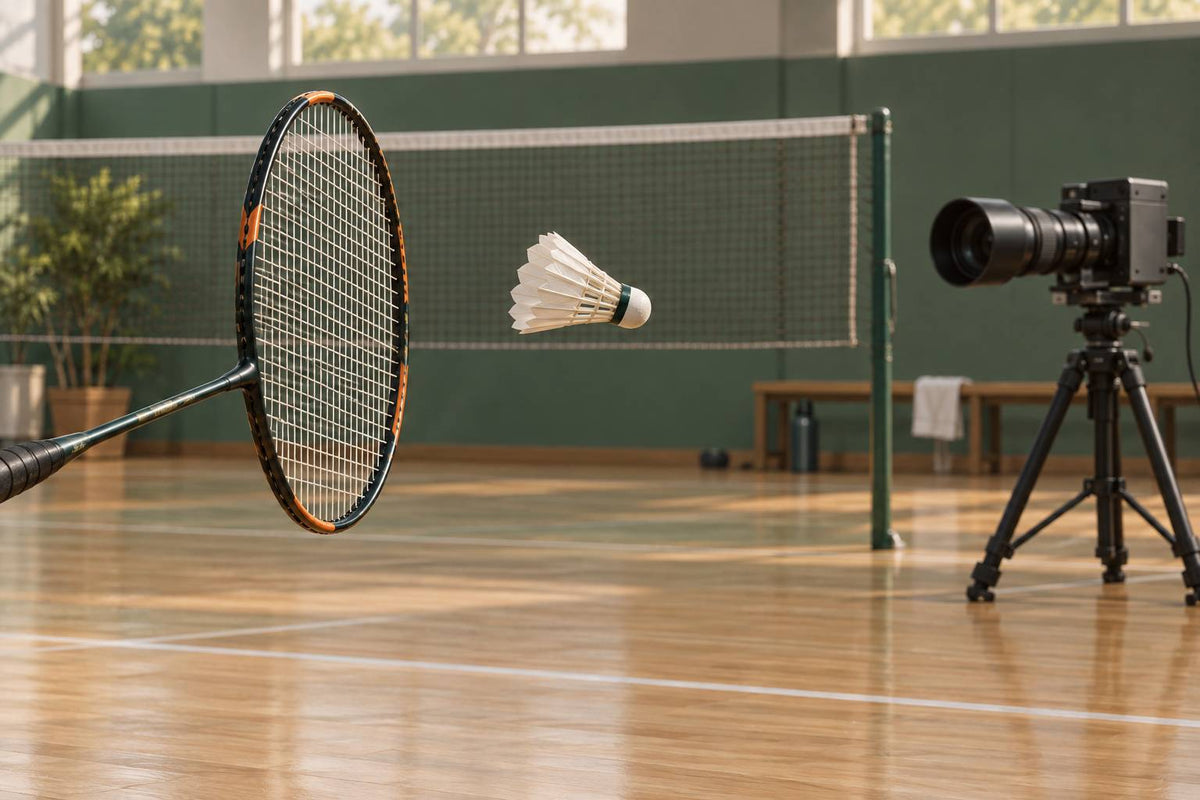
The two 2023 marks were set on the same day at the same venue: a gymnasium at Yonex's Tokyo Factory, where an ultrahigh-speed camera shooting 40,000 frames a second clocked the shuttlecock in the instant after it left the strings. Tan Pearly's 438 km/h women's record used the same rig and the same day. Kolding's 426 km/h, by contrast, is the one Guinness title that came from a real Badminton Premier League match, played in Bangalore rather than a test facility.
Before Rankireddy, the men's lab record was 493 km/h, set by Malaysia's Tan Boon Heong on 28 May 2013 in a gymnasium at a Yonex plant in Soka, Japan, the same city as the 2023 marks. An archived copy of Guinness's own page for this exact title names Tan Boon Heong at that speed and date, and Yonex's own account of Rankireddy's 2023 record independently states that the mark he broke had stood since May 2013 at 493 km/h. Guinness's live page today shows only the current holder, so the archive is what confirms the prior record rather than a page you can click through to now. The same 493 km/h range also shows up independently in badminton physics literature (more on that next); no source ties the two data points together directly, but they land in the same range.

What the two records do and do not measure
The 565 km/h figure measures speed immediately after impact. A shuttle slows rapidly in flight, but the competition record’s public entry does not state where its speed was measured, so the two records do not establish a measured drag loss.
A peer-reviewed shuttlecock aerodynamics study in the New Journal of Physics puts a number on that drag. Even at the highest initial shuttlecock speed the researchers found recorded anywhere in the literature (137 m/s, about 493 km/h), the shuttle's calculated maximum range is only 13.8 metres, barely past the court's own 13.4 metre length. Push the exit speed higher and the shuttle does not travel proportionally further: drag eats almost all of the extra pace before it matters, which is the physical reason a big exit-speed number does not turn into an equally big number by the time the shuttle reaches a defender.
A live rally adds a second constraint a factory test never faces: the shuttle still has to clear the net and land inside the lines. Our guide to smash angle physics covers how that requirement, not raw speed, is what actually shortens a defender's reaction window in a real point.
What this means for your smash
None of these records are a training target for a club player, and treating one as a benchmark misreads what they measure. The number that matters on your own court is racket-head speed at the instant of contact, plus how cleanly you strike the shuttle, not a marketing figure from a factory test rig you will never be tested on.
Build racket-head speed through a full, relaxed swing that only tightens the grip at contact, and get comfortable meeting the shuttle as high as your jump and reach allow. Both do more for a smash that actually wins points than any amount of arm strength aimed at a number on a page.
On defence, the same physics cuts the other way. Even a club-level smash has already shed most of its exit speed by the time it reaches you, so a good split step and early racket preparation beat trying to react to the shot itself. Reading the hitter's swing and getting your racket to the right side before contact does more for your return than raw reflexes ever will.
Before your next session
Skip the speed-gun mindset. Film one rally, watch where your contact point sits relative to your reach, and work on meeting the shuttle higher before you worry about swinging harder.


Leave a comment
This site is protected by hCaptcha and the hCaptcha Privacy Policy and Terms of Service apply.