
Last updated: July 2026 · Written by the team at Badminton House
Quick Answer: Badminton Racket Carbon Labels
Treat carbon labels as clues, not proof; choose by finished-racket specs and hitting feel first.
Read label
Translate, don't rank: identify whether the claim names grade, modulus, tonnage, or tow size.
Check context
Use a fibre datasheet or family reference, and do not treat higher modulus as automatically stronger or more durable.
Judge whole racket
Trust weight, balance, shaft flex, frame shape, string setup, and response on court before any carbon sticker.
When a racket says 40T, HM graphite, high modulus carbon, or 3K weave, do not treat the label like a skill-level rating. Treat it like one clue about the raw material, then ask the player questions that actually decide feel: does the racket swing fast enough in defence, load smoothly on clears, stay stable on off-centre hits, and feel comfortable at your usual string tension? Carbon labels can be useful, but they are easy to over-read because they rarely tell you the resin, layup, frame shape, shaft design, or manufacturing quality behind the finished racket.
In This Guide
What badminton racket carbon labels actually name
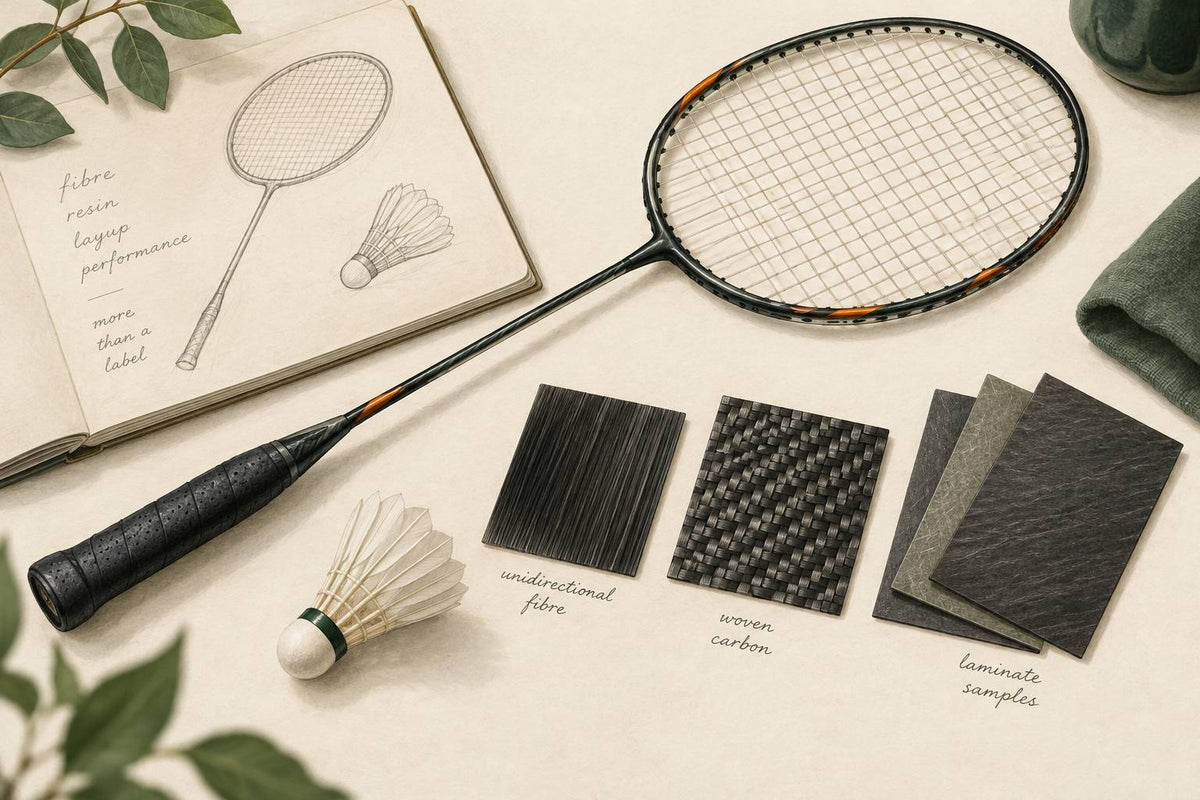
Labels such as fibre grade, modulus, tonnage, and 1K/3K/12K tow size usually name properties of the carbon fibre before it becomes a racket part. Toray’s TORAYCA data separates carbon fibre into standard-modulus, intermediate-modulus, and high-modulus families, and its published grade datasheets list fibre-specific numbers such as tensile strength and tensile modulus. Tow size is different again: it is the number of filaments in a bundle, not a quality ranking.
So when a racket advertises a carbon label, read it as a clue about the raw reinforcement being claimed. It does not, by itself, tell you the resin system, layup, molding, frame shape, drilling quality, or final playability of the racket.
Modulus, tonnage, and T claims are not a universal score
Toray’s published fibre families are useful context, but they are not a scoreboard for rackets. Its standard-modulus fibres sit around 230 GPa, intermediate modulus around 294 GPa, and high-modulus M-series grades go higher; that tells you mainly about fibre stiffness, not whether the finished racket is automatically “better.”
That is why market shorthand such as “40T” should be read as a stiffness cue, not a standardized quality ranking. Modulus and tensile strength are separate properties, so one number does not establish the other. The M-series shows the opposite trade-off clearly: M40J is listed at 377 GPa modulus and 4,400 MPa tensile strength, while M60J rises to 588 GPa modulus but drops to 3,820 MPa tensile strength.
So higher modulus can mean stiffer fibre, but not stronger fibre, more durability, or a feel you will prefer on court.

Why fibre grade alone cannot predict finished-racket feel
A raw carbon label names an input material, not the finished racket. In racquet composite testing, the meaningful tensile and flexural properties are measured on fibre-plus-matrix specimens: carbon fibre embedded in resin, cured into a laminate. That matters because the resin system and matrix choice affect how load moves between fibres, how vibration is damped, and how the structure fails.
Layup is just as important. Ply orientation, ply architecture, molding quality, and interlaminar bond strength can change stiffness, crack resistance, and durability even when the fibre label looks similar. Thin-ply, non-crimp laminate designs, for example, can suppress micro-cracks and delamination up to ultimate strength, which is a construction effect rather than a sticker claim.
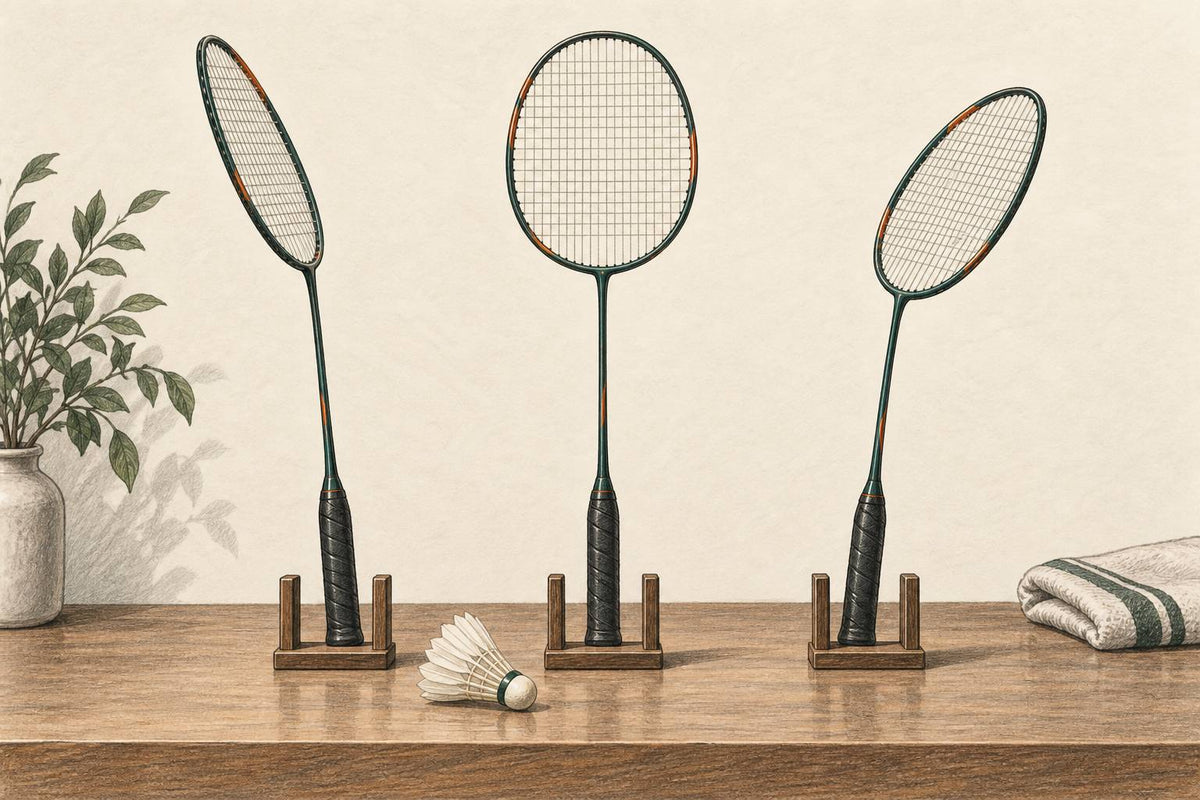
So when a racket feels crisp, whippy, muted, or harsh, do not credit the carbon grade alone. For the player-facing difference between shaft behaviour and material marketing, see our guide to stiff vs flexible badminton shafts.
How to read carbon hype without over-trusting it
Use carbon wording as a filter, not a verdict. The label can tell you what a brand wants to emphasize, but your decision should move from the sticker to the full racket.
Look for a claim you can verify. A named fibre grade can be checked against its maker's datasheet; vague phrases such as “advanced carbon” cannot. Even a verifiable grade only describes an input, so compare it with the racket's stated weight, balance, shaft behaviour, frame design, and recommended stringing range before drawing a player-facing conclusion.
If you're shopping, compare carbon labels only after narrowing by playing style and feel. Translate K-count as bundle-size language; if a claim says high modulus, ask where it is used and what else is specified; then judge the whole racket by weight, balance, shaft flex, frame shape, string setup, and on-court response.
Which Carbon Label Should You Trust?
If two rackets are in front of you, use the label as a clue, not the decision. The most reliable choice is still the racket whose full design matches your swing, timing, and preferred feedback.
| Choice | Use it when... | Do not assume... |
|---|---|---|
| Read label | Identify whether the wording names a fibre grade, modulus or tonnage claim, or K-count and tow size. | That the label is a universal quality ranking. |
| Check context | Verify a named grade against its maker's data and separate stiffness, strength, and bundle size. | That higher modulus means greater strength or durability. |
| Judge whole racket | Choose by weight, balance, shaft flex, frame shape, string setup, and on-court response. | That one fibre sticker explains the finished racket. |
Get 10% off your first order
Join the Badminton House list and we’ll email you a 10% welcome code — plus training guides, technique advice, and badminton updates.
By subscribing, you agree to receive Badminton House emails and can unsubscribe anytime.
We play badminton too, so our final advice is simple: treat carbon labels as clues, then judge the whole racket — weight, balance, flex, frame shape, strings, and how it feels in your hand. If you want a second opinion, reach us through contact.
Shop the whole racket, not just the label.
Browse Badminton RacketsCompare current racket options by the traits that affect play.


Leave a comment
This site is protected by hCaptcha and the hCaptcha Privacy Policy and Terms of Service apply.