
Last updated: July 2026 · Written by the team at Badminton House
Quick Answer: Badminton Racket Face Angle
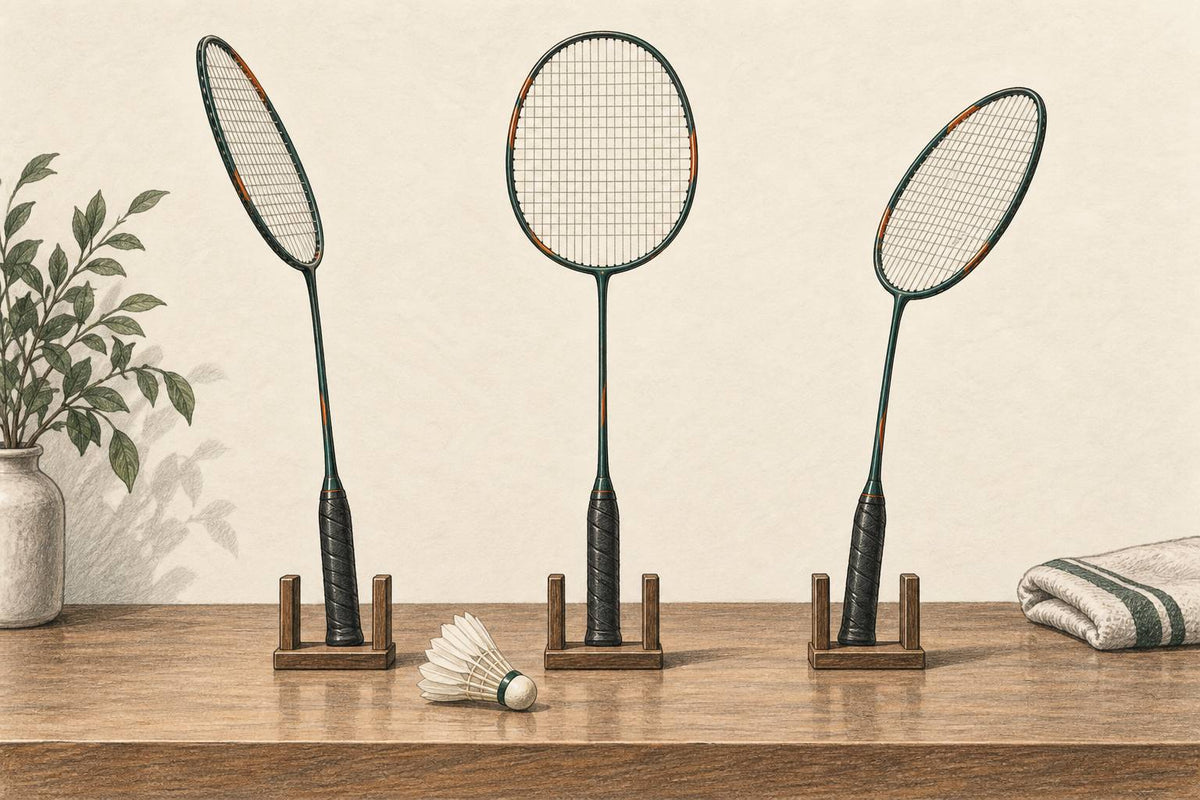
To control direction and height, start with a flat face, then open or close/slice it only when your contact point and shot goal demand it.
Flat
Default: Neutral reference; use it to feel where the strings are pointing before changing angle.
Open
Use when the shuttle must rise; keep the change small.
Closed/sliced
Use only for a deliberately lower or redirected flight, matched to contact point and swing path.
If your clear has power but lands mid-court, your net lift keeps sitting up, or your drive drifts into the tramline, do not only blame your swing. A small change in the racket face at contact can alter the shuttle's line and height, but the result still depends on contact point, swing path, and contact quality.
In This Guide
Why Face Angle Matters Most at Contact

Think of the racket face as the steering wheel for the shuttle. But it only steers at one instant: the moment the strings meet the shuttle. Before contact, your preparation can look identical; after contact, the shuttle is already reacting to the face angle, contact point, swing path, force, and whether the contact is clean or brushed.
That is why tiny changes can feel huge. A face that is only slightly more open can help the shuttle rise; a face that points a little downward can make it lose height early. Small changes in racket-face angle and contact point can noticeably affect the outgoing flight.
Good control is not just “hit harder” or “hit softer.” Players adjust racket angle and force together to send the shuttle far or near, high or low, straight or diagonal, depending on the tactical shot they want.
Control Direction: Flat, Angled, and Sliced Faces
When the face is nearly square to the shuttle’s path, the shot tends to travel straight ahead. That is useful on attacking clears and drives, where you want a clean, direct transfer instead of a brushed contact.
At the net, small tilts matter more. Turn the forearm so the strings face the corner you want: pronate inward on backhand angled net shots, and supinate outward on forehand angled net shots. For a right-handed player looking toward the net, backhand cross-court angles travel left-to-right and forehand cross-court angles travel right-to-left; the opposite corner usually needs more precision and a later face change.
For disguise, use double motion: show one face, withdraw slightly, then change the angle into the other direction. On slice shots, the face cuts diagonally across the shuttle; slice proper angles inward, while reverse slice angles outward. For the overhead version, see the slice drop shot guide, and for the body-language layer, see badminton deception technique.
Control Height: Open Face, Closed Face, and Shuttle Rise
Height control is not one fixed racket-face angle. It depends on your contact point, swing path, racket speed, and the shuttle’s orientation as it meets the strings. As a simple guide, a more open face can help the shuttle rise; a too-open face can make it float, wobble, or feel unstable instead of travelling cleanly.
The opposite mistake is closing the face too much for the intended outgoing line. If the strings point too far downward at impact, the shuttle can lose height early, so a lift may become short even when your arm action feels correct.
For net shots, meet the shuttle as close to the top of the net as possible, let it bounce off the face with little pace, then keep the racket moving upward along the shuttle’s path. On a low serve, face the strings toward the intended direction, but avoid gripping too tightly; that can send the serve too high and too far.
Use Contact Point to Choose the Right Face Angle
Before you think about “opening” or “closing” the face, ask where the shuttle is relative to your body. Use this quick check:
- Clear: contact high and in front, then let the face send the shuttle high and deep. If your clears fall short, review the full badminton clear technique.
- Smash: contact a little in front because the shuttle must travel down. The higher you meet it, the steeper the angle; low contact usually becomes a flatter defensive drive, not a true steep smash. See the smash angle breakdown.
- Drop: prepare like a clear, take power out at the last moment, and contact slightly farther forward so the face can guide the shuttle down.
- Underarm lifts and net replies: a controlled open face helps the shuttle rise; a tight grip blocks adjustment, while a loose grip can wobble. Use relaxed-to-firm timing from this grip pressure guide.
Which Face Angle Should You Choose?
Pick the face angle from the shot you want, not from one fixed rule. Contact point, swing path, and shuttle orientation still decide how cleanly the angle works.
| Choice | Choose this if... | Key check |
|---|---|---|
| Flat face | You want the shuttle to travel straight ahead, such as on drives or attacking clears. | Keep the strings pointing through the intended line at contact. |
| Open face | You need the shuttle to rise, especially from a low position. | Avoid over-opening it; the shuttle can float instead of travelling cleanly. |
| Closed face | You deliberately want a lower outgoing line and your contact point and swing path already support it. | Use a small adjustment, not one fixed tilt for every smash or drop. |
| Sliced face | You want spin, a changed trajectory, or cross-court deception. | Brush diagonally across the shuttle path rather than striking straight through it. |
Get 10% off your first order
Join the Badminton House list and we’ll email you a 10% welcome code — plus training guides, technique advice, and badminton updates.
By subscribing, you agree to receive Badminton House emails and can unsubscribe anytime.
Face angle is a feel skill: small changes only matter when your contact point, swing path, and grip pressure support them. We play badminton ourselves, so if you are unsure whether your racket setup is helping or hiding your touch, contact us for practical advice.
Want a racket that suits your control game?
Browse badminton rackets with balance, weight, and feel in mind — then ask before you choose if you need a second opinion.
Explore Badminton Rackets

Leave a comment
This site is protected by hCaptcha and the hCaptcha Privacy Policy and Terms of Service apply.