

Last checked: August 2026 · Written by the player-led team at Badminton House
Quick answer
Racket clashes cluster at the mid-court seam because side by side is the standard doubles defensive shape, and opponents are coached to smash or drop straight down that seam on purpose. Pre-decide who takes the middle before the rally, usually whichever partner's forehand reaches it without crossing the body, call the shot the instant it is clear, and keep net swings compact.
- Agree who owns the middle before you start playing, not during the rally.
- Call "mine" or "yours" the moment you read the shot, and trust the call.
- After any clash, check your hand and the frame before the next point.
Why doubles racket clashes happen
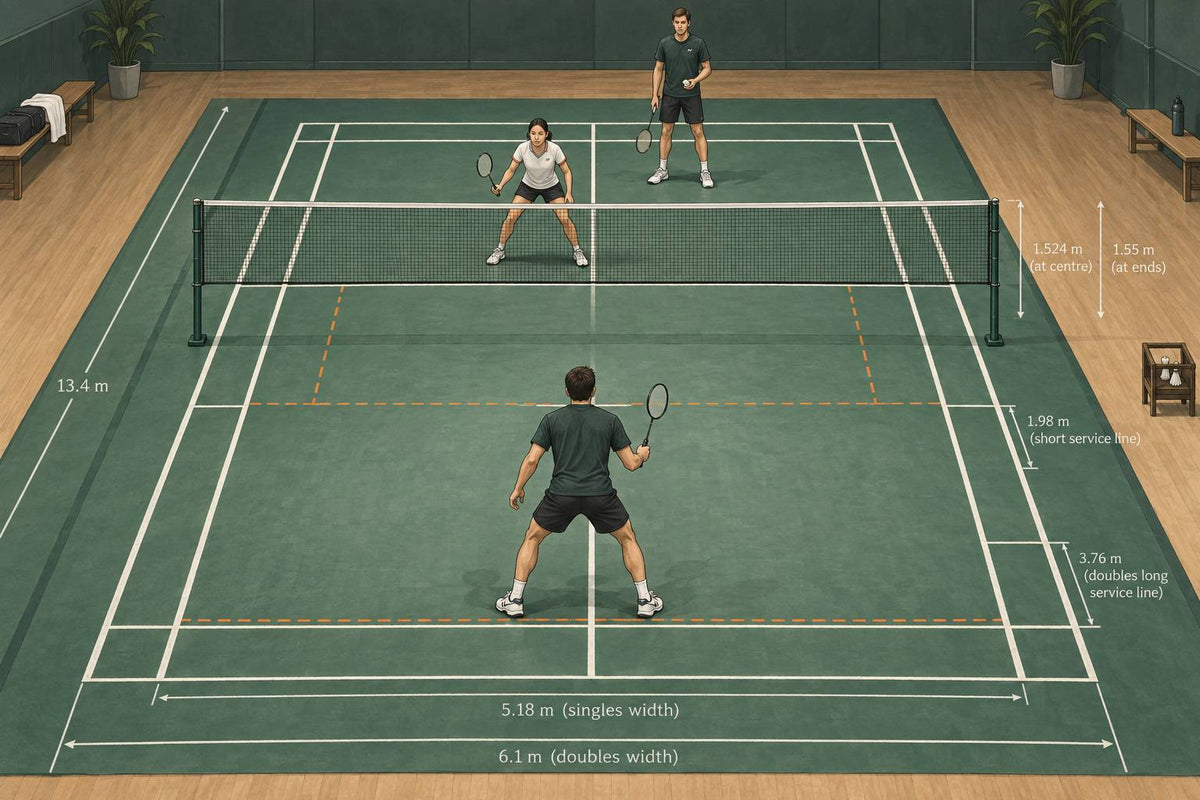
Racket clashes cluster at the mid-court seam because side by side is badminton's standard defensive shape, and coaches teach attackers to smash or drop straight down that seam on purpose. A shot between the defenders can leave both unsure who should play it, so their rackets may arrive at the same spot together.
This is not an accident of poor play. BWF coach education confirms that men's and women's doubles both use side by side as their defensive formation, and it coaches rearcourt attackers to aim smashes and steep drops "at the straight player or to the middle of the two players, to force a weak return or hit a winner." Cutting the angle of return is the point of the shot. Two defenders converging on one shuttle is the deliberate side effect.
Regular partnerships settle who owns the seam without ever discussing it out loud. Randomly paired drop-in partners rarely have that history, so agreeing who handles a reachable middle shuttle is particularly useful: the pair may not yet share that understanding. Once the shuttle is flat and fast (the kind of exchange covered in our doubles flat rally positioning guide), there is no time left to negotiate mid-rally.
Three rules that prevent most clashes
Three positional habits remove the main cause of racket clashes before a rally even starts: deciding who owns the middle in advance, calling the shot out loud the instant it is clear, and keeping net swings compact enough that stepping in does not put your racket where your partner's hands are. None of the three rely on faster reflexes.
- Default the middle to one player. A workable rule from doubles coaching: the partner whose dominant-hand racket can reach the middle without crossing the body takes it. For a typical right-handed pair facing the net side by side, that is usually the player on the left, whose forehand faces the middle.
- Call it early, and trust the call. The clash usually happens when both players go for the shuttle, arrive at the same moment, and each pulls the shot to avoid hitting the other's racket. Coaching from Shuttle Lab frames the fix directly: pre-decide who takes the middle, then have the other player stop reaching for it the moment a call is made.
- Shorten your swing at the net. When both partners are pressing forward on a tight net exchange, a full backswing is what puts a racket into your partner's space. A short, compact swing at the net is standard technique anyway, and it happens to be the version that keeps your racket in front of your own body instead of swinging into your partner's.
These three habits are positional, not reflex-based. You cannot out-react a shuttle that is already closer to your partner than it is to you; you can only make sure you were never both moving for it in the first place.

After a clash: check hands, fingers and the frame
A racket clash rarely ends the point cleanly, so check three things before you serve again: how your hand and fingers feel, whether either frame took real damage, and whether any cut near the face needs more than a wipe. None of this requires a diagnosis, only a clear line for when to stop and get it looked at.
An impact can cause knuckle and finger bruising, but symptoms alone cannot rule out a fracture. The American Academy of Orthopaedic Surgeons lists swelling, tenderness, bruising, inability to move the finger completely, and visible deformity among the signs of a finger fracture. Stop playing and seek prompt assessment for rapid swelling, a crooked or shortened appearance, numbness, or an inability to move the finger through its normal range. A deep facial cut or bleeding that does not stop with firm direct pressure needs urgent care.
Inspect both frames before the next point, not after the session. A racket does not need a visible scratch or dent to have taken damaging force; carbon can hold hidden internal damage that only shows up as a sudden failure later. Racket manufacturer Global Carbon Sports names racket clashes among the leading causes of frame cracks and lists the signs that mean stop using it now: a visible opening in the frame or shaft, a soft spot near the impact point, a change in sound compared with the undamaged side, and any warping or sink-in near the grommet holes. Structural cracks, including ones caused by a clash, are generally a replacement decision rather than a repair. Run through the fuller repair-or-replace checklist in our guide to when to replace a badminton racket if the frame looks borderline.
Before your next drop-in session
If you are paired with someone new, spend ten seconds before the first rally agreeing who takes the middle. It feels unnecessary right up until the first flat exchange down the seam, and by then it is too late to negotiate. That one sentence prevents more clashes than any amount of quick hands.


Leave a comment
This site is protected by hCaptcha and the hCaptcha Privacy Policy and Terms of Service apply.