
Last updated: July 2026 · Written by the team at Badminton House
Quick Answer: Box vs Aero Frames
Compare the complete racket if you want both manageable handling and a predictable hit; a hybrid label alone does not guarantee that balance.
Hybrid
Best choice: a design approach worth comparing when both handling and impact feel matter.
Box
Choose box if you value torsional stability, a solid impact response, and a solid impact feel more than maximum swing speed.
Aero
Choose aero if quick defence, drives, and reduced swing effort matter more than the most planted off-centre response.
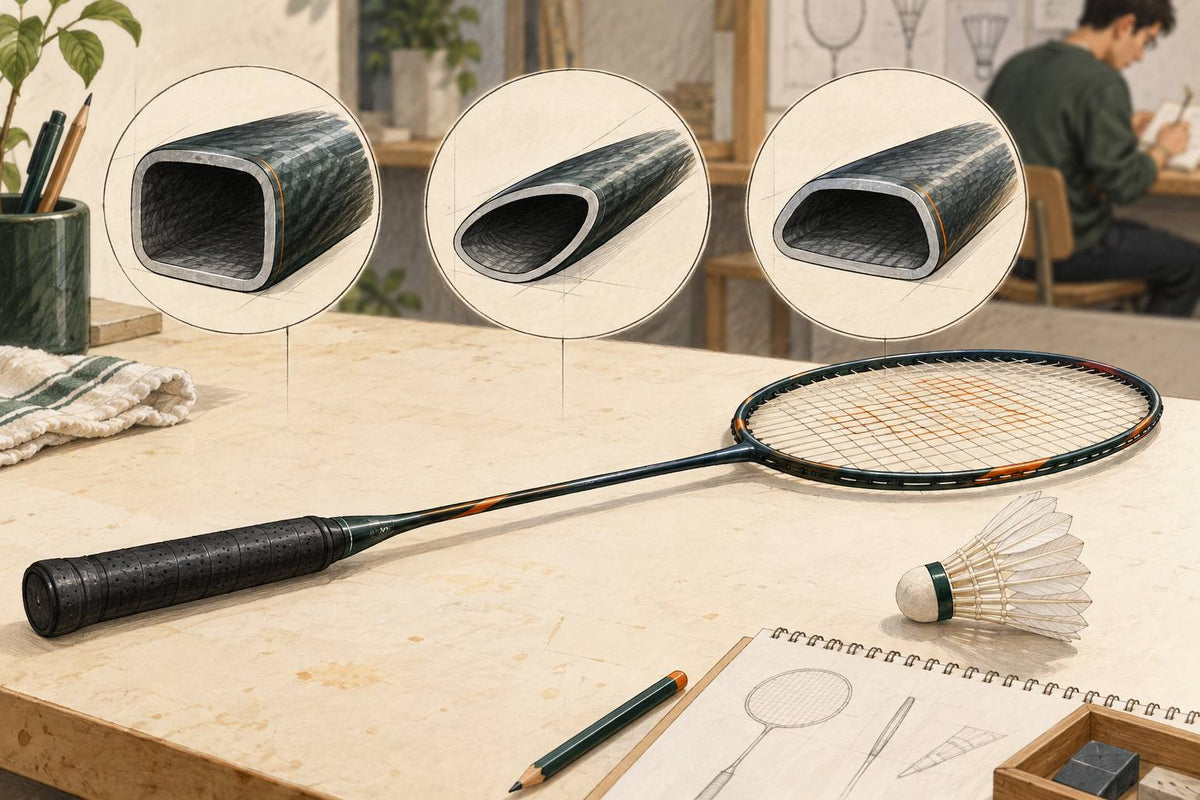
When two rackets share the same weight and balance, the frame cross-section can still make one feel steadier and the other feel quicker. A box frame usually gives a more solid, controlled response when the shuttle lands slightly off-centre. An aero frame cuts through air with less resistance, which can help in fast defence, flat drives, and quick grip changes. The tricky part is that faster is not automatically better if your timing or accuracy drops. This guide breaks down the box frame vs aero frame badminton racket choice in plain player terms, then shows where hybrid frames fit.
Compare options without guessing. Browse our badminton rackets collection to check live availability while you read the guide.
In This Guide
What a Badminton Racket Frame Cross-Section Changes

A badminton racket’s frame cross-section is the shape you would see if you sliced through the frame: boxy, wing-like, rounded, thin, or some hybrid of those ideas. It is a separate design variable from the racket’s material, balance point, shaft flex, string tension, and head shape. Those factors still matter, but the frame profile has its own job.
In simple terms, frame geometry changes two things players can actually feel: how easily the racket moves through the air and how solid it feels when the shuttle hits the strings. The main tradeoff is aerodynamic drag during the swing versus structural rigidity at impact. A sharper aero profile can feel quicker through drives and defensive blocks; a more box-like profile can feel steadier when the hit is slightly off-centre.
If you are still sorting out the bigger racket variables first, start with our badminton racket choosing guide, then use frame shape as a finer tuning point.
Box Frames: Stability, Control, and Solid Impact Feel

A box frame uses a rectangular or square cross-section with rounded corners. That fuller shape can support a stiff design, but rigidity also depends on materials, wall thickness and orientation, which is why many players describe box-section rackets as solid, direct, and predictable at impact.
The practical benefit shows up when contact is not perfectly centred. A stiffer box structure resists twisting better, so the racket face is less likely to deflect on mishits. That can make clears, blocks, and placement shots feel more controlled, especially for players who value feedback over maximum swing speed. A box-shaped profile does not establish a racket’s tension limit; follow the exact model specification.
The tradeoff is air resistance. A bulkier cross-section pushes more air than a sharper aerodynamic profile, so it can feel slower through quick exchanges. If your priority is a crisp, control-oriented hit, that slower swing impression may be worth it.
Aero Frames: Faster Swings, Lower Drag, and Maneuverability

An aero frame, or wing frame, uses a thinner, flatter cross-section than a box frame. Depending on the racket, the profile may look teardrop-shaped, sword-like, or airfoil-like, with the goal of helping the head cut through the air instead of pushing as much air in front of it.
That lower drag is the main reason aero frames feel quick. Sharper profiles can reduce swing resistance compared with bulkier profiles, so repeated blocks, interceptions, and flat drive exchanges demand less effort from the hand and forearm. In fast doubles defense, that can mean getting the racket face into position a fraction earlier, especially when you are changing from forehand to backhand under pressure.
The tradeoff is impact feel. A very sharp aero profile may not feel as solid or direct as a box frame, and severe off-centre hits can send more unpleasant vibration into the hand. Choose the speed only if you can still control the shuttle.
Hybrid Frames: Why Many Rackets Mix Box and Aero Ideas

Hybrid frames are best understood as compromises, not automatic upgrades. Instead of making the whole head one shape, brands tune different parts of the frame for different jobs: a box-style section near the T-joint can add torsional stability where the shaft meets the head, while aero sections around 3 and 9 o’clock can reduce drag in those frame regions, and trapezoidal or other hybrid sections may appear elsewhere to balance speed and solidity.
That is why manufacturer language often sounds like “blend” or “integration.” Victor’s AERO-DIAMOND combines diamond-shape controllability with sword-shape stability and smoothness, while Victor also describes POWER-BOX, DIAMOND, AERO, and AERODYNAMIC structures being integrated through simulation; its ultra-thin description is a manufacturer-specific comparison, not a universal measure of all aero frames. Yonex uses similar ideas: AERO+ BOX Frame targets solid feel with quick swing, Duora used a box/aero dual-face concept, and Nanoflare positions its aero frame around speed.
How to Choose Between Box, Aero, and Hybrid Frames

Start with the miss you want to reduce, not the marketing name on the frame. A twisting, off-centre feel at higher tensions points toward more torsional stability; a racket that feels heavy to whip through fast exchanges points toward less drag. Mixed-profile designs are one approach to this balance, but materials, wall construction and mass distribution also affect the result.
The table below breaks down which frame style fits which priority and what you give up with each choice — frame shape works best as a tie-breaker once the rest of your racket spec is already settled.
Which Should You Choose?
Use frame shape as a tie-breaker after you know your preferred racket weight, balance, shaft flex, string, and tension. The right choice is the one that supports your normal swing under pressure.
| Frame style | Choose it if... | Accept this tradeoff |
|---|---|---|
| Box | You want solid impact feedback, torsional stability, predictable control, and a solid impact response; check the model’s actual tension rating. | More air resistance, so rapid exchanges can feel slower. |
| Aero | You play fast doubles, defend often, or want less swing effort over long rallies. | Less direct feel and more vibration risk on severe off-centre hits. |
| Hybrid | You want a designed compromise: stability in key sections with faster-moving aero zones. | It is still a compromise, not automatically the best option. |
Get 10% off your first order
Join the Badminton House list and we’ll email you a 10% welcome code — plus training guides, technique advice, and badminton updates.
By subscribing, you agree to receive Badminton House emails and can unsubscribe anytime.
Frame shape is one detail, but the best racket still has to match your timing, swing path, and shot priorities. We play badminton and can help you sort through box, aero, and hybrid options without overcomplicating it. If you want a second opinion, contact us with your level and current racket.
Ready to compare rackets by feel, speed, and control?
Browse Badminton RacketsCheck live availability and choose based on how you actually play.


Leave a comment
This site is protected by hCaptcha and the hCaptcha Privacy Policy and Terms of Service apply.