
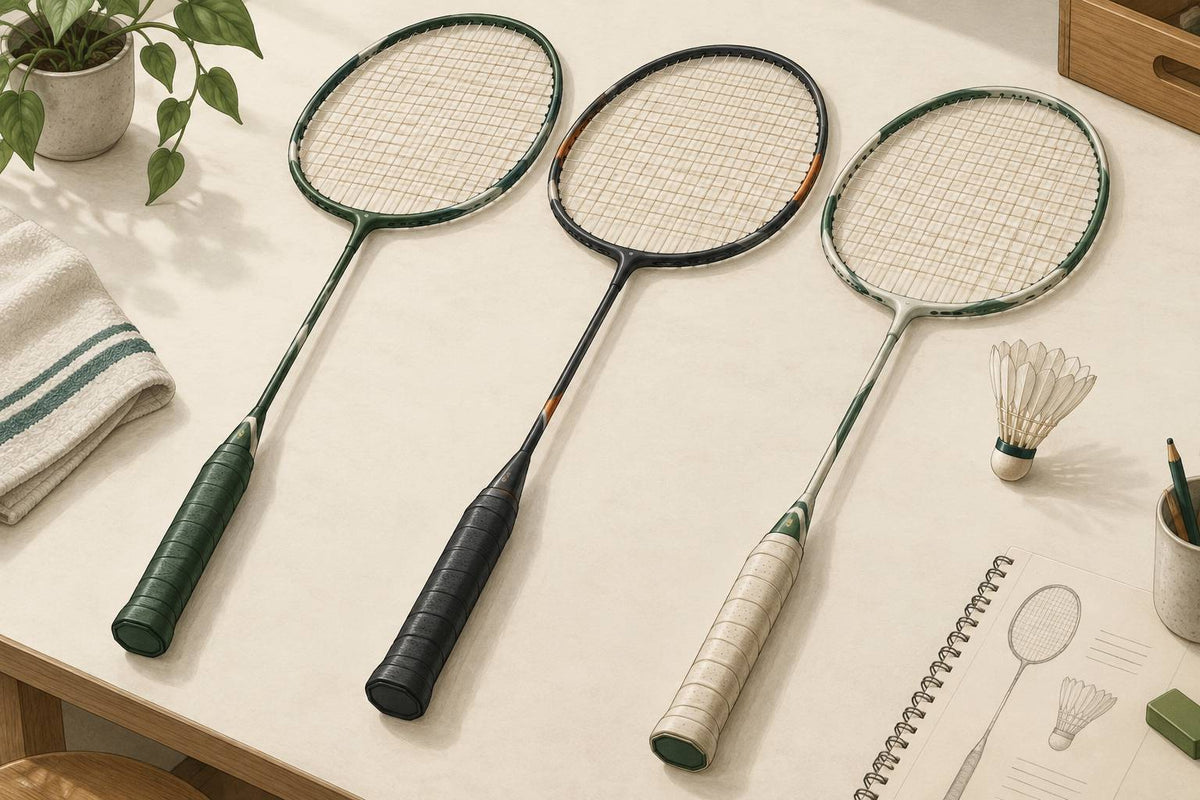
Last updated: July 2026 · Written by the team at Badminton House
Quick Answer: How to Choose a Badminton Racket
If you do not know which badminton racket to buy, start by trying a 4U, even-balance, medium-flex, isometric racket with a grip that fits your hand. That setup is forgiving enough for beginners and still useful for regular club play.
Default
Starting point: try 4U, even balance, medium flex, an isometric head and a comfortable grip, then compare alternatives using normal rallies.
Power
Choose 3U-4U, head-heavy, medium-stiff to stiff if you play singles, hit from the rear court, and can swing the extra mass cleanly.
Speed
Choose 4U-5U, head-light or even balance, medium flex if you play fast doubles or want quicker reactions in defense.
The right badminton racket is the one your swing can load and control. Six specs shape that feel: weight, balance, shaft flex, head shape, grip size, and whether you mostly play singles or doubles. This guide explains each spec in plain language so you can stop guessing from model names and choose a racket that fits how you actually play.
Best for first racket
Use the default all-round setup, then adjust once your swing and game type are clearer.
Best for singles power
Prioritize mass and a head-heavy balance if you can swing it without fatigue.
Best for doubles speed
Prioritize a lighter, faster frame for drives, blocks, and quick net reactions.
Ready to compare specs? Browse badminton rackets from Yonex, Victor, and Li-Ning, then use this guide to match weight, balance, flex, and grip to your game.
In This Guide
What Are the Parts of a Badminton Racket?
Before comparing specs, know what you are looking at. Most racket listings mention the head, shaft, balance, grip, and tension range; those details tell you more than the colour or series name.

|
Head (Frame) The string-bed frame. Shape and size determine your sweet spot. |
Shaft Thin tube between head and handle. Its stiffness changes how the shaft bends and feels during the swing. |
|
T-Joint Connects shaft to head. The cone is a separate tapered part immediately above the handle. |
Handle & Grip Where you hold it. Grip size (G4–G6) affects wrist control and comfort. |
6 Specs That Define How a Badminton Racket Plays
Weight
The U rating (2U–6U)
Compare swing effort and recovery; weight alone does not determine shot speed.
Balance
Where the weight sits
Relative mass distribution changes handling; try the complete setup.
Shaft Flex
How much it bends
Flex changes shaft response; the preferred feel depends on timing.
Head Shape
Isometric vs oval
Compare head outlines and contact feel; shape alone does not guarantee power.
Grip Size
G4, G5, or G6
Choose a comfortable size that allows relaxed grip changes.
Singles vs Doubles
Different game, different specs
Consider your shots and recovery speed in both formats.
1. How Do You Pick the Right Racket Weight (the "U" System)?
Badminton racket weight is graded by the U system: 3U is 85–89 g, 4U is 80–84 g, and 5U is 75–79 g unstrung. The lower the U number, the heavier the racket. If you are wondering how to pick the right badminton racket weight, start with your swing speed: choose heavier only if you can still recover quickly after clears, smashes, and defensive blocks. These three weights cover almost every racket on Canadian shelves (for a deeper breakdown, see our guide to 3U, 4U and 5U racket weights):
Heavy
3U
85–89g unstrung
Power
More mass behind smashes and full-court clears. May require more effort to accelerate and recover.
Best for: Singles attackers, power hitters
Most Popular
4U
80–84g unstrung
All-Round
Balanced power and speed. A common starting point for comparing club rackets.
Best for: Most players, singles and doubles
Light
5U
75–79g unstrung
Speed
Lower static weight can feel easier to manoeuvre; balance and setup also matter.
Best for: Players who prefer a lighter setup
Also available: 2U (90–94.9g) and 6U (70–74.9g) in the usual 5g classes. Strings and added grip material increase the finished weight.
2. Head-Heavy, Even, or Head-Light — Which Balance?

Two rackets can weigh the same but feel different. Balance point is measured from the handle butt, but there is no universal millimetre cutoff shared by every brand; strings and grip changes shift the reading. Our head-heavy vs head-light balance guide explains the handling tradeoffs.
Head-Heavy
Farther from handle
balance point
Power
More mass toward the head changes swing effort and recovery.
Best for: Attacking singles, rear-court, smash-heavy
Even Balance
Relative midpoint
balance point
Versatile
Decent power and decent speed. Adapts to any situation.
Best for: All-rounders, developing style, mixed play
Head-Light
Nearer handle
balance point
Speed
Less relative head mass can feel quicker to reposition.
Best for: Doubles front-court, defensive, fast-reflex
Not sure? Start even-balance. Move to head-heavy once your swing is consistent enough to use the extra mass.
3. What Shaft Flex Should You Choose?

The shaft bends during the swing. Flexible, medium and stiff are relative manufacturer ratings, not guaranteed power or accuracy levels. Compare feel using similar strings, tension and grip; our stiff vs flexible shaft guide explains the practical differences.
Beginner
Flexible
high shaft bend
Forgiving
More shaft deflection; test whether its response suits your swing timing.
Best for: New players, casual, developing technique
Intermediate
Medium
moderate shaft bend
Balanced
A relative middle flex rating, useful as a comparison point.
Best for: Club-level, regular competitive players
Advanced
Stiff
minimal shaft bend
Precise
Less shaft deflection; test the contact feel and swing timing.
Best for: Competitive and tournament-level players
Extra-stiff is another relative rating. Choose the response that suits your current swing rather than treating stiffness as a skill badge.
4. Isometric or Oval Head Shape?

Isometric heads have gently squared shoulders; conventional oval heads are rounder. Manufacturers describe their own string-bed designs, so avoid assigning a universal sweet-spot percentage or power advantage to every racket of either shape.
|
ISOMETRIC (Square) |
OVAL (Conventional) |
|
Squared shoulders isometric outline Gently squared upper shoulders alter the string-bed outline; exact contact behaviour depends on the model and string setup. |
Rounded outline conventional oval Traditional oval outline; centre-contact feel depends on the complete racket and string setup. |
|
Best for: Most players, especially beginners & intermediates |
Best for: Advanced players with consistent centre hits |
5. What Grip Size Do You Need?
In Yonex’s common G4–G6 options, the higher number indicates a smaller handle. Grip codes, available sizes and finished circumference vary by brand and added grip material; try the actual setup.
Large
G4
Larger than G5 in this system
Spacious
More grip area for players with larger hands. Less common in retail.
Best for: Players with larger hands
Standard
G5
Between G4 and G6
Try for fit
A common listed option; circumference and availability vary by brand and market.
Best for: Players comfortable with this size
Small
G6
Smaller than G5 in this system
Compact
A smaller starting circumference leaves more room to build with an overgrip.
Best for: Smaller hands, juniors
Fit check: hold the racket in your normal playing grip and practise relaxed forehand–backhand changes. Avoid needing a constant hard squeeze. Compare actual grip sizes in hand; pencil and finger-gap tests are rough cues, not universal measurements. Between sizes, a smaller base can be built up with an overgrip.
6. Do Singles and Doubles Need Different Rackets?
Your game type changes which specs matter most. Singles gives you more full swings and rear-court hitting; doubles rewards fast racket recovery, drives, blocks, and net interceptions.
|
SINGLES |
DOUBLES |
|
Weight: 3U – 4U Balance: Head-heavy or even Flex: Medium-stiff to stiff Priority: Power + court coverage |
Weight: 4U – 5U Balance: Even or head-light Flex: Medium Priority: Speed + quick reactions |
|
Full-court movement, powerful clears and smashes. Mass behind every shot matters. |
Fast drives, net kills, defensive blocks. Reaction time beats raw power. |
Get Gear Checklist and Restock Alerts
Check current shipping and return policies before ordering.
Should You Buy a Carbon, Aluminum, or Steel Racket?
Full graphite frames often provide a lighter starting point and published model specifications. Metal recreational rackets can suit introductory play too. Check the actual weight, fit and manufacturer’s restringing advice rather than inferring safe tension from material alone.
| Frame material | What you get | Verdict |
|---|---|---|
| Full graphite (carbon fibre) | Check the model’s weight, flex, balance and recommended stringing range | A practical option to compare for regular indoor play |
| Aluminum head, steel shaft | Check actual finished weight and the manufacturer’s restringing instructions | Can suit introductory play if the size and handling work for you |
| One-piece steel | Often used in basic recreational sets; compare weight and build quality | Assess the actual racket instead of inferring suitability from material alone |
Compare the actual setup: a low price does not establish whether a racket suits you, and an expensive frame does not replace technique. Prioritise comfortable handling and reliable model specifications.
How Much Should You Spend on a Badminton Racket in Canada?
Use the following CAD amounts as illustrative shopping budgets, not current price quotes or guarantees about construction. Check the actual model’s material, weight and included stringing before buying:
| Price tier (CAD) | What your money buys | Who it's for |
|---|---|---|
| Under ~$60 | Check material, dimensions and included stringing; price alone is not a specification | A limited budget; compare individual models |
| $60–$120 | Compare entry models with published weight, flex and stringing advice | First racket, casual club players |
| $120–$200 | Compare the extra features with the fit and handling you actually need | Improving club and league players |
| $200+ | Check whether the extra cost buys a preferred specification and whether stringing is included | Competitive players who already know their specs |
Our advice: set a budget, prioritise comfortable handling and compare the actual model details in our badminton racket collection, including whether strings and fitting are included.
What Do Racket Series Names Mean? (Astrox, Nanoflare, Thruster…)
The series table gives broad marketing orientations, not a complete specification. Read each model’s weight, flex and balance because rackets within a family differ.
| Playing style | Yonex | Victor | Li-Ning |
|---|---|---|---|
| Power (head-heavy) | Astrox | Thruster | Axforce |
| Speed (head-light / fast frame) | Nanoflare | Auraspeed | Bladex, Windstorm |
| All-round (even balance) | Arcsaber | DriveX | Halbertec |
Bladex and Windstorm sit within Li-Ning’s speed-oriented marketing, but check each model’s actual weight and balance. Model numbers are identifiers, not a universal price or performance ladder.
Going deeper on Yonex? Our best Yonex rackets in Canada guide ranks specific Astrox, Nanoflare, and Arcsaber models with model comparisons.
What String Tension Should You Ask For?
String tension is measured in pounds (lb). Start within the exact model and weight variant’s recommended range, then compare small changes using the same string. A higher number does not automatically improve control, and lower tension does not guarantee more power.
| Step | What to compare |
|---|---|
| Read the model limit | Use the correct racket and weight variant’s recommended range. |
| Record the baseline | Keep the string, tension, grip and shuttle type in your notes. |
| Change one variable | Try a small adjustment within the manufacturer’s range and compare normal rallies. |
| Reassess comfort | Stop if play is painful; equipment selection does not diagnose or treat symptoms. |
Check the model’s limit: use the manufacturer’s current stringing instructions, including the correct weight variant, and ask a qualified stringer if the frame is damaged or specifications are unavailable. Factory stringing and warranty terms vary by model and region. For example, Yonex lists 5U NANOFLARE 001 FEEL at 20–27 lb in its official specifications.
Test before you buy: a racket's feel changes dramatically with tension, so borrow a clubmate's racket that matches your target specs (or ask at your club's demo night) before committing. Ten minutes of real rallies tells you more than any spec sheet.
Quick Decision Guide
| If you... | Choose |
|---|---|
| Are buying your first racket | Try 4U–5U, even balance, flexible–medium, isometric; choose grip by fit |
| Love smashing (singles) | 3U–4U, head-heavy, medium-stiff to stiff |
| Play fast doubles | 4U–5U, head-light, medium |
| Want versatility | 4U, even-balance, medium |
| Find the racket uncomfortable | Stop painful play and reassess technique, workload and equipment; persistent symptoms need qualified assessment |
What we'd pick off our own wall (July 2026)
Series names provide broad orientations; confirm the individual model’s specifications. We recommend series rather than single models because stock and budgets vary, but this is where we point Canadian players first.
| You are... | Specs we'd pick | Series we'd look at first |
|---|---|---|
| Buying a first racket | Try 4U, even balance, flexible–medium; choose grip by fit | Yonex Arcsaber, Victor DriveX |
| A singles player who smashes | 3U–4U, head-heavy, medium-stiff | Yonex Astrox, Victor Thruster, Li-Ning Axforce |
| A doubles player living at the net | 4U–5U, head-light, medium | Yonex Nanoflare, Victor Auraspeed |
Still unsure? Contact us with your skill level, playing style, and budget — we'll recommend the right racket for your game.
From the Badminton House stringing bench
The finished racket includes strings and grip material, so compare it as you will actually play. When borrowing or testing rackets, record string, tension and grip differences before attributing all of the feel to the frame. The 2026 Yonex catalogue provides model-specific weight, flex and stringing references.
Badminton Racket FAQ
Canadian badminton specialty shop; check current shipping and return policies before ordering.
Get 10% off your first order
Join the Badminton House list and we’ll email you a 10% welcome code — plus subscriber-only restock alerts, giveaways, and honest gear advice from players.
By subscribing, you agree to receive Badminton House emails and can unsubscribe anytime.

Leave a comment
This site is protected by hCaptcha and the hCaptcha Privacy Policy and Terms of Service apply.