
Last updated: July 2026 · Written by the team at Badminton House
Quick Answer: T-Joint vs One-Piece Frames
If you are comparing rackets, treat a visible external T-joint as a budget-construction clue, not a performance feature.
Default
Best choice: consider a modern composite frame with an integrated junction because this area manages shaft-to-head stress and off-centre twisting.
External
Older connector: often found on low-cost casual rackets; it joins separate head and shaft parts, but can add head weight and may loosen if cheaply made.
Ignore
Fine print: do not choose by “T-joint tech” alone; weight, balance, shaft flex, and grip size will affect your play more.
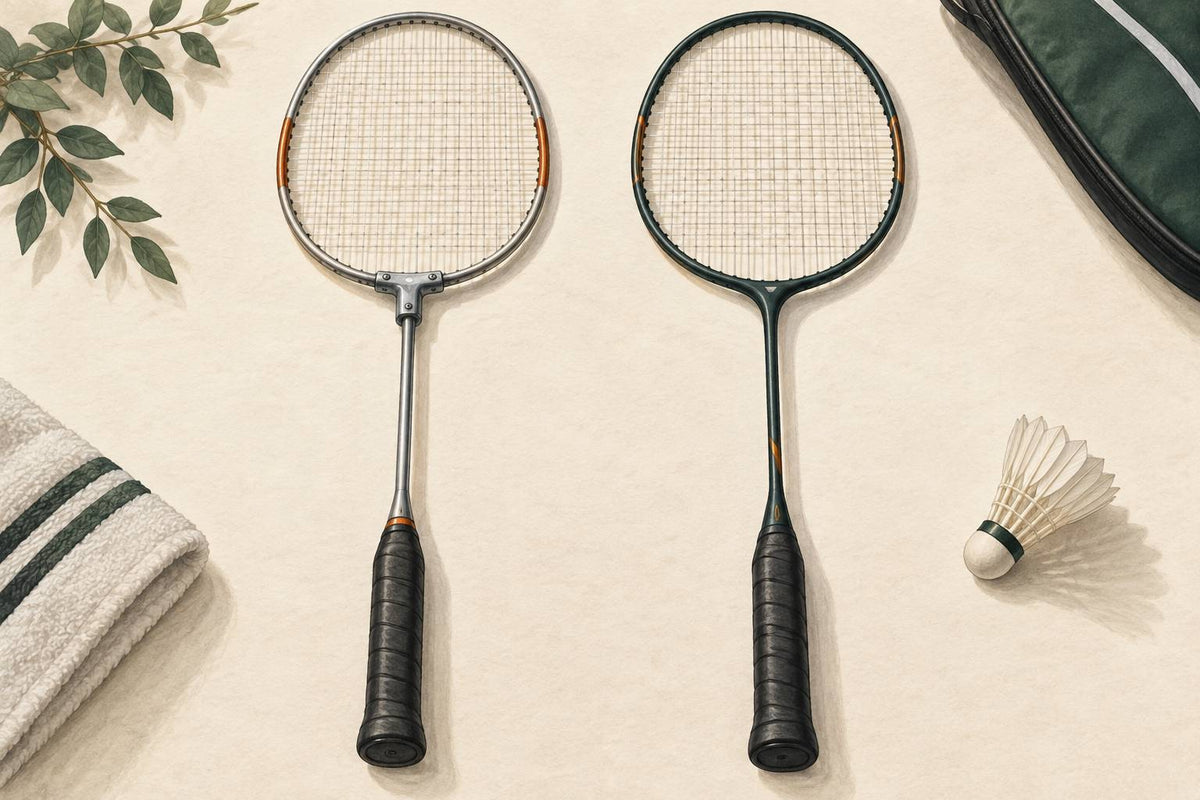
If you’re comparing rackets and see “T-joint” in the description, read it as a frame-construction clue, not a separate part you need to tune. The T-joint is the junction where the shaft meets the racket head, and it carries impact forces from the head into the shaft. On older traditional builds, that area used a visible connector joining the hoop and shaft. On many modern frames, the junction has a smooth integrated exterior, with manufacturers using that region to manage strength, weight distribution, and twisting on off-centre hits. This guide explains what that difference actually means before you choose a racket.
Comparing frame construction? After you understand the joint, check live availability in our badminton rackets collection.
In This Guide
What the T-joint actually does

The T-joint matters because shuttle impact loads do not stay neatly in the strings or the racket head. The head bends and twists, then that force has to pass into the shaft — and that junction becomes the main handoff point between the hitting surface and the handle-side structure.
An engineering badminton racket patent describes impact forces travelling from the head to the shaft through the T-joint, with the joint geometry turning much of that load into torsional stress. That is why this region is often discussed in terms of twisting resistance, not just simple strength. A separate shaft-physics analysis also models most of the resulting shaft-end motion at the top end of the shaft, where it meets the head at the T-joint. This describes a load path and a simplified model, not proof that one joint label guarantees better play.
External T-joints: the older connector-based design

A traditional external T-joint racket is built from three main pieces: a head hoop, a shaft, and a T-shaped tubular connector. The two lower ends of the head slide into the side sleeves of the connector, while the shaft inserts into the stem. That connector becomes the visible bridge between frame and shaft.
Yonex traces the first T-Joint to 1968, inspired by a gas-tap design and used on Japan’s first aluminum badminton racquet. In practical terms, the design made sense for older metal construction: it was a relatively cheap way to create a strong, sturdy-feeling bond.
The trade-off is that the connector can add weight near the head, reduce aerodynamics, and, if cheaply made, loosen or fail over time. That is why external T-joints are now mostly associated with budget aluminum or steel rackets; for material context, see carbon vs aluminum vs steel badminton rackets.
One-piece frames and built-in T-joints

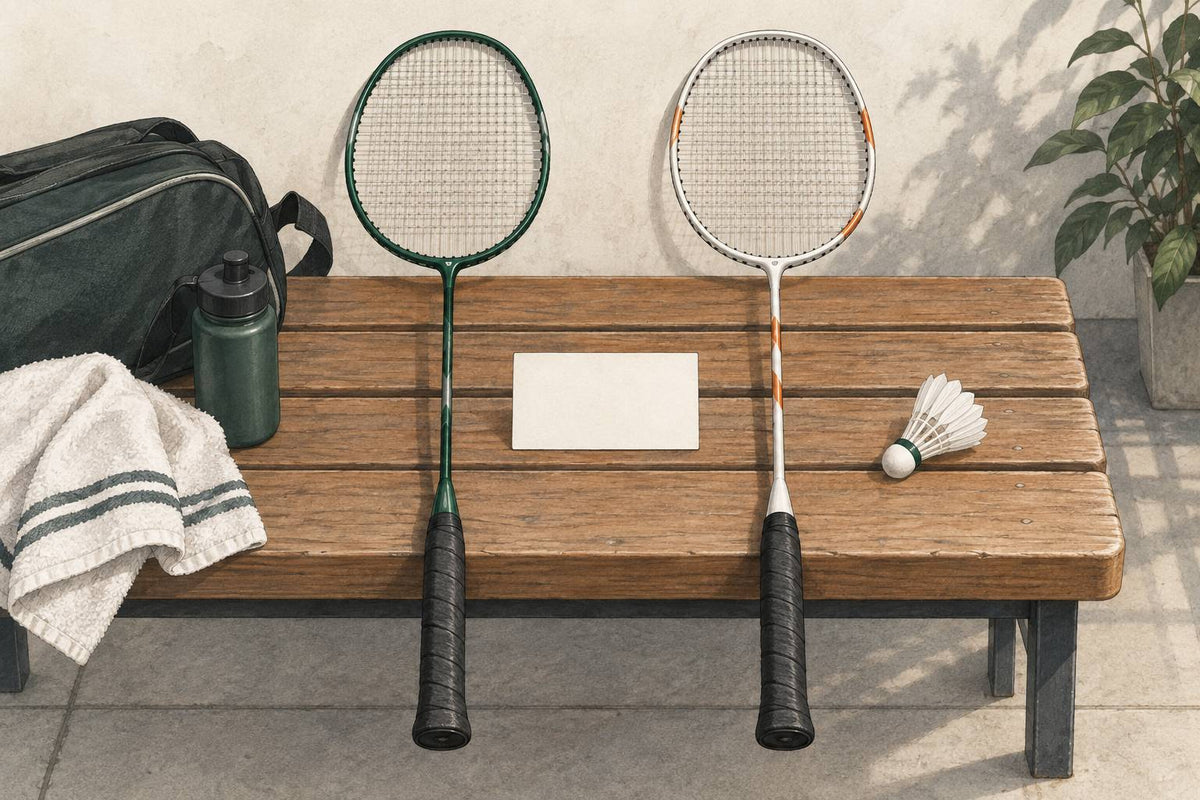
Many modern badminton rackets have a smooth shaft-to-head junction instead of a visible external connector. “One-piece” and “built-in T-joint” are not complete manufacturing descriptions: the exact reinforcement, materials and joining method depend on the model. A smooth exterior does not prove that every part was made from one continuous piece.
That area is still important. Yonex has described built-in T-joint design in terms of weight distribution, while coaching and manufacturer explanations point to reduced lateral twisting on off-centre hits. Mizuno describes reinforced joint construction as reducing torque from the frame and shaft for better power and control transfer. Frame-shape design follows the same logic: the section near the T-joint is often made sturdier because it is where torsional stability matters most.
What this means when choosing a racket
If you see a visible external T-joint, treat it mainly as a sign of older or budget-oriented construction. It does not automatically mean the racket is unusable, but it does suggest a simpler frame design than the one-piece, built-in T-joint approach used on most modern performance rackets.
When comparing options, look at frame construction alongside weight, balance, shaft feel, and materials rather than isolating the T-joint as the deciding feature.
The honest caveat: players still debate how much the T-joint itself changes feel, vibration transfer, or stability, so use it as one construction clue—not a complete performance verdict.
Which Should You Choose?
For most players, the practical answer is simple: compare modern composite rackets alongside any casual-use options that meet your needs. The junction still matters, but today it is usually an engineered part of the frame, not a visible connector.
| Choose | Why |
|---|---|
| One-piece / built-in T-joint | Best default. Built-in designs are used to add strength and torsional stability at the shaft-head junction and reduce lateral twisting on off-centre hits. |
| External T-joint | Common in low-cost casual frames; assess condition, weight and intended use alongside the construction. |
| Not sure? | Prioritize weight, balance, flex, and grip before obsessing over hidden T-joint wording; construction should support the racket feel you actually want. |
Get 10% off your first order
Join the Badminton House list and we’ll email you a 10% welcome code — plus training guides, technique advice, and badminton updates.
By subscribing, you agree to receive Badminton House emails and can unsubscribe anytime.
Frame construction matters, but it should support the way you actually play. We play badminton ourselves, so if you are unsure whether a stiffer, faster, or more forgiving racket fits your level, contact us before you buy. We can help you narrow the choice without getting lost in marketing terms.
Browse frames by feel, not just construction label.
Compare Modern Badminton RacketsCheck live availability and choose a racket that matches your swing.

Leave a comment
This site is protected by hCaptcha and the hCaptcha Privacy Policy and Terms of Service apply.