
Last updated: July 2026 · Written by the team at Badminton House
Quick Answer: Reaction Light Training for Badminton
Reaction lights are worth considering only if you already train footwork consistently and will use them as a supplement, not a replacement.
Default
Best choice: Try partner calls, shadow footwork, or a random interval timer first; they provide useful timing or direction cues without committing to hardware.
BlazePod
Consider it if you want app-led light drills and a portable consumer setup, but check which features require the paid Pro membership.
FitLight
Consider it when motion and touch sensing fit the drill; confirm the current controller, app and kit requirements.
If you feel late to smashes, flat drives, or sudden net changes, reaction-light training looks tempting: tap the glowing pod, move to the next cue, watch your times drop. For badminton, the better question is not “do lights work?” It’s whether they improve the thing you actually need: reading the shuttle, timing your split step, and recovering into balance.
Systems like BlazePod and FitLight can make off-court drills sharper, but they’re best treated as a feedback tool, not a shortcut. This guide explains where the evidence is useful, where it’s thin for badminton, and what to try before buying lights.
Need help connecting training tools to your real on-court setup? Ask us a question before you buy; we’ll keep the advice practical and badminton-specific.
In This Guide
What reaction-light training actually is

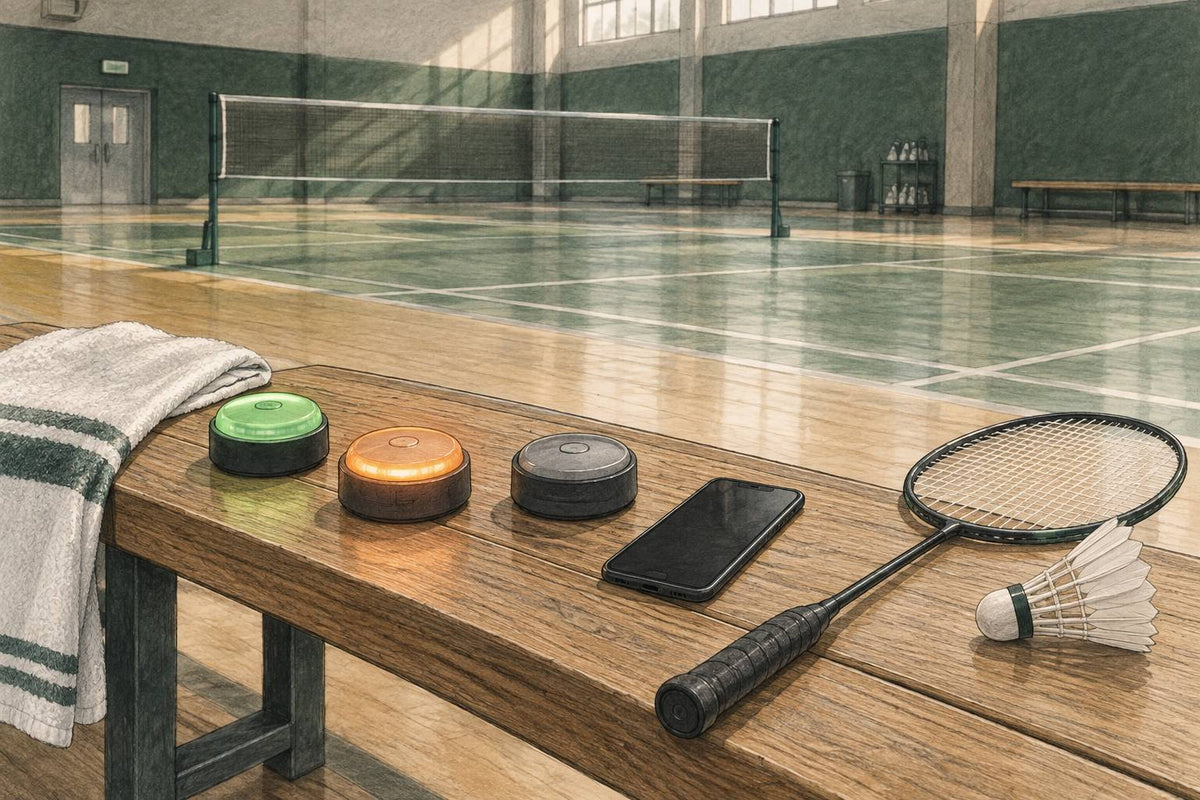
Reaction-light training for badminton uses small wireless LED pods with lights and sensors. The pods are controlled through an app or controller, and the athlete reacts when a light appears by tapping, touching, or otherwise deactivating the lit pod. Most systems include pre-programmed exercises, so you are not building every drill from scratch.
BlazePod and FitLight are the two most-cited systems in this category. The basic idea is similar across both: lights turn on, the player moves or reaches to shut them off, and the system records the response. BlazePod commonly uses programmable RGB pods; kits differ in pod count, while its pods can show eight colours.
For badminton, that makes reaction lights a visual-cue tool. They can be placed near court corners, around a gym space, or beside a player for hand-speed drills, depending on the session goal.
What the evidence says for badminton

The honest answer: badminton-specific evidence is limited, but it is not zero. One badminton LED footwork study used ten junior high school players across a three-week, nine-session program of fixed and random footwork drills. It reported significant improvements in visual reaction time and agility. Another small badminton shadow-training study also reported improved footwork agility when reaction-light work was combined with shuttle-run style training.
Larger studies also exist in other court and team sports, though size alone does not remove design limitations. A FitLight study involving 412 basketball, handball, and volleyball athletes reported improved manual reaction time to visual stimuli. That sounds promising for reaction light training badminton use, but the study had important limits: it lasted six weeks, used athletes aged 16–18, did not use standardized tests, did not directly measure reaction speed itself, and had no control group. So the takeaway is cautious: lights can be a useful stimulus tool, not a proven shortcut to better badminton movement.
Buying factors: BlazePod vs FitLight, cost, and app limits

Choose around court space, coaching workflow and the data you will use. Check the current BlazePod specifications and FITLIGHT system information; controller arrangements, included equipment and app plans can change.
| Factor | BlazePod | FitLight |
|---|---|---|
| Best fit | Portable app-controlled cue-response drills. | Drills that benefit from motion and touch sensing. |
| Hardware | Eight colours and stack charging; check current device compatibility and supported data features. | Motion and touch activation; check the current compatible device and kit contents. |
| Battery | Check the current pod version, session runtime and charging arrangement. | Check the current pod version, session runtime and charging arrangement. |
| Cost | Compare the current total for the chosen kit, accessories and app access. | Compare the current total for the chosen kit and the equipment actually included. |
| App caveat | Go and Pro tiers differ; confirm which drill, analysis and player-management features you need. | The current manufacturer page describes a subscription-free app for App Store and Google Play. |
How to use lights without replacing badminton footwork

Reaction lights are useful when they make your footwork more badminton-like, not when they turn training into a game of chasing dots. The shuttle travels fast over a short distance, so reaction time matters — but the light should cue a movement pattern you already want: split step, first push, lunge or chasse, shot shape, then recovery.
For a fixed drill, place lights in the corners and call one pattern at a time: rear-court scissor, front-court lunge, then base recovery. For a random drill, let the light choose the corner, but keep the same rule: split before moving, arrive balanced, and recover before the next cue. If the light makes you skip the split step or overrun your base, slow the drill down.
For technique-first context, review badminton split step timing and shadow badminton footwork training before adding lights.
Lower-cost alternatives before you buy

Reaction-light tools can be worth considering if you are a coach, a small training group, or a player who will use them every week and track progress over time. They are less convincing if you only want occasional fun, because the category can get expensive and the lights are still a general reaction-training tool, not a substitute for badminton-specific movement.
Before buying, try the low-tech version: have a training partner call random corners, point late, or feed unpredictable shuttles. If you train solo, use a random interval timer for shadow footwork so you cannot pre-count every move. For the hands rather than the feet, our badminton reflex training guide uses a simple wall-toss test and a club-night plan with no hardware at all. If those habits stick for a few weeks, lights may add structure and feedback. If not, spend first on the kit you actually use on court before adding training tech.
Which Should You Choose?

Use this table once you know you want to go ahead — it sorts by situation, not by feature list (see the comparison table above for hardware specs).
| Choose this if... | Best fit | Keep in mind |
|---|---|---|
| You already train footwork consistently and want objective session data to track progress. | BlazePod | Check whether the required drill modes and analysis are available in your app tier. |
| You need motion and touch activation for a defined coaching drill. | FitLight | Compare the current complete kit, device requirements and supported workflow. |
| You haven't nailed split-step timing or shadow footwork yet. | Skip lights for now | Partner cues and timers offer different low-cost practice options — see the drills above. |
Get 10% off your first order
Join the Badminton House list and we’ll email you a 10% welcome code — plus training guides, technique advice, and badminton updates.
By subscribing, you agree to receive Badminton House emails and can unsubscribe anytime.
Reaction-light tools can be useful, but they’re still just one layer of training. Weigh them against coaching, footwork work, or a better on-court setup before you spend on hardware.
Keep your training kit court-ready
Browse grips, bags, and practical on-court add-ons before your next session. A tidy kit matters more than another gadget when practice time is limited.
Browse Badminton Accessories

Leave a comment
This site is protected by hCaptcha and the hCaptcha Privacy Policy and Terms of Service apply.