
Last updated: July 2026 · Written by the team at Badminton House
Quick Answer: Head Heavy vs Head Light Badminton Racket
If you are unsure, choose even balance first; go head-heavy for more smash and clear momentum, or head-light for faster defence, drives, and net interceptions.
Even
Best default: roughly 285–295 mm balance point; the safest choice for beginners, rotating doubles players, and all-round singles players who need both back-court power and quick defence.
Heavy
Usually above about 295 mm; choose this if you play rear court, rely on smashes and clears, and can handle a slower-feeling swing without your shoulder or arm tiring early.
Light
Usually below about 285 mm; choose this for doubles defence, quick drives, net interceptions, and easier manoeuvrability, while accepting less natural smash power.
Choosing between a head heavy vs head light badminton racket is one of those decisions that sounds simple until you actually step on court. One racket feels effortless in drives and defence; another makes clears and smashes feel heavier, but suddenly your reactions at the net feel late. If you only compare the printed weight (3U, 4U, 5U), you can still end up with a racket that feels completely wrong in motion.
The real question is not “which balance is best?” It is “which balance helps your game?” A rear-court power player, a front-court doubles interceptor, a rotating all-rounder, and a beginner still building technique may all need different balance profiles, even if they choose the same racket weight category.
This guide explains racket balance in practical terms for Canadian players: how balance point is measured, what head-heavy, even-balance, and head-light rackets change on court, why swing weight matters more than grams alone, and how major racket series tend to sit on the balance spectrum.
Need help choosing a racket in Canada? Browse our badminton rackets collection for current CAD pricing and availability notes. Badminton House ships across Canada.
In This Guide
What Does Racket Balance Point Mean?

In a head heavy vs head light badminton racket comparison, balance is simply about where the racket’s weight is distributed: more toward the handle, more toward the head, or somewhere close to the middle.
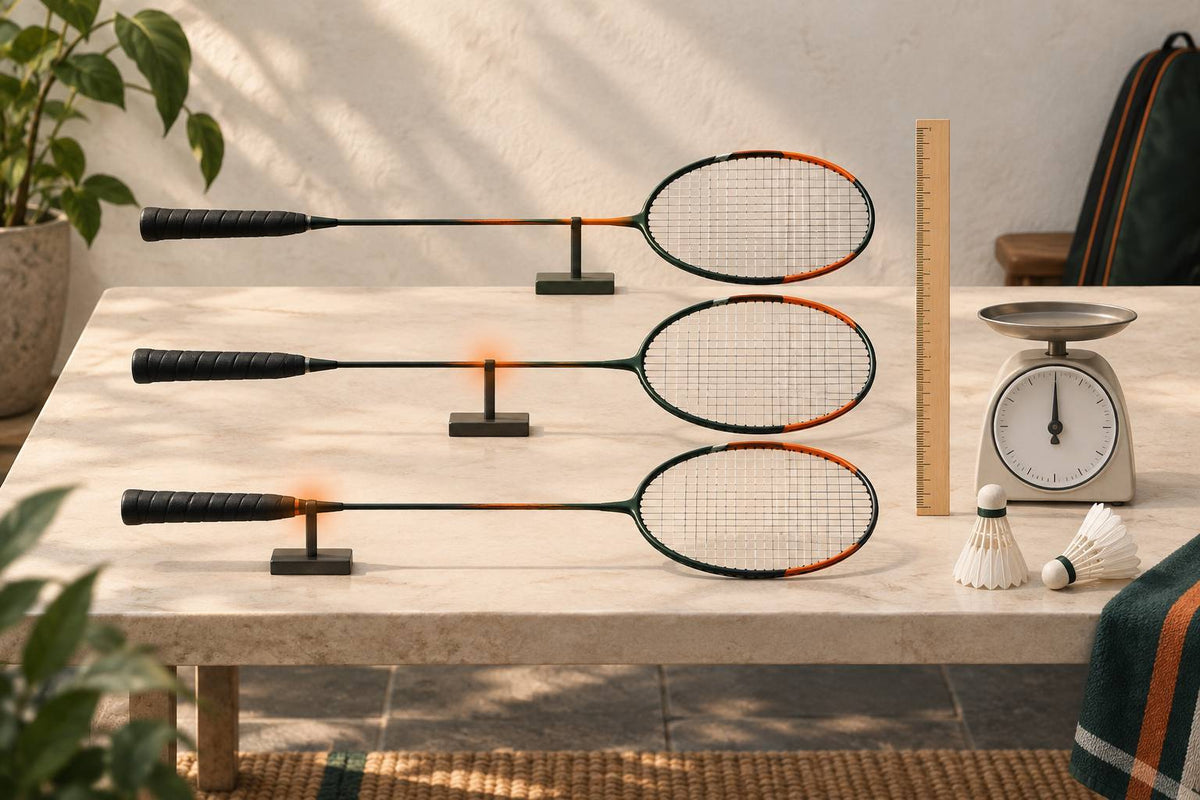
The balance point is measured in millimetres from the bottom of the handle (the butt end) to the exact spot where the racket can balance horizontally. If that balancing spot sits closer to the head, the racket is more head-heavy. If it sits closer to the handle, it is more head-light.
DIY balance-point check
- Use the racket in the setup you actually play with (strung, gripped, and with any overgrip you normally use).
- Place the racket shaft gently across your index finger.
- Slide the racket forward or backward until it balances horizontally without tipping.
- Mark or remember that point, then measure from the bottom of the handle to the balance point in millimetres.
This measurement is useful because two rackets can have the same listed weight but feel different in motion. A 4U racket with more mass toward the head can feel more demanding than you expect, while a heavier racket with a lower balance point may feel quicker in fast exchanges. We cover that “felt weight” idea later in the swing-weight section.
For now, treat balance point as one part of the full racket-fit picture. Weight, balance, and shaft flex work together, so if you are still building your overall framework, start with our broader guide: How to Choose a Badminton Racket: Visual Guide to Weight, Balance & Flex.
We compare the playing effects in the Head Heavy vs Head Light section below (first, the measurement ranges).
What Are the Balance Point Ranges in Millimetres?
On a standard 675 mm badminton racket, a balance point below about 285 mm is head-light, about 285–295 mm is even balance, and above about 295 mm is head-heavy, always measured from the butt end of the handle.
Use the DIY balance-point check from the previous section, then compare your result to the ranges below.
675 mm racket balance map
Head-light
Below about 285 mm. Usually feels quicker through defensive blocks, drives, and net interceptions.
Even balance
Around 285–295 mm. The common middle ground for players who want both back-court power and front-court handling.
Head-heavy
Above about 295 mm. Usually feels more loaded toward the head for clears and smashes.
| Measured balance point | Usual label | How to interpret it |
|---|---|---|
| Below about 285 mm | Head-light | The balance point is closer to the handle, so the racket typically feels faster to move. |
| About 285–295 mm | Even balance | The middle range: enough head presence for power without committing fully to a speed or smash-power extreme. |
| Above about 295 mm | Head-heavy | The balance point is farther toward the frame head, so the racket typically carries more momentum through big swings. |
Small footnote: balance labels are not perfectly standardized. Some sources call 285–290 mm balanced, with anything lower treated as head-light and anything higher treated as head-heavy. Treat the numbers as a practical comparison tool, not a lab-grade rule.
Also remember that balance point is not the whole feel of a racket. Materials and density distribution along the frame and shaft can make two rackets with similar balance-point numbers feel different in play.
Head Heavy vs Head Light Badminton Racket: What Changes?

The head heavy vs head light badminton racket choice is mostly a trade-off between momentum and manoeuvrability. A head-heavy racket carries more mass toward the frame, so once your swing is moving it can add power on smashes and clears. A head-light racket is easier to start, stop, and redirect, which helps when the rally gets fast.
That difference shows up most clearly in doubles defence, net interceptions, backhands, and short punchy drives. If you play a lot of fast club doubles in Canada, your balance choice should match your role: rear-court attackers often benefit from more head weight, while front-court interceptors and defensive players often prefer faster handling. For more role-specific examples, see our best badminton rackets for doubles in Canada guide.
| Balance type | What changes on court | Best fit | Main compromise |
|---|---|---|---|
| Head-heavy | Adds head momentum for stronger smashes and deeper clears. | Back-court attackers, singles players who like to push opponents deep, and players who want maximum hitting weight. | Can feel slower for defence, trick shots, quick doubles exchanges, and backhands. If the swing weight is too demanding, it may also bother the shoulder. |
| Head-light | Improves reaction speed, racket recovery, and manoeuvrability. | Front-court doubles players, defensive players, tactical singles players, and anyone who relies on net interceptions, backhands, and short fast strokes. | Usually gives up some smash weight compared with a similarly built head-heavy racket. |
| Even balance | Sits between the two: enough back-court power while still reacting quickly at the front. | All-rounders, beginners, rotating doubles players, and anyone who does not want to commit too early to a power or speed bias. | Does not usually excel at the extreme end of smash power or ultra-fast handling. |
Simple decision list:
- Choose head-heavy if your best points come from smashes, steep attacks, and full overhead clears from the rear court.
- Choose head-light if you are often late on defence, play quick doubles exchanges, intercept at the net, or want easier backhand acceleration.
- Choose even balance if you are a beginner, an all-rounder, or a doubles player who rotates between front and back court and wants one racket to cover both jobs.
Why Does Swing Weight Matter More Than Grams?
Static weight is what the racket weighs on a scale. Swing weight is how heavy or light that racket feels once you actually move it through a clear, drive, block, smash, or defensive lift.

That “feel” comes from a combination of stationary weight, racket length, and balance point. The farther the mass sits toward the head, the more effort it takes to start the swing, change direction, and recover for the next shot. That is why a racket can look light on paper but still feel demanding in fast doubles defence.
Picture it this way
A 75 g head-heavy racket can feel as heavy in motion as an 85 g head-light racket, because the head-heavy frame places more of its mass farther from your hand.
| On the scale | Balance feel | What you may notice on court |
|---|---|---|
| 75 g | Head-heavy | More solid through overhead shots, but slower to start and recover if your timing or shoulder strength is not ready for it. |
| 85 g | Head-light | May feel quicker in drives, blocks, and front-court interceptions despite being heavier in static weight. |
This is also why weight class alone can mislead you. A head-heavy 4U can feel more demanding than an even-balance 3U, so compare the full racket package instead of reading the gram category in isolation. If you are choosing between 3U, 4U, and 5U, use our 3U vs 4U vs 5U badminton racket weight guide alongside this balance guide.
Signs the swing weight is too high for you
The best test is not one warm-up smash. It is what happens after several rallies, especially when the pace speeds up.
- The racket feels slow to start. You know where the shuttle is going, but the head does not get moving quickly enough.
- You are late on defence. Blocks, drives, and body smashes feel rushed, even when your footwork is in position.
- Your arm aches early. If the shoulder, forearm, or wrist tires before your legs and lungs do, the racket may be asking for more strength than your current setup can support.
For singles players who want rear-court pressure, some extra swing weight can be useful. For fast doubles, mixed front-court play, or beginner/intermediate players still building clean technique, too much swing weight can make every recovery shot harder.
Setup changes can alter the feel
Your racket’s original balance point is not the whole story once the racket is strung and gripped. Strings, replacement grips, overgrips, towel grip, and small tuning changes can all change how the racket feels in motion.
Setup note: after stringing plus a thicker PU grip, total racket weight can rise by about 6–10 g while the balance point stays roughly similar. That added mass still matters in long rallies, especially if you already find the racket tiring.
| Setup change | Typical effect | When it helps |
|---|---|---|
| Thicker grip or extra overgrip | Adds weight near the handle and can make the racket feel less head-heavy in hand. | Useful if the frame feels too head-dominant, or if you want a larger handle feel. |
| Lead tape on the head | Adds head mass and raises the power-oriented feel. | Useful if your racket feels too quick or unstable through clears and smashes. |
| Lead tape near the handle | Adds handle-side mass and can shift the feel toward faster handling. | Useful as a tuning experiment before replacing a racket completely. |
If you are changing strings or grip thickness at the same time, change one variable at a time when possible. Otherwise, it becomes hard to know whether the new feel came from the string bed, the handle build-up, or the balance shift.
Need Setup Help? Book Stringing Service
String tension, grip feel, and balance all work together
Bottom line: when comparing head heavy vs head light badminton racket options, do not stop at the weight label. Ask how the racket starts, stops, recovers, and feels after repeated rallies. If you are still unsure, start with the broader decision framework in our How to Choose a Badminton Racket guide.
Yonex, Victor, and Li-Ning Series Balance Map
Series names are useful shortcuts when comparing a head heavy vs head light badminton racket, but they are still shortcuts. Treat the map below as a starting point: the exact model, weight class, grip, strings, and production version can all change how a racket feels in your hand.
For a deeper Yonex-only breakdown, see our Yonex Astrox vs Arcsaber vs Nanoflare comparison.
Series balance map, from fastest feel to strongest head-weighted feel
Head-light
About 275–285 mm
Even balance
About 285–295 mm
Head-heavy
About 295 mm+
Yonex
Nanoflare
Speed-focused, about 275–285 mm
Arcsaber
Even-balance range for club players who rotate roles
Astrox
Power-focused, about 290–310 mm
Victor
Auraspeed / Jetspeed
Generally speed and quick-reaction oriented
DriveX
All-around, balanced-feel family
Thruster
Power-oriented, head-heavy family
Li-Ning
BladeX
Speed-focused family; some models sit closer to even
Halbertec
Controlled, well-rounded, even-balance family
Axforce
Attacking, power-oriented family
Model specs override series stereotypes. Series names indicate tendencies; check the exact model’s weight, balance, flex and recommended tension.
| If your role feels like... | Start your search around... | Why |
|---|---|---|
| Rear-court attacker in doubles or singles player who builds rallies around clears and smashes | Astrox, Thruster, Axforce | These series sit on the power side of the map, where more head weight helps create momentum through the shuttle. |
| Front-court doubles player, fast defender, or player who wins with interceptions | Nanoflare, Auraspeed, Jetspeed, BladeX | These families are mapped toward speed and manoeuvrability, which helps in short, quick doubles exchanges. |
| Rotating club player who attacks, defends, lifts, blocks, and covers both front and rear court | Arcsaber, DriveX, Halbertec | Even-balance series are the safest starting point when you do not want to commit fully to smash power or front-court speed. |
If you are still deciding between weight, balance, and flex together, start with our visual guide to choosing a badminton racket. Doubles players can also compare role-specific recommendations in our best badminton rackets for doubles in Canada guide.
Canadian shopping note
Racket availability in Canada changes by brand, weight class, grip size, and colour. If the head-light or even-balance model you want is not listed in our badminton rackets collection, check back on the collection or join the newsletter for availability updates.
Canadian Product and Setup Notes
Compare the exact model and finished setup. The Astrox 100 ZZ and 100VA Game are different tiers with different flex and construction; the Game model should not be treated as an even-balance flagship because of a catalogue label.
| Badminton House catalogue example | Listed balance | Why it matters for this guide | Current catalogue note |
|---|---|---|---|
|
Yonex Astrox 100 ZZ Kurenai, Dark Navy 4U avg. 83 g or 3U avg. 88 g · extra-stiff flex · 4U 20–28 lbs, 3U 21–29 lbs |
Head-heavy | This is the flagship catalogue example for the power end of the balance spectrum: more mass toward the head for attacking momentum, especially useful for players who build rallies from the back court. | Flagship power frame — check the collection page for current availability. |
|
Yonex Astrox 100VA Game Grayish Beige HM Graphite / NANOMESH NEO / VOLUME CUT RESIN / Tungsten frame · medium flex · 4U avg. 83 g or 3U avg. 88 g · 4U 20–28 lbs, 3U 21–29 lbs |
Check the exact model and setup | The Game tier has medium flex and its own materials; it is not the same construction as the extra-stiff 100 ZZ. | Game-tier frame — check the collection page for current availability. |
| Head-light example | Head-light | If you want maximum speed for front-court doubles, flat drives, and quick defensive reactions, compare head-light models when they are available. | Compare current listings when you are ready to buy, since head-light availability shifts over time. |
Because availability changes, use the badminton rackets collection as the live starting point rather than choosing from an old product screenshot.
Setup before you switch frames. As covered in the swing-weight section, strings, grips, and lead tape can shift how balance feels. If a racket is almost right, consider a setup adjustment through our stringing service before replacing the frame.
Read balance, weight, flex and tension together, then compare the racket after stringing and gripping. The useful setup matches your role and timing.
Which Should You Choose?
Use balance as a playing-style filter, not as a status symbol. The right answer depends on where you win points, how fast you need the racket to recover, and whether you already know your preferred feel.
| Choose this balance | Best if... | Trade-off to accept |
|---|---|---|
| Head-heavy | You want more momentum and power per swing, especially for smashes and clears, or you like pushing opponents deep to the back court. | The stroke can feel slower. It is less helpful for smash defence, trick shots, quick short doubles strokes, and backhand; it can also bother the shoulder if you are not strong enough to manage it. |
| Head-light | You need faster reaction time, easier manoeuvrability, quick defensive shots, net interceptions, short fast strokes, or a racket that is easier on the arm and shoulder. This is often attractive for doubles players and tactical singles players. | You give up some smash power compared with a more head-heavy setup. |
| Even balance | You want an all-court racket that can still smash from the back while reacting quickly in defence. This is the safest direction for all-rounders and beginners who should not commit too early to a strong head-heavy or head-light bias. | It will not excel at the extremes of pure speed or maximum smash power. |
| Still unsure? | Start with the broader racket-fit process in our How to Choose a Badminton Racket guide, then compare weight in the 3U vs 4U vs 5U guide. | See the swing-weight section above for why grams alone mislead. |
Product context: For a concrete head-heavy reference, see the Yonex Astrox 100 ZZ. To compare current Canadian availability, check our badminton rackets collection.
Get 10% off your first order
Join the Badminton House list and we’ll email you a 10% welcome code — plus subscriber-only restock alerts, giveaways, and honest gear advice from players.
By subscribing, you agree to receive Badminton House emails and can unsubscribe anytime.
Still unsure whether head-heavy, even-balance, or head-light makes sense for your game? We play badminton ourselves, so we can help you think through your level, doubles or singles role, swing speed, shoulder comfort, and current racket setup. Contact us for honest racket advice before you buy.
Choose a racket balance that fits your game — not just the spec sheet.
Browse Badminton RacketsShips across Canada · 14-day returns · Canadian badminton specialty shop

Leave a comment
This site is protected by hCaptcha and the hCaptcha Privacy Policy and Terms of Service apply.