
Last checked: August 2026 · Written by the player-led team at Badminton House
Quick answer
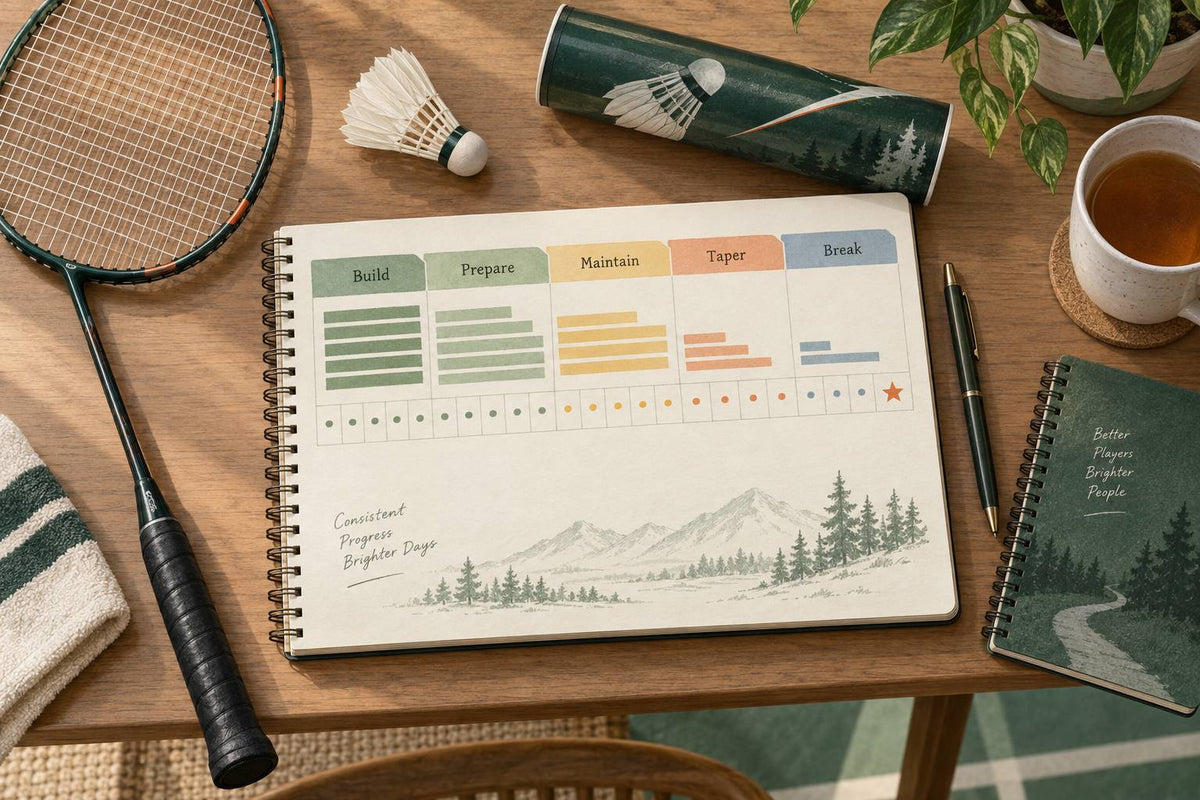
A badminton season plan works in five blocks instead of one repeating week: off-season and pre-season build general and then badminton-specific fitness; in-season defends what you built while match frequency is high; taper cuts volume before a target event while keeping intensity; and break lets you stop fully before the cycle restarts. Training volume and technical risk move together: both are highest when competition is furthest away and lowest right before it.
Start with The five-block season map
Find your current block in the table, read its section, then apply the single fix for the mistake most players make there.
Related reading: A Badminton Weekly Training Plan for Club Players — use it to fill in the day-by-day session structure inside whichever block you are in now.
The five-block badminton season map
A badminton season plan divides the year into five blocks: off-season, pre-season, in-season, taper and break. Each block sets a different job for training (to build capacity, defend it, or wind the season down), so the plan's real function is matching what you do this week to the block you are actually in right now.
Sports-science periodization treats a full training year as a macrocycle, broken into mesocycles of a few months and microcycles of one to four weeks, with each phase pointed at a different physical target, moving from general capacity toward event-specific sharpness as the calendar advances (see a 2015 review of periodization models for strength and conditioning). The five blocks below apply that logic to a club calendar: two building blocks before competition, one defending block through it, and two blocks that bring the season to a controlled close instead of an abrupt stop.
The table is Badminton House's own season map, not an official grading or federation system. It sets the purpose, the technical and physical emphasis, the match-play and recovery approach, and the single most common mistake for each block.
| Block | Purpose | Technical & physical | Match play & recovery | Common mistake |
|---|---|---|---|---|
| Off-season | Rebuild general capacity and fix structural limits with no matches to protect. | Full technical rebuilds, mobility and movement work, general strength and aerobic base. | Little to no competitive play; recovery sits inside lower overall intensity. | Skipping straight into league play with the same faults as last season. |
| Pre-season | Turn general capacity into badminton-specific fitness and finish any technical change. | Groove the new pattern under light pressure; intermittent conditioning replaces steady running. | Controlled practice matches and conditioned games; recovery stays generous. | Starting a stroke change here and still bedding it in during the first ranked matches. |
| In-season | Defend the fitness and technique already built while results are on the line. | No new technical work; only reinforcement of existing patterns at match speed. | High match frequency; conditioning volume drops while intensity holds. | Trying to fix a stroke mid-league, which gets worse before it gets better. |
| Taper | Arrive at a target event fresh without losing sharpness. | No technical changes; only rehearsal of existing patterns and serves. | Volume drops sharply; short, high-quality efforts remain; sleep gets extra attention. | Panic-training in the final week because less volume feels like doing nothing. |
| Break | Recover fully and bank the lessons from the season just finished. | No structured training; unstructured play only if you want it. | Full rest; write down what worked and what broke down under pressure. | Either skipping it entirely or letting it run so long the next block starts from zero. |
Read the blocks in order: the first two build, the third defends, and the last two bring the season down on purpose, before injury or burnout forces the issue.
If you are unsure which block applies right now, check two things: how many competitive matches sit on your calendar in the next two weeks, and whether you are mid-way through changing a stroke or serve. Plenty of matches and no active technical project point to in-season. Few or no matches with an active technical project point to off-season or pre-season. A single event three weeks or less away points to taper, no matter what else is happening that week.

Off-season and pre-season: build before you compete
Off-season and pre-season are the two blocks where you can afford to look temporarily worse. Off-season rebuilds general capacity and fixes technical faults with no matches to protect; pre-season converts that capacity into badminton-specific fitness and finishes locking in any technical change before ranked matches test it under real pressure.
Coaching guidance is direct about why technical work needs that room to fail first: players should not be pushed to the next stage of a skill progression until they are reasonably competent at the current one (per the BWF Level 1 coaching manual, which designs practice from simple to complex and predictable to unpredictable). Competence takes reps that a five-night-a-week league schedule rarely allows. A rebuilt clear or a new grip is, for a while, worse than the habit it replaces, and off-season is the block where that dip does not cost you a match.
Conditioning follows the same shift. General work (running, general strength, mobility) gives way to shorter, higher-intensity, badminton-specific movement as pre-season approaches, so the legs and lungs are ready for stop-start rallies rather than steady pace. Off-season is also the easiest place to fit structural work: ankle and hip mobility after an old sprain, single-leg strength for lunging, or shoulder capacity for repeated overhead swings. None of it competes with match minutes, because there are no matches yet, and it is far harder to schedule once league nights return.
In-season: defend what you built
In-season training has one job: defend the technique and fitness already built rather than add to it. Match frequency stays high, conditioning volume drops, and intensity holds, because the qualities built in off-season and pre-season decay faster than they improve once league nights and open tournaments start stacking up.
For most club players that means two to four competitive matches a week during a busy stretch, alongside just one or two dedicated conditioning sessions, well down from the three or four typical of an off-season block. That pattern holds up under controlled testing. In one controlled trial, cyclists who did heavy strength training twice a week through a 12-week preparatory block, then cut to a single maintenance session a week for the first 13 weeks of the competition period, kept the muscle size and strength gained beforehand (Rønnestad et al., 2010). A comparison group that trained endurance only over the same period saw two of four performance measures stay flat, while the maintenance group improved on all four. One session a week was enough to defend gains that had taken three months to build.
The same logic applies to a badminton week: keep the sessions, cut the sets, and hold the intensity. Our badminton weekly training plan lays out how to arrange a 4-5 session in-season week around league nights and one genuine recovery day.
The in-season mistake is trying to fix a stroke mid-league. A rebuilt pattern gets worse before it gets better, exactly during the weeks it will be tested against real opponents at real pace. Save the fix for the next off-season or pre-season block, and manage the current fault with tactics until then.
Taper and break: peak for the event, then let it go
A taper is a short, planned drop in training volume before a target event that keeps intensity high so match sharpness survives the rest. Break is the reverse: a genuine stop after the season's last event, with no structured training, so the next off-season starts from a genuinely rested body.
Research on tapering is specific about the shape of that drop. The recommended approach maintains training intensity while cutting training volume by up to 60 to 90 percent and trimming frequency by no more than about 20 percent, over a period of roughly 4 days to more than 4 weeks, producing an average performance gain of about 3 percent (Mujika and Padilla, 2003). The volume comes out; the intensity and the touch on the shuttle stay. In practice that is a handful of full-pace smash-and-serve reps and short, sharp footwork bursts, not extended conditioned games or long multi-shuttle drills.
Working backward from a single target event makes the whole map concrete. Say your target is a graded open 20 weeks out. The final 1-2 weeks are taper: volume falls hard, but full-speed smashes and serves still happen, just fewer of them. The 6-10 weeks before that are in-season: match play and conditioned games, no new technical work. Before that, 4-6 weeks of pre-season convert whatever general fitness you built into badminton-specific speed and finish any grip or stroke change. Everything earlier than that is off-season, the only stretch in the 20 weeks where a rebuilt backhand is allowed to look worse before it looks better. A realistic session count across that timeline rises from three or four a week in off-season to four or five in pre-season, holds around four through in-season, then keeps about four much shorter sessions in taper.
Break begins once the target event is over. A week or two of unstructured play, or no racket at all, lets the body and the motivation recover; use the downtime to write down what the season exposed, ready for the next off-season block to act on. The taper mistake is panic-training in the final week because cutting volume feels like doing less. The break mistake is either skipping it entirely or letting it drag on so long that the next off-season loses its edge before it starts.
Fitting the five blocks around a real league calendar
Most indoor leagues do not hand you five neat blocks; they hand you a fixed season and a summer gap. Off-season and break usually collapse into that gap; pre-season starts a few weeks before the league resumes; in-season covers the whole league-plus-opens stretch; and taper sits only in front of your single biggest event of the year.
As a rough starting point, off-season commonly runs 4-8 weeks, pre-season 4-6 weeks, taper 1-2 weeks, and break 1-3 weeks, with in-season filling whatever is left between them, which for most club calendars is the majority of the year. A bigger technical change earns a longer off-season or pre-season; a season with only small fixes to defend needs less of both.
If your league runs roughly September to April with a quiet summer, the summer becomes your natural off-season and the few weeks before September are pre-season. The whole September-to-April run is one long in-season, with taper folded into the two weeks before your club's biggest open of the year and break taken right after it, before the summer restarts the cycle.
Some leagues run close to year-round with barely a gap. In that case, borrow a short off-season and pre-season from whatever quiet stretch exists (a slow month, a holiday break, an injury layoff) rather than skipping technical work indefinitely, even if the borrowed time is only three or four weeks combined. A short, deliberate off-season beats no off-season at all.
None of this needs to be exact. The blocks exist to help you decide what to train this month. If a block runs long or short because life intervenes, simply pick back up at whichever block you are actually in once things settle.
Build your five-block season this week
- Mark your next target event and count back the weeks; that fixes where in-season ends and taper begins.
- Block out 4-6 weeks of pre-season before that, and put whatever off-season time remains into technical or structural work.
- Through in-season, cut conditioning volume while holding intensity steady, and freeze new technical projects until the next off-season.
- Schedule the break itself on the calendar; do not leave it to happen by accident.


Leave a comment
This site is protected by hCaptcha and the hCaptcha Privacy Policy and Terms of Service apply.