

Last checked: August 2026 · Written by the player-led team at Badminton House
Quick answer
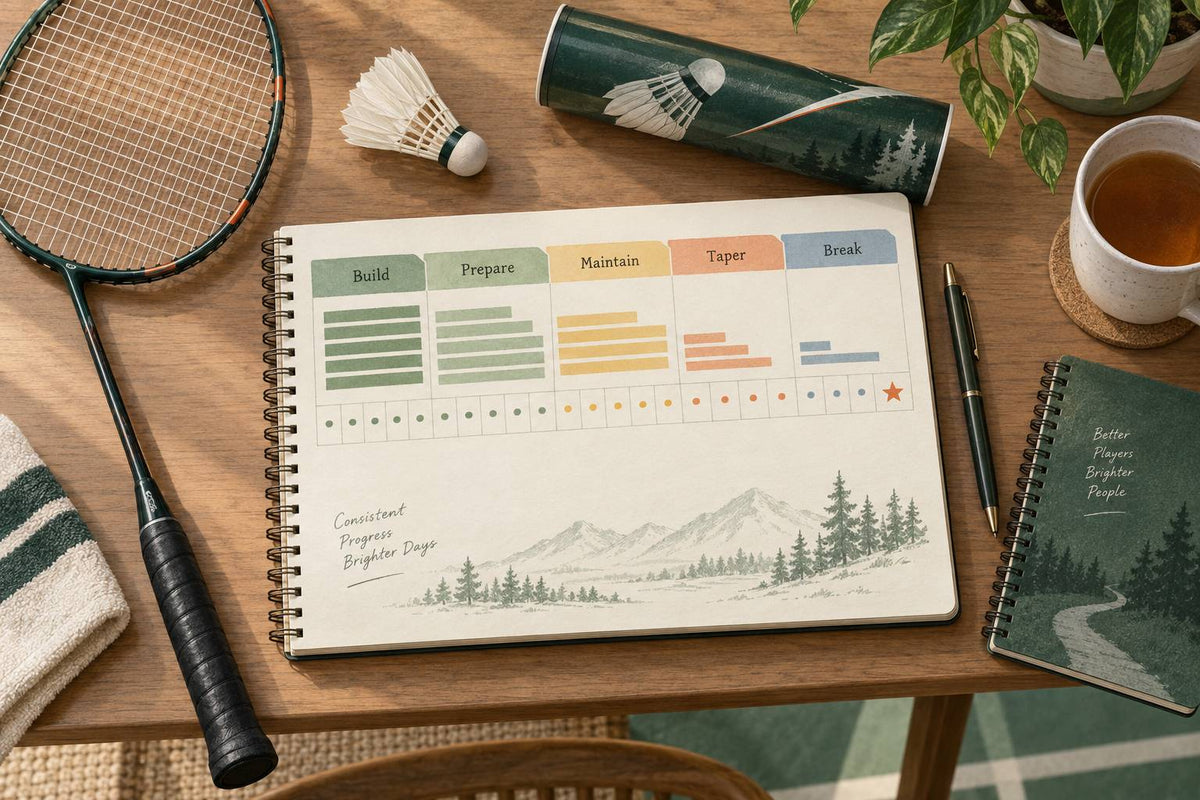
This plan turns badminton defence into six weeks of dedicated training instead of a warm-up habit. Weeks 1 and 2 groove a low stance and a repeatable contact point at half-pace, weeks 3 and 4 add mixed short and long feeds plus a hit-retreat-reset cycle, and weeks 5 and 6 add reaction cues and grip endurance at faster pace. Every week carries its own shuttle count, rest interval and one pass test.
Start with Why defence needs its own training block
Skim the six-week tables, run the pass test for the week that matches your current level, and start there rather than at week 1 by default.
Related reading: Badminton Defense Ready Position Guide — the low stance and racket-up posture this plan assumes you already have.
Why defence needs its own training block
Club doubles is smash-heavy, and players who can absorb pressure move up a level faster than players who only add power. Treating defence as a dedicated six-week block, rather than a five-minute warm-up habit, is what turns blocking and lifting from a lucky reflex into a return you can rely on under real pressure.
In practice, a receiver who keeps returning smashes without breaking down forces the attacker to hit more shots to win the point, and more shots means more chances for the attacker to make the error instead. That is the practical payoff this plan is built around: rallies you do not lose just by being attacked.
This plan is Badminton House's own six-week structure, not an official periodisation programme from BWF or any federation. The set counts, shuttle counts and pass tests below are our own design for a club player training defence twice a week. What is not invented is the shape of the progression: BWF coach education guidance designs practice from simple to complex, slow to fast and predictable to unpredictable, and that is exactly the order these six weeks follow.
Move to the next phase only when you pass its test. Two weeks on the calendar does not earn a promotion by itself. The same coach education guidance is explicit that players should not progress through a practice ladder until they are reasonably competent at the current stage, and a defence block is exactly where rushing shows up fastest: skip ahead on pace before the contact point is repeatable, and the return degrades the moment a real smash arrives.
This plan assumes the underlying mechanics are already in place. If your low stance or racket-up posture still needs work, start with our defence ready position guide before adding volume, and if the block and lift swing itself is shaky, our smash defence guide covers the shape this plan is drilling into a habit.
Slot the defence block early in a session, right after the warm-up, while your legs and reactions are still fresh. Bolting it onto the end of a two-hour club night after games have already tired your legs teaches your body to defend badly under fatigue, which is the opposite of what six weeks of dedicated work is for.
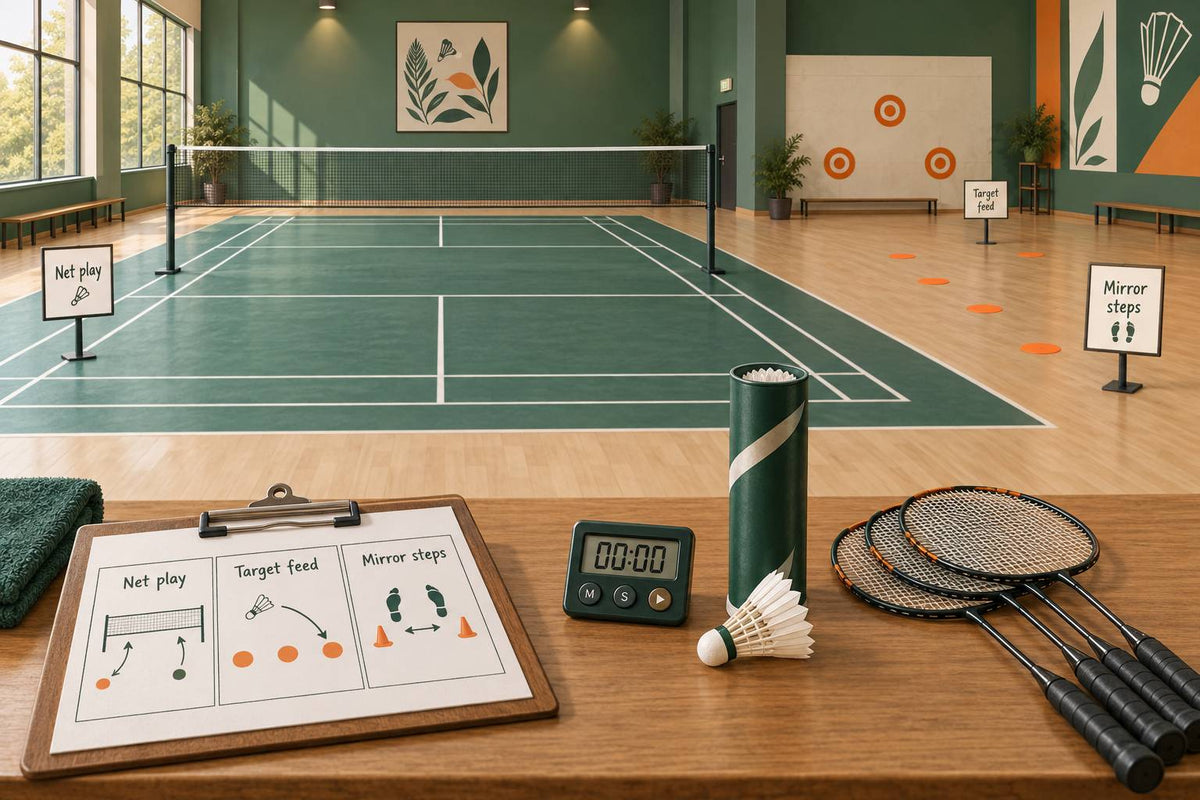
Run this with whoever is willing to feed: a coach, a steady club partner, or you feeding a partner from a multi-shuttle tube and swapping roles every set. Whoever feeds needs a full tube or bucket on hand so a set does not stall while shuttles get collected, and the receiver should keep a simple tally, hits landed over hits attempted, so a pass or fail is read off a number rather than a feeling at the end of the set.

Weeks 1-2: stance and contact point at low feed speed
The first two weeks have one job: make the low stance and the contact point repeatable before speed enters the picture. A feeder feeds straight, half-pace overhead shots from a known side, and the receiver blocks or lifts from a compact base rather than reaching or stepping back.
| Week | Session menu | Rest | Pass test |
|---|---|---|---|
| 1 | 4 sets of 10 shuttles, half-pace straight feed to a known side, block or lift back into play | 45 sec between sets | Land 6 of 10 returns back in play from the half-pace feed |
| 2 | 4 sets of 12 shuttles, same half-pace feed, feeder calls the target zone before each feed | 45 sec between sets | Land 7 of 10 returns in the called target zone |
Two things separate week 1 from week 2. Week 1 only asks the shuttle to come back; week 2 asks it to land somewhere specific, which is the real test of a repeatable contact point rather than a lucky block. If you cannot hit 6 of 10 by the end of week 1, stay on week 1's menu for a third week instead of moving on with a base you cannot trust.
Half-pace means the feeder swings gently enough that the shuttle arrives with plenty of set-up time, nothing close to a competitive-speed clear or smash. The most common fault at this stage is a racket face that drifts open on the backhand side, which sends blocks long instead of staying tight to the net or cross-court dead. If your misses cluster on one side, spend an extra set shadow-feeding that side alone with no shuttle before you repeat the pass test.
Weeks 3-4: mixed feeds and the hit-retreat-reset cycle
Weeks 3 and 4 remove the guarantee of knowing what is coming and add the movement pattern defence actually runs on: hit, retreat to base, drop into a low stance, and reset before the next feed. The feeder now mixes short and long feeds so the receiver cannot pre-commit to either shot.
| Week | Session menu | Rest | Pass test |
|---|---|---|---|
| 3 | 4 sets of 12 shuttles, mixed short and long feeds at moderate pace, feeder does not call which is coming, full hit-retreat-reset cycle every rep | 60 sec between sets | Complete the full cycle (return in play, then fully reset to base before the next feed) on 8 of 12 reps in one set |
| 4 | Same 4 sets of 12 mixed feeds, receiver calls "short" or "long" out loud the instant they read it, before contact | 60 sec between sets | 8 of 12 reps both called correctly and carried through the full cycle |
Calling the feed out loud does two things a silent rep cannot: it proves you read the shuttle before your body committed, and it stops a late guess from passing as good instinct. If the retreat-and-reset half of the cycle keeps breaking down before the swing does, the fix is footwork rather than hands; our receive footwork recovery guide covers the low-base recovery step this cycle depends on.
With only one regular partner, rotate the feeder role every set rather than every session: you feed a set, they receive, then swap, so both of you bank real reps instead of one player only ever swinging and the other only ever feeding. If the reset half of the cycle collapses under pace before the block does, the honest fix is fewer shuttles per set at week 3's pace until the retreat is automatic. Piling on more reps at a pace your feet cannot yet hold only drills the fault in deeper.
Weeks 5-6: reaction speed and grip endurance
The last two weeks raise the feed to club-attack pace and add two things this plan has deliberately delayed: reading the feeder's racket preparation before contact, and returning to a relaxed ready grip through a long, unbroken set. Both are what separate a drill-court return from a match-night return.
| Week | Session menu | Rest | Pass test |
|---|---|---|---|
| 5 | 5 sets of 15 shuttles at fast, attacking pace, feeder alternates early-telegraphed and disguised racket preparation without announcing which | 90 sec between sets | 10 of 15 clean returns (no mishit or drop), split step timed around the feeder's contact, landing as the shot becomes readable |
| 6 | One continuous 20-shuttle set at the same fast, mixed pace, no pause between shuttles to reset the grip | Rest only between sets, not within | 14 of 20 clean returns, with shuttles 15-20 judged no worse than shuttles 1-5 |
The reason week 5 trains cue reading rather than raw speed is that raw speed is not where the expert advantage actually lives. A 2026 study comparing 33 expert badminton players against 33 novices found experts anticipated shuttle landing zones with about 14.8 percentage points higher accuracy than novices, while their raw reaction time was not significantly faster; the drift-diffusion analysis behind that result traced the gap to more efficient use of the same visual and auditory information rather than to quicker reflexes. A separate 2026 study using shot video frozen before contact found experts correctly predicted shot direction about 72% of the time 40 milliseconds before the feeder's racket struck the shuttle, against 59% for novices, and responded roughly 360 milliseconds sooner on average; the gap closed once the shuttle's actual flight became visible to everyone. That is the case for week 5's disguised-preparation feeds: the skill under training is reading the racket before contact, well ahead of any reaction to a shuttle already in flight.
Fast, attacking pace here means close to the pace a mid-level club smash actually travels at, fast enough that you cannot block it half-asleep. In week 6, distinguish normal grip adjustments and relaxation between strokes from losing control of the handle or needing to stop the set. If that is where you are failing, repeat week 6 at 15 shuttles instead of 20 before adding the last five back in, rather than abandoning the continuous format altogether.
This plan trains reading speed inside a live feed. For isolated hand-speed work you can add between sessions, see our reflex training guide.
The one-session-a-week compressed plan
Most club players cannot commit two court sessions a week to defence alone, so this compresses the same three phases into three sessions instead of six weeks: one session on stance and contact point, one on mixed feeds and the reset cycle, and one on reaction cues and grip endurance, repeated in a rolling cycle.
| Session | Session menu | Rest | Pass test |
|---|---|---|---|
| A: stance and contact point | 3 sets of 10 shuttles, half-pace known-side feed, switching to a called target zone from set 2 | 45 sec between sets | 7 of 10 returns land in the called target zone by the final set |
| B: mixed feeds and reset cycle | 3 sets of 12 shuttles, mixed pace, receiver calls "short" or "long" before contact from set 2 | 60 sec between sets | 8 of 12 reps called correctly and fully reset to base |
| C: reaction and grip endurance | 3 sets of 15 shuttles at fast pace, finishing with one continuous 15-shuttle set with no pause | 90 sec between sets | 10 of 15 clean returns, last 5 of the continuous set no worse than the first 5 |
Run session A, then B, then C, then back to A, treating each pass test as the gate rather than the calendar. Pass a session twice in a row and tighten its bar (two extra shuttles per set, or 15 seconds less rest) before moving on. On one session a week this cycle usually takes longer than six weeks to finish, and that is the trade a single weekly booking makes: the same order of skills, at whatever pace one court session a week actually allows.
The compressed plan suits anyone training defence around a single weekly booking, a shared court, or a season where court time is genuinely scarce. Someone with two sessions available should use the six-week version instead, since it banks more reps per phase and reaches match-pace defence sooner; treat the compressed track as the plan your schedule requires over the plan that merely looks easiest on paper. Miss a week entirely and repeat the same session rather than skipping ahead; a pass test you have not actually run yet is not a pass.
Put this plan on the court this week
- Book two court sessions a week for the full plan, or one for the compressed version, and put the defence work first in the session.
- Run the week 1 pass test after the warm-up before deciding which week to start on.
- Write down each set's hit count so a pass or fail is a fact, no guessing required.
- Move to the next phase only on a pass, never on the calendar.

Leave a comment
This site is protected by hCaptcha and the hCaptcha Privacy Policy and Terms of Service apply.