fitness

A Badminton Weekly Training Plan for Club Players

Illustration of a badminton player planning a balanced weekly training schedule on an indoor court

Last updated: June 2026 · Written by the team at Badminton House

Quick Answer: Badminton Weekly Training Plan

Most Canadian club players improve fastest with a balanced 4–5 session microcycle: footwork and strength, technique, conditioning, match play, and real recovery.

Default

Best choice: use 4–5 sessions per week: one footwork and strength day, one technical court day with games, one conditioning and mobility day, weekend match play, and rest days between hard sessions.

Beginner

Keep the week simpler: fewer strength sessions, basic movement quality, light technical work, and enough recovery so your legs and joints adapt before you add intensity.

Tournament

In the final taper phase, reduce overall load, keep sharp matchplay and tactical work, and arrive fresher instead of trying to cram fitness late.

If you leave club night sweaty but unsure whether you actually improved, the problem may not be effort — it may be structure. Many Canadian club players train by habit: the same games, the same favourite shots, and only occasional focused work on movement, technique, or conditioning.

A good badminton weekly training plan gives each session a job. Your week becomes a simple microcycle: some days build physical capacity, some sharpen strokes and footwork, some test decisions in match play, and some are kept lighter so your body can adapt. That balance is what turns “I played a lot this week” into steady, measurable improvement.

This guide is written for Canadian club and league players who train around work, school, family, indoor court bookings, and weekend matches. You do not need a national-team schedule. You need a repeatable week that fits real life, protects recovery, and keeps your training from drifting into random games only.

Planning footwork or shadow sessions? Support your training week with proper indoor court footwear from our badminton footwear collection.


Why Structured Training Beats Random Club Nights

If your only plan is “show up and play games,” you can still get fitter and sharper for a while. The problem is that random club nights usually repeat the same stress: a few warm-up rallies, familiar opponents, similar doubles patterns, and a lot of points played at whatever intensity the group happens to create that night.

That is fun, and match play matters. But steady improvement comes from balancing five pieces across the week: on-court technical training, footwork or shadow work, physical conditioning, match play, and recovery. A badminton weekly training plan gives each piece a job, instead of hoping casual games will cover everything.

The goal is not to train more days. The goal is to make each day clearer: one session for quality strokes, one for footwork, one for conditioning, one for match pressure, and enough recovery to adapt.

In training terms, the weekly plan is your microcycle: a typical 7-day block that lays out what happens on each day. Larger programs can also use longer phases across the season, but for most Canadian club players, the week is the practical unit that determines whether you are building your game or just collecting court time.

Random club-night approach Structured weekly approach
Plays the same types of games every session. Changes the focus by day: technique, footwork, conditioning, match play, and recovery.
Can waste time because there is no clear target for the session. Makes progress measurable because each session has a purpose.
Often overworks the fun parts of the game while ignoring weaker areas. Balances stroke work, movement, fitness, tactical play, and rest.
Recovery gets added only when fatigue or soreness forces it. Rest days, stretching, mobility, and sleep are planned as part of the training week.

This matters because badminton is not one continuous effort. Match play is intermittent: short bursts of high-intensity movement are followed by rest periods, and players need both anaerobic power and aerobic endurance to repeat those bursts and recover between rallies. A week built only around games may give you intensity, but it may not give you enough controlled repetition, strength work, or recovery to improve safely.

Structure also protects quality. If Monday is hard footwork, Tuesday should not automatically become another all-out physical session just because courts are available. A better week alternates stress: a demanding lower-body or movement day, a technical day with clearer stroke goals, a conditioning or mobility day, a match-play day, and rest between harder blocks. That spacing helps prevent burnout and keeps the important sessions sharp.

For Canadian club players, this is especially useful during busy indoor seasons when drop-ins, leagues, lessons, and tournaments can pile up quickly. If you already play two or three nights a week, your training plan may need fewer extra sessions, not more. The missing piece might be 20 minutes of focused shadow footwork, a short strength session, or a planned rest day after league night.

If you are starting from unstructured play, keep it simple: choose one main theme for each session before you arrive. For example, “better defensive recovery,” “cleaner net control,” or “first three shots in doubles.” For a session-level template, see our badminton practice session plan; for the weekly picture, the next section gives you a copyable structure you can adjust around your own club nights.


A Copyable Badminton Weekly Training Plan

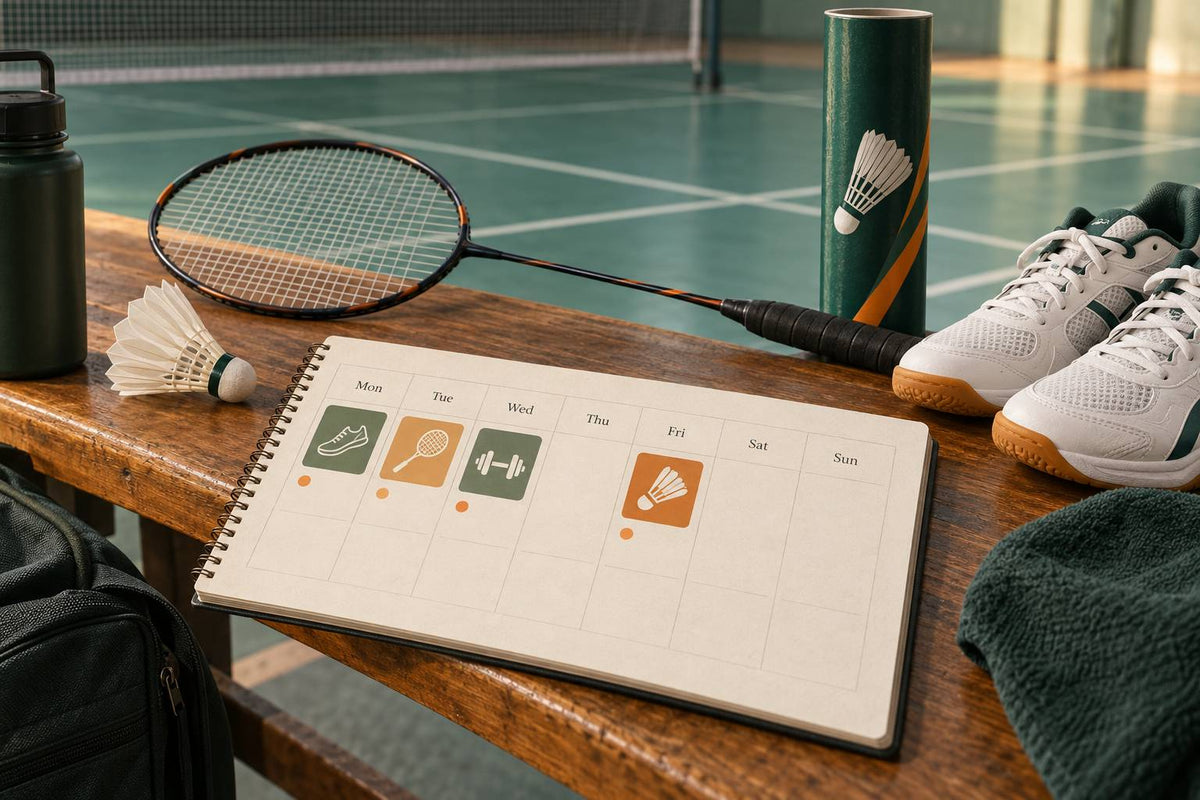
Seven-day weekly training strip labelling each day's session focus, from Monday footwork and strength through to Sunday recovery, with intensity tags.
A sample 7-day badminton microcycle, with each day given one clear job and hard sessions spaced apart.

Use this as a starting microcycle: a 7-day weekly plan that balances hard court work, gym work, match play, and recovery. It is not a mandatory schedule. Move the days around based on your club bookings, family schedule, league night, and how your body feels.

For most self-coached recreational and intermediate players, the sweet spot is usually four main sessions, with a fifth session only if recovery is good. The goal is simple: stop making every night the same, and give each session a clear job.

Day Session focus What to do Intensity
Monday Footwork + strength Lower-body strength, core work, and controlled shadow footwork. Keep the movement quality high rather than rushing every rep. Moderate to hard
Tuesday Technical drills + match play Pick one technical theme, such as net control or defensive drills, then finish with games where you deliberately use that theme. Moderate
Wednesday Recovery Rest, easy walking, light stretching, or mobility. Do not turn this into a hidden hard session. Easy
Thursday Conditioning + mobility Use HIIT or speed-focused conditioning, then finish with mobility. This is the day to train repeated efforts, not to play endless casual games. Hard
Friday Rest or light skills Rest fully if Thursday was demanding. If you feel fresh, do a short, easy touch session: serves, net shots, or relaxed drives. Easy
Saturday Weekend match play Play club matches, ladder games, league matches, or practice games. Choose one tactical goal instead of trying to fix everything at once. Moderate to hard
Sunday Recovery or optional fifth session Rest if Saturday was intense. If you are recovering well, make this a light technical session or relaxed doubles, not another max-effort day. Easy to moderate

The key pattern: hard work is separated by recovery or easier skill days. That spacing is what makes the week trainable instead of just tiring.

How to scale the plan

  • If you are newer or coming back after time off: keep Monday, Tuesday, Thursday, and one weekend match day. Make the second weekend day full recovery.
  • If you are an intermediate club player: keep the four core sessions and add the optional fifth only when your legs, shoulder, and motivation still feel good.
  • If league night is fixed: treat league as the match-play day and move the technical session earlier in the week.
  • If court time is limited: do footwork and strength off-court, then save booked gym time for technical drills and games. For more ideas, see Badminton Practice Session Plan for Busy Canadian Players.

What each session should accomplish

A useful badminton weekly training plan gives every day a purpose. Monday builds the legs and trunk that support lunges, jumps, and recovery steps. Tuesday connects technique to games. Thursday trains the repeated high-intensity efforts that badminton demands. The weekend tests whether those improvements show up under pressure.

Keep notes after each session: what you trained, what felt sharp, what broke down, and what to repeat next week. That small habit turns club play into measurable progress without needing a full-time coach.


How to Balance Conditioning, Technique, Footwork, and Matches

Once your week has structure, the next question is simple: what gets the time? For most Canadian club players, the answer is not “more games every night.” It is a rotating mix of technical work, footwork, conditioning, match play, and recovery, with one or two priorities per session.

Badminton rewards that mix because the sport is stop-start: studied match play has shown average rallies around 5.5 seconds with about 11.4 seconds of rest, which is close to a 1:2 work-to-rest pattern. In practical terms, you need short-burst speed and repeat power, but also enough aerobic fitness to recover between rallies and hard training days. For a deeper conditioning breakdown, see our badminton stamina and fitness guide.

Weekly element What it improves How to use it without overloading
On-court technical training Cleaner contact, better shot quality, repeatable patterns Place it before hard games when your timing is fresh. Pick one theme, such as net control, defence, or clears, instead of trying to fix everything in one night.
Footwork or shadow work Court coverage, recovery steps, timing, leg endurance Keep it short and high quality. Shadow footwork is essentially playing the movement pattern without striking a shuttle, and it fits well on a separate day or before a lighter technical session. If you are still building the basics, start with our badminton footwork basics.
Physical conditioning Repeat sprint ability, strength, power, and recovery between rallies Do not make every session brutal. Beginners can use fewer strength sessions, while intermediate recreational players often build with structured strength work in the off-season and lighter technical or mobility days between.
Match play Decision-making, tactics, pressure, serve and receive habits Treat games as a test of the week’s work, not the only training method. One focused match night is usually more useful than turning every court booking into random games.
Recovery Adaptation, freshness, reduced accumulated fatigue Plan rest days, stretching, mobility, and sleep like real training. If you only add work and never add recovery, your “training plan” becomes a fatigue plan.

A useful weekly balance is to separate your hardest leg days from your hardest match days where possible. For example, heavy footwork or lower-body strength the day before a long doubles night can make your split step slower and your lunges messier. Put the quality work where you can actually move well.

If you only have three court opportunities, make each one carry a different job: one technical session, one movement or conditioning session, and one match-play session. If you have four or five sessions, add a second technical theme or a short conditioning block rather than simply adding more games.

Training-week gear note. Footwork and shadow days are where court shoes matter most. The Babolat Shadow Tour Men’s Badminton Shoes – Orange are currently in stock at $119.99 CAD and are built for explosive footwork, rapid direction changes, and all-day comfort. Badminton House lists prices in CAD and offers free shipping within Canada on orders over $200.


Where Shadow Work and Drill Sessions Fit

Shadow footwork is exactly what it sounds like: playing badminton movement patterns without striking a shuttle. You move to the front court, rear court, sides, and recovery base as if a rally is happening, but the goal is cleaner movement rather than winning the point.

Used well, shadow work can improve court endurance, speed, anticipation, timing, and physical condition. Because shadowing sets can run longer than many actual rallies, they also help your legs stay organized when a rally keeps extending instead of ending after the first few shots.

Think of shadow work as footwork practice, not punishment. If every rep is rushed and sloppy, you are training panic. Start with clean split steps, balanced lunges, and full recovery before adding speed.

Use Shadow Work on Focused Footwork Days

In a badminton weekly training plan, shadow work belongs on the days where movement is the main theme. It can be the core of a footwork session, or it can sit before a light technical hit to remind your body how to arrive behind the shuttle.

For Canadian club players who only get limited court time, shadow work is especially useful because you can do it in a gym space, basement, garage, community centre room, or beside a court before games start. For a fuller no-court setup, use the ideas in Badminton Drills at Home rather than trying to turn every club night into a training lab.

  • Before technique: use shadow movement to rehearse the footwork pattern you will hit from later.
  • On a conditioning day: use shadow work to build badminton-specific endurance without needing a feeder.
  • After an easy hit: use a few controlled patterns to reinforce recovery steps and balance.

Use Drill Days to Connect Movement to the Shuttle

Shadow work teaches the movement pattern. Drill days teach whether that movement still holds up when a shuttle, timing, decision-making, and pressure are added.

A multi-shuttle-style drill day is more focused than casual games. One player feeds or repeats a pattern; the working player repeats the same movement and shot until the technique becomes more automatic. This is where you connect footwork with real strokes: net lift recovery, rear-court scissor jump, defensive block to net, or drive exchange into an attacking lift.

Session Type Best Use Avoid
Shadow work Grooving split step timing, lunges, recovery, rear-court movement, and court coverage patterns. Rushing every rep until posture, balance, and recovery disappear.
Multi-shuttle-style drills Linking movement to shot quality under repeated feeds: defence, net play, rear-court attack, or transition patterns. Feeding so fast that the worker can only survive, not improve.
Open games Testing whether the trained pattern appears naturally during points. Calling it training when you are only repeating comfortable habits.

A Simple Way to Place Them in the Week

If your week already includes match play, do not add hard footwork and hard drill work on every available day. Instead, give each session a job:

  • Footwork-focused day: shadow patterns first, then light hitting or mobility.
  • Technique-focused day: controlled feeding and repeated shot patterns, with enough rest to keep quality high.
  • Match-play day: play games, but choose one movement cue to monitor, such as recovering to base or staying low after defence.
  • Recovery day: skip hard movement and let the previous work adapt.

If you want more footwork variety without repeating this whole section, pair your weekly plan with Badminton Agility Ladder Drills and Cone Footwork. Ladder and cone work can sharpen movement rhythm, while shadow work keeps the patterns badminton-specific.


Simple Training Phases: Base, Specific Work, Match Play, Taper

Three concentric rounded frames showing the macrocycle of 9 to 12 months containing the 3 to 6 week mesocycle, which contains the 7-day microcycle.
Nested training cycles: the season macrocycle contains shorter mesocycle blocks, which contain your weekly microcycle.

A good badminton weekly training plan is not just a list of workouts. It is the smallest piece of a bigger training cycle. In simple terms, periodization means changing the emphasis of your training over time so you are not trying to build endurance, max speed, tactical sharpness, and recovery all at the same intensity every week.

Here is the plain-language version for a Canadian club player preparing for a league, club championship, or first tournament:

Cycle Typical length What it means for you
Macrocycle Roughly a 9–12 month season The big-picture season goal: improving for league play, peaking for a tournament block, or building a stronger year-round base.
Mesocycle Usually a 3–6 week block A focused phase such as general preparation, specific preparation, pre-competition, or taper.
Microcycle Typically 7 days Your actual week: which days are hard court sessions, which days are gym or footwork, and where recovery fits.

That weekly microcycle is where the plan becomes practical. Monday might be strength and footwork, Tuesday might be technique and games, Thursday might be conditioning and mobility, and the weekend might be match play plus rest. But the reason behind those sessions should change depending on the phase you are in.

Phase 1: General preparation

General preparation is the base-building phase. The priority is aerobic fitness, basic strength, mobility, and cleaner technique at moderate intensity. For club players, this is the best time to fix inefficient movement patterns, rebuild consistency, and make your body more tolerant of regular training.

In this phase, your week should feel productive but not frantic. You can include longer warm-ups, controlled shadow work, strength sessions, mobility, and technical drills without turning every session into a match-night battle. If you are building your first structured week, the ideas in Badminton Practice Session Plan for Busy Canadian Players fit well here.

Phase 2: Specific preparation

Specific preparation shifts the work closer to badminton. The focus moves toward badminton-specific speed, power, multi-shuttle feeding, and higher-intensity footwork. You are still training, but the sessions now look and feel more like the demands of real rallies.

This is where repeated lunge-recover patterns, explosive first steps, rear-court recovery, drive exchanges, and short high-quality intervals become more important. The goal is not just to get tired; it is to move faster while keeping the technical shape of your shots and footwork. For more detail on this kind of work, see Badminton Explosive Power Training Guide for Canadians and Badminton Agility Ladder Drills and Cone Footwork in Canada.

Phase 3: Pre-competition match play

Pre-competition is where intensity is highest, but total volume should be controlled. The emphasis is matchplay simulation and tactics: serving under pressure, starting rallies with a plan, playing to score, testing doubles rotations, and reviewing what breaks down when the session gets competitive.

For club players, this does not mean playing random games until you are exhausted. It means setting match-like constraints. Examples: first to 11 with only one serve each, two-game match blocks with a tactical goal, or doubles games where the pair must call a serve-return plan before each rally. If you are entering an event, pair this phase with the practical prep in How to Enter Badminton Tournament Canada: First-Timer Guide.

Phase 4: Taper, then transition recovery

The taper phase reduces overall training load before competition so your body feels sharper instead of heavy. You keep movement quality, short bursts, touch work, and tactical rehearsal, but you stop chasing extra fatigue. This is the phase where many improving players make the mistake of doing one more brutal session because they feel nervous.

After the event or target week, use a transition period for recovery. That can mean easier court sessions, mobility, light hitting, and a reset before the next build. Recovery is not wasted time; it is what lets the next training block actually work.

Simple rule: build fitness first, make it badminton-specific second, sharpen with match play third, then reduce load before the event.

A simple 8–12 week build-up

If you have a target event or league playoff coming up, an 8–12 week build-up is a practical structure. You do not need elite-level complexity; you just need each block to have a clear purpose.

Weeks Phase Weekly emphasis
1–3 Base Higher volume, moderate intensity: aerobic work, basic strength, mobility, technique, and controlled footwork.
4–6 Specific work Badminton-specific speed and power, multi-shuttle feeding, high-intensity footwork, and sharper drill design.
7–9 Pre-competition Matchplay simulations, tactical work, pressure scoring, and controlled volume.
10–12 Taper Reduced overall load while keeping speed, touch, tactics, and confidence high.

The exact dates matter less than the pattern. If your club schedule changes, keep the same logic: do not stack every hard session together, do not let match play replace all technical work, and do not wait until you feel injured to take recovery seriously. That is the difference between a random week and a training plan that actually builds your game.


Recovery: The Part Most Improving Players Skip

The easiest mistake in a badminton weekly training plan is adding more: more games, more footwork, more conditioning, more gym work. The smarter move is making sure your hard days actually create adaptation. Rest days, stretching, mobility sessions, and sleep are not extras — they are part of the plan.

This matters even more when you combine court work and conditioning in the same week. Badminton is built around repeated bursts: sprint, lunge, jump, recover, then do it again. A better aerobic base helps you recover between rallies and between intensive workouts, which is why easy conditioning and recovery work belong beside the high-intensity pieces.

Simple recovery rules for club players

  • Do not stack every hard session together. If Tuesday is intense match play, make Wednesday lighter or technical.
  • Warm up before court speed. Cold Canadian gyms make this especially important; use a progressive routine like these badminton warm up exercises before footwork, drills, and matches.
  • Cool down after hard sessions. A short post-play routine helps you downshift instead of going straight from max effort to sitting in the car. Use this badminton cool down stretches guide after longer club nights.
  • Keep at least one true low-load day. That can mean full rest, light mobility, or an easy walk rather than another intense session.
  • Protect sleep before key sessions. If you want quality footwork, sharp reactions, and better match decisions, do not treat sleep as optional.

How to know when your weekly load is too high

A plan only works if the quality stays high. If your legs feel flat every session, your timing gets worse, or your “easy” sessions start feeling hard, the answer is usually not another workout. Reduce the week’s volume, keep movement quality high, and rebuild gradually.

What you notice What to adjust
Footwork speed drops early in drills Shorten the drill blocks and keep the focus on clean movement instead of grinding extra reps.
Match night feels heavy after conditioning Move conditioning farther from match play, or make the conditioning day easier that week.
Technique breaks down under fatigue End the technical block sooner and save the hard fatigue work for a separate session.
You feel stale across the whole week Take a lighter week: fewer games, fewer conditioning sets, more mobility, and more sleep.

For most improving club players, recovery is what turns training from “busy” into productive. Plan the rest day with the same seriousness as the hard day, and your next footwork, drill, or match session will be sharper because of it.


Gear Notes for Canadian Training Weeks

Gear will not make a messy weekly plan work, but it can make a good plan easier to repeat. The two items that matter most during a structured training week are court shoes for repeated movement work and enough shuttles for technical sessions.

Footwork and shadow days deserve proper badminton shoes. The in-stock Babolat Shadow Tour Men's Badminton Shoes are $119.99 CAD, regularly $139.99 CAD, and are built to accommodate explosive footwork, rapid direction changes, and all-day comfort for intermediate to advanced players. You can also check current sizes and future options in badminton footwear.

Match your gear to the day's training load

  • Footwork and shadow sessions: Use non-marking badminton court shoes rather than saving them only for match night. These sessions involve the most repeated lunges, pushes, recoveries, and direction changes.
  • Technical drill days: Plan shuttles before you arrive. If your session includes feeding, net reps, clears, or defensive blocks, running out of usable shuttles turns a focused practice into a casual hit.
  • Match play days: Keep a fresh grip and a backup shuttle plan in your bag so games do not stall. A simple club-night checklist is often enough.

For shuttles, use the live shuttlecock collection rather than assuming availability from a past practice plan. Canadian clubs can go through shuttles quickly, especially during multi-shuttle or team sessions.

Canadian shuttle-speed note

Shuttle speed should match the gym temperature. In warmer gyms, choose a slower shuttle. If your club plays in different facilities during the week, do not assume the same speed will feel right everywhere.

Badminton House prices are listed in CAD, and orders of $200+ ship free within Canada. That matters when you are building a practical training setup: shoes, shuttles, grips, and other small items are easier to plan when you are not converting currencies or guessing at cross-border costs.

If you want more detail before upgrading, the guides on badminton shoes versus running shoes, club-night packing, and shuttlecock speed in Canada pair well with this weekly plan.


Which Weekly Training Plan Should You Choose?

Pick the smallest weekly structure you can repeat with quality. A badminton microcycle is typically a 7-day plan, so the best choice is not the hardest-looking week — it is the one that balances hard court work, gym work, and recovery without letting fatigue take over.

Choose this plan Best if... Weekly emphasis Why it fits
Beginner or return-to-training week You are still learning basic movement patterns or coming back after a break. Use fewer gym sessions; beginners can do two strength sessions per week in the off-season while learning the exercises. It builds the habit of structured training without turning every week into a max-effort week.
Standard club-player week You can handle 4–5 sessions and want a practical default. A sample structure is Monday footwork and lower-body/core strength, Tuesday technical work plus games, Thursday speed or HIIT conditioning plus mobility, then weekend match play with rest days between. It spreads the load across the week so you are not only playing games and hoping your movement, fitness, and technique improve by accident.
Strength-focused off-season week You are an intermediate or recreational player with fewer match demands right now. A typical off-season approach uses three strength days per week for strength, power, injury-prevention, and progressive overload, with rest or lighter technical/shuttle work on other days plus 1–2 easy cardio or mobility sessions. It gives you a base before you push more badminton-specific speed, power, and match intensity.
8–12 week tournament build You have a tournament or league peak coming up. Weeks 1–3 build base with higher volume and moderate intensity; weeks 4–6 move into specific work; weeks 7–9 emphasize pre-competition match play; weeks 10–12 taper. It changes the purpose of each block instead of repeating the same club-night routine every week.
Recovery or deload week Your performance has plateaued or fatigue is climbing. Reduce volume by 20–30% for a week, then build back gradually. Rest days, stretching, mobility, and sleep are part of the plan, not a sign that you are slacking.

Gear note for footwork-heavy weeks. If your plan includes shadow work, speed drills, and rapid direction changes, the Babolat Shadow Tour Men’s Badminton Shoes – Orange are currently in stock at $119.99 CAD, regular $139.99 CAD, and are built for explosive footwork, rapid direction changes, and all-day comfort for intermediate to advanced players. Badminton House lists prices in CAD and offers free shipping within Canada on orders $200+.

If your main gap is movement quality, pair this section with Badminton Footwork Basics or Badminton Agility Ladder Drills and Cone Footwork in Canada. For the overall weekly template, keep the five core elements in view and adjust only one variable at a time.

Get Canadian badminton gear advice + restock alerts

Join the Badminton House list for buying checklists, restock alerts, and practical gear advice for Canadian players.

By subscribing, you agree to receive Badminton House emails and can unsubscribe anytime.

A good badminton weekly training plan should feel challenging, repeatable, and adjustable around your real club schedule. We play badminton ourselves, so if you are unsure how to match your training goals with shoes, shuttles, strings, or racket setup, contact us and we will help you choose gear that fits the way you train.

Shop Badminton Footwear

Build your training week on court shoes made for badminton movement.
Reading next

Illustration of a badminton player practicing wall drills alone against a marked net-height line
Illustration of an intermediate badminton player breaking a plateau with better movement, smash preparation and net touch practice.

Leave a comment

This site is protected by hCaptcha and the hCaptcha Privacy Policy and Terms of Service apply.