
Last checked: August 2026 · Written by the Badminton House player-led team.
Quick answer
Under the standard BWF service law, the whole shuttle must be below 1.15 m from the court surface when your racket hits it. The limit is about shuttle contact height, not where your hand, grip, or racket head happens to be before or after contact.
“Below the waist” is still the phrase many returning players remember. The current standard-law wording is different: it uses one fixed line measured from the court surface. That gives you a clearer practice target, although a temporary tape line or phone video is only a training reference. It is not a substitute for an official’s decision.
Use this guide for standard standing badminton. Wheelchair Badminton and Para badminton Standing Classes have specific service-law exceptions. Follow the regulations for your event when they apply.
What does the 1.15 m badminton serve-height rule mean?
The rule is exact: at the instant your racket hits the shuttle, the whole shuttle must be below 1.15 m above the court surface. It is not a maximum for your hand or racket during the preparation. The legal moment is the instant of contact.
Law 9.1.6 in the current BWF Laws of Badminton uses that wording directly. “Below” matters: treat a contact that reaches your 1.15 m reference line as too high for practice, then build some margin underneath it.
The practical question is therefore simple: where is the shuttle, from the floor up, when strings first meet cork? A serve can look low because the racket is held low after the hit, yet still be too high if the shuttle rose before contact. Conversely, a compact flick can remain legal if the whole shuttle is below the line at contact.
| Check | What to watch |
|---|---|
| Reference point | Measure upward from the playing surface, not from your waist, hips, or the top of the net. |
| Object to judge | The whole shuttle, including its uppermost part, must remain below the line at contact. |
| Moment to judge | Freeze the action at racket-to-shuttle contact, rather than judging your ready position or follow-through. |

What changed from the old waist rule?
The old standard test was tied to the server’s body. It required the shuttle below the waist, defined in the old wording as an imaginary line at the lowest part of the bottom rib. The current standard test instead uses the same 1.15 m line from the court for every player.
That change also separates two ideas that are often blended together in club conversation. The old wording required the racket shaft and head to point downward at contact. In the current standard text, the racket must continue forwards from the start of service until delivery, but the old downward-at-contact condition is not stated as a separate standard-law requirement.
BWF’s 2017 Council decision on the service-law change records both versions: the bottom-rib waist definition and downward-racket condition in the Alternative Service Law material, alongside the proposed 1.15 m standard wording.
Do not turn that history into permission to improvise a high serve. A serve still has to meet every applicable part of Law 9.1. If your organiser announces Alternative Service Laws or a Para badminton variation, use that event’s published regulation rather than applying this standard-law summary by habit.
How can you practise the 1.15 m contact height without an official?
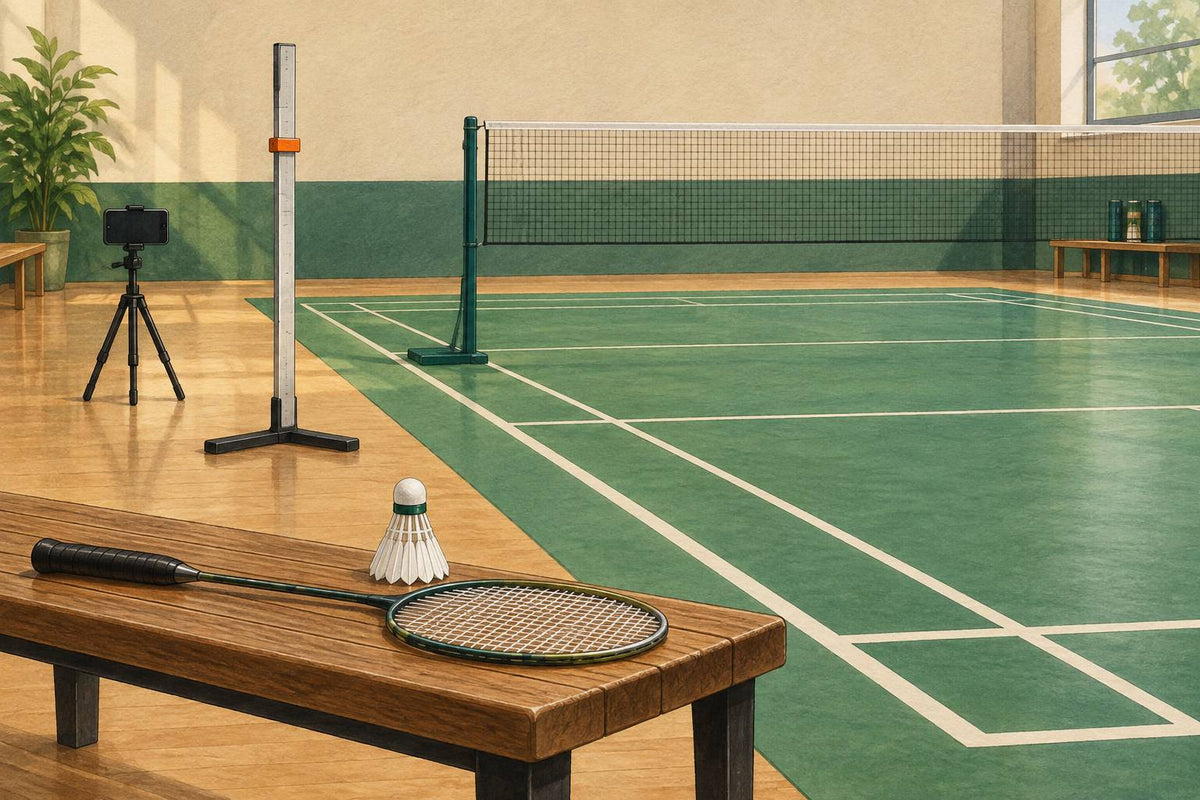
Build a repeatable reference, then use it to lower your normal contact point rather than to litigate borderline frames. A temporary line at 1.15 m and a side-on recording give you useful feedback across several serves. They cannot reproduce an official fixed-height device or replace an umpire’s call.
- Measure from the court: place removable tape or a light string at 1.15 m above the playing surface on a safe nearby reference point. Do not attach anything that interferes with the net, posts, or another court.
- Film from the side: place a phone roughly level with the contact area and perpendicular to the line of the serve. Keep the camera position unchanged for the whole set so your comparisons mean something.
- Serve six deliberate repetitions: three low serves and three flick serves are enough to reveal whether one version drifts higher. Pause only at contact and compare the shuttle with your reference line.
- Change one thing: if the shuttle reaches the line, lower the release and make contact earlier in its path. Retest before changing grip, stance, and swing all at once.
Three habits commonly make a practice contact creep upward: rising onto the toes, releasing the shuttle from a higher starting point, and waiting until the shuttle has risen farther before hitting it. The fix is not to force the racket lower after the hit. It is to make the shuttle contact clearly lower in the first place.
For international tournament groups covered by BWF’s facility specification, the service judge uses a BWF-approved fixed-height measuring device. BWF’s facility specification makes that equipment a requirement for the listed events. At an officiated match, accept the official decision and use your practice setup to arrive better prepared next time.
Take this into your next session
Set a 1.15 m reference, film six serves from one unchanged angle, and look only at the shuttle at contact. Once the height is comfortably under control, refine the shot itself with our doubles low and flick serve guide. That order keeps legality and technique from becoming the same problem.

Leave a comment
This site is protected by hCaptcha and the hCaptcha Privacy Policy and Terms of Service apply.