
Last checked: August 2026 · Written by the player-led team at Badminton House
Quick answer: five groups of six
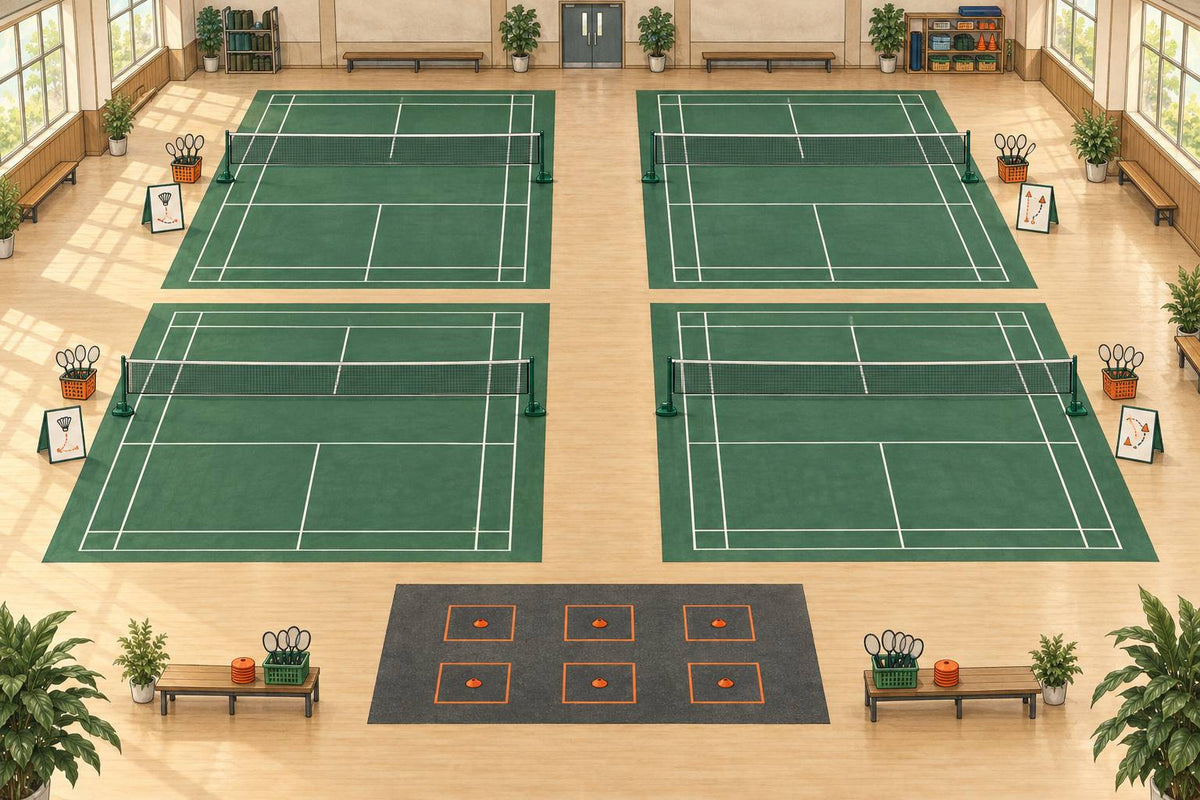
Divide 30 beginners into five fixed groups of six. Four groups use the four courts while the fifth works in a clearly separated movement grid. Every eight minutes, all five groups rotate one station in the same direction.
30 players
Group plan: five groups of six, with no membership changes during the lesson.
4 courts
Three technical courts, one restricted team-game court and one off-court station.
8 minutes
Seven minutes of activity followed by one minute to freeze, collect and rotate.
This plan solves a group-management problem, not an entire beginner curriculum. The hour teaches safe spacing, controlled underarm and sidearm contact, simple placement and cooperative rallying. Use the separate six-week badminton unit when you need a longer progression.
Player arithmetic and the five-station map
Five groups of six account for all 30 players. Four groups occupy Courts 1 to 4, and the fifth occupies a cone-marked movement grid outside the court run-off area. Three court groups use two hitting lanes and one support role; Court 4 keeps all six players in a restricted team game.
| Station | Surface and six-player layout | One adult watches for |
|---|---|---|
| A · Movement grid | Six marked boxes in a clear side area. Three pairs mirror a ready position, two side steps and a controlled stop, then throw and catch one shuttle. No rackets. | Players stay inside their boxes and freeze on the signal. |
| B · Court 1 | Two side-by-side half-court teaching lanes. Two pairs send and catch underarm over the net; the third pair counts and gathers only after the freeze signal. | Compact underarm action, safe feeder position and no loose shuttles in the lane. |
| C · Court 2 | Two half-court teaching lanes. Two pairs tap sidearm cooperatively over the net; the support pair counts the longest rally and keeps spare shuttles outside the sideline. | Rackets stay below shoulder height and neighbouring swings cannot meet. |
| D · Court 3 | Two half-court teaching lanes with one large target zone per lane. Hitters send underarm or sidearm toward the target; the support pair counts controlled landings. | Accuracy before power and retrieval only after all rackets are down. |
| E · Court 4 | A 3-versus-3 teaching game. Each player stays in a marked left, centre or right zone. Serve underarm, use compact strokes and rotate zones after three rallies. | Nobody crosses zones, runs behind a partner or uses a large overhead swing. |
The court arithmetic is 18 hitters plus six feeding, counting or collecting players across Courts 1 to 4, with six more in the movement grid. That is 30 assigned roles. At Stations B, C and D, three pairs rotate through lane one, lane two and the support position every two minutes. Each pair hits for four minutes and supports for two, then the whole group gets a one-minute challenge.
This layout follows the options in BWF Shuttle Time's large-group module: use smaller task areas, pair and group practice, timed on-court and off-court intervals, pupil feeding, and useful activities that do not need a court or net.
Teaching lanes are not regulation courts. The official doubles court is 13.40 metres long and 6.10 metres wide with 40-millimetre lines under the BWF Laws of Badminton. Cones, tape and assigned zones in this lesson create local teaching surfaces only. Do not teach service-box or boundary rules from those temporary marks.

The complete 60-minute timeline
Use the same start signal, freeze signal and clockwise rotation throughout the hour. The teaching explanation lasts two minutes because each station card carries one task, one count and one safety rule. The supervisor spends the station rounds observing spacing and flow rather than repeatedly rebuilding activities.
| Time | Block | What happens |
|---|---|---|
| 0:00–4:00 | Entry and safety | Assign five colour groups, show the outside rotation route and rehearse “freeze, racket down, shuttle down, eyes up.” |
| 4:00–10:00 | Whole-group warm-up | In three lines of ten, use ready stance, side steps, controlled stops, then partner throw and catch. Keep rackets parked. |
| 10:00–12:00 | Demonstration | Show one compact underarm send, one compact sidearm tap, the support role and the rotation direction. |
| 12:00–20:00 | Station round 1 | Seven minutes work, then freeze, collect and rotate for one minute. |
| 20:00–28:00 | Station round 2 | Use the same two-minute role cycle at each technical court. |
| 28:00–36:00 | Station round 3 | The supervisor gives one cue per group and leaves the task running. |
| 36:00–44:00 | Station round 4 | Groups rotate outside the courts and begin only on the start signal. |
| 44:00–52:00 | Station round 5 | Every group completes its fifth and final station. |
| 52:00–57:00 | Final challenge | Stay at the current station and beat the group's earlier rally, target or movement count without changing the safety rule. |
| 57:00–60:00 | Collect and review | Freeze, collect by station, count rackets and shuttles, then ask each group for one control cue and one safety cue. |
The five station rounds consume exactly 40 minutes. Every group experiences every station once, so Court 4 does not become an advanced court reserved for the strongest players. The restricted team game is simply another beginner task.
Make five stations manageable for one supervisor
Do not run this as a one-adult plan unless venue, organizer and safeguarding requirements permit that ratio, every station remains in direct sight and the adult can stop the whole group at once. Otherwise add a qualified supervisor or reduce the number of live stations.
- One freeze signal: every racket goes down before anyone retrieves a shuttle or crosses a boundary.
- One-way rotation: groups travel around the outside of the courts, never through an active court or behind a hitter.
- Visible station cards: each card shows one verb, one count and one safety rule. Example: “Send underarm · count catches · collect on freeze.”
- Controlled shuttle supply: keep a small station batch in a container outside the sideline. Do not scatter a full box across the floor.
- Safe support positions: feeders, counters and collectors stand behind a cone outside the swing and landing areas.
- No independent overhead hitting: this first large-group lesson uses throwing, underarm sends and compact sidearm taps. Overhead work belongs in a later lesson with more space and closer supervision.
- Stable equipment: check net posts and bases before entry. Use only venue-approved anchors for an optional teaching rope, and make the rope highly visible.
- Reduce before improvising: if the adult loses sight of a lane or players cannot maintain spacing, stop that lane and convert it to throw-and-catch or shadow movement.
These controls follow BWF's specific warnings about loose shuttles, space between pairs, safe feeder positions and stable net posts. The Shuttle Time lesson plans also keep waiting learners beside active courts, rotate roles in larger groups and use groups of four to six for fed activities.
The adult's technical feedback stays deliberately small. Watch first for spacing, retrieval and compliance with the freeze signal. Once those are stable, give one contact cue such as “send upward” or “short swing.” Trying to correct six different racket details while five stations run weakens the supervision system.
Adapt the arithmetic to 20 players on three courts
For 20 players and three courts, use four groups of five. Three groups occupy the courts and one uses the movement grid. Each court has two pairs hitting and one support player, so 12 players hit, three support and five move off court.
| Constraint | 30 players on four courts | 20 players on three courts |
|---|---|---|
| Groups | 5 groups of 6 | 4 groups of 5 |
| Court roles | 18 hit, 6 support | 12 hit, 3 support |
| Total live roles | 18 hit, 6 support, 6 move | 12 hit, 3 support, 5 move |
| Rotation block | 5 rounds of 7 minutes plus 1 minute | 4 rounds of 9 minutes plus 1 minute |
With five players on a technical court, rotate the support role after a short rally count rather than waiting for a long clock. The support player counts three completed rallies, calls the change and joins the next pair. Keep the same freeze signal, outside route and local teaching boundaries.
If you want more game choices without turning the session into full matches, use the separate guide to badminton games for large groups and few courts. Keep this lesson's five-station structure until the group can rotate and retrieve safely without repeated reminders.
Print this at the top of the lesson sheet
Groups: five colours, six players each.
Signal: freeze, racket down, shuttle down, eyes up.
Clock: seven minutes work, one minute rotate.
Route: clockwise around the outside of the courts.
Safety priority: spacing and retrieval before technical correction.

Leave a comment
This site is protected by hCaptcha and the hCaptcha Privacy Policy and Terms of Service apply.