
Last checked: August 2026 · Written by the player-led team at Badminton House
Quick answer
The cited research ratios used defined isokinetic testing conditions, and these sources do not establish a universal norm or a badminton injury prediction. A band hold is a separate general-training activity, not an isokinetic ratio.
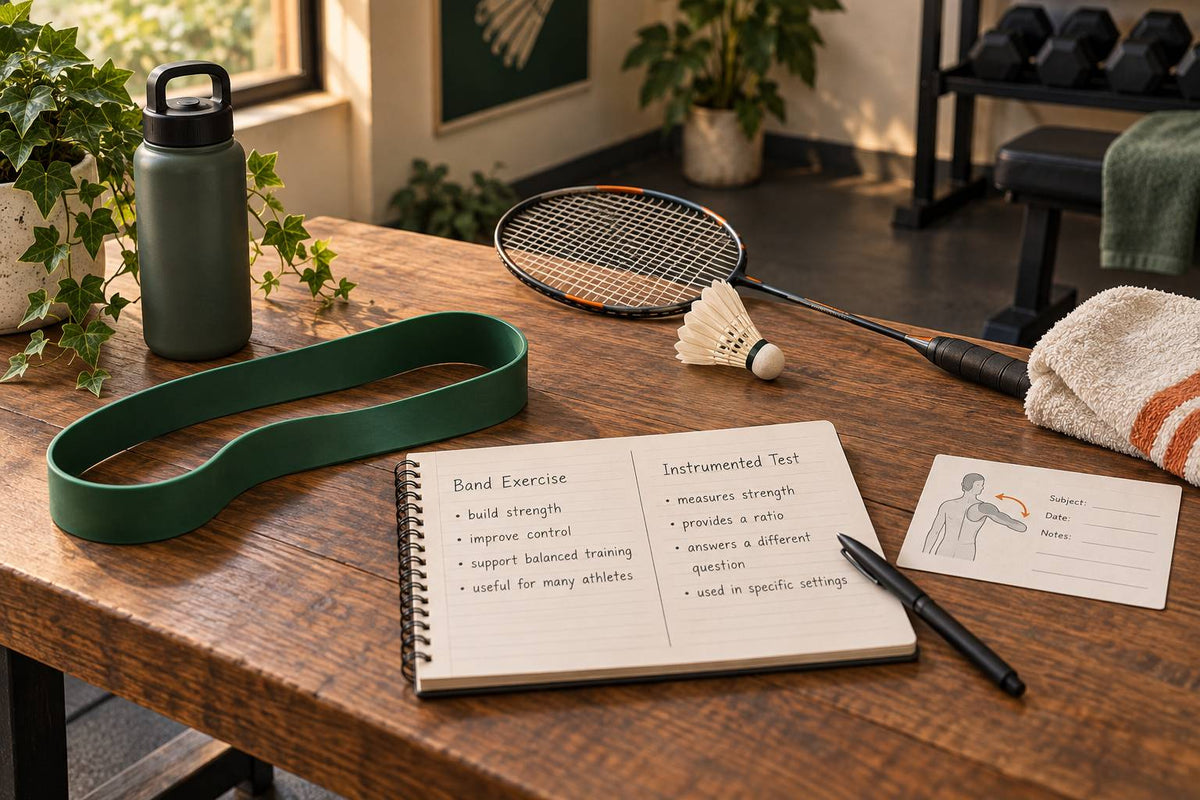
Start with a home band test is not an isokinetic rotator ratio
Keep a ratio tied to an isokinetic measurement and its stated test conditions. A band hold or home exercise is a separate local training choice; it cannot produce the research-style ratio.
- For a ratio number, record the stated isokinetic range of motion, contraction type, and test speed.
- Treat a band exercise as general training rather than an isokinetic ratio or target.
- Do not compare a timed band hold with an instrumented ratio from a study.
- Keep any individual decision separate from the limited population evidence in the cited studies.
A home band test is not an isokinetic rotator ratio
The cited studies use isokinetic dynamometry and report study-specific test conditions. A band exercise or timed hold is not an isokinetic ratio comparable with those studies, so a home exercise cannot stand in for the research measurement. isokinetic-dynamometry systematic review and shoulder-ratio study

A band exercise is not an isokinetic measurement. Whether to include it in a local training routine is a separate coaching choice, not a ratio result.
Treat an instrumented ratio as context-specific
Some prospective evidence links instrumented shoulder strength-ratio measures with injury in overhead-athlete populations, but further individual-sport research is needed. The systematic review reports limited prospective evidence and a need for sport-specific work. isokinetic-dynamometry systematic review

An instrumented measurement and a general shoulder exercise are different activities. Keeping them separate is a local record-keeping choice, not a measured ratio or target.
Separate general shoulder exercise from a ratio claim
In this cross-sectional sample, functional strength ratios differed between several sport groups; the authors advise caution when grouping overhead athletes across sports. The study does not supply a universal norm or settle a broader individual decision. shoulder-ratio study

The cited studies do not establish a universal ratio norm, a badminton-specific injury prediction, or an individual decision rule. A band exercise or timed hold does not create the research-style ratio.
Keep two kinds of information separate
In one local record, write the isokinetic test conditions beside any ratio reported by a source: range of motion, contraction type, and test speed. In a separate line, write the ordinary band exercise or timed hold being considered. Do not treat the two lines as the same measurement.
This preserves the study’s method without turning a general training activity into a ratio, a universal target, or a badminton-specific prediction.
Separate a measurement question from an exercise question
| Question | Appropriate record | Do not infer |
|---|---|---|
| Research-style ratio | Isokinetic test conditions, including contraction and test speed | A ratio from a band exercise |
| General shoulder work | The band exercise and resistance used | A universal norm or individual decision rule |
- Name whether the question is about a research-style ratio or general shoulder work.
- Keep a band exercise or timed hold in the general-exercise column.
- Keep any isokinetic result with its range of motion, contraction type, and test speed.
Read a published ratio at the right level
A reported shoulder ratio belongs to the way it was measured. Before using it as a comparison, keep the testing method together: isokinetic dynamometry, the stated range of motion, contraction type, and test speed. Removing those conditions leaves a number with no clear link to the task that produced it.
The systematic review concerns overhead-athlete populations and reports limited prospective evidence. The cross-sectional paper found several sport- and sex-specific differences and advises caution when grouping overhead athletes; neither source supplies a universal number for badminton players.
A useful local note can therefore have three short fields: the source’s stated testing conditions; the athlete population it studied; and the exact claim the source does not make. For this article, the last field is important: a band exercise or timed hold is not the instrumented ratio, and a ratio from one research population is not an automatic individual decision rule.
This approach leaves general shoulder work in its own lane. A local training choice can be described honestly without borrowing the authority of an isokinetic measurement, and a published measurement can be cited without being stretched into a badminton-specific target.
Two sources may both use the word “ratio” while relying on different positions, speeds, or populations. Keep the method beside the result so they are not treated as interchangeable. The same restraint applies to a band exercise: its resistance and movement can be recorded for the activity itself, but those fields do not convert it into the apparatus-based result used in the research.
The instrumented setup is not a decorative detail. Defined range of motion, contraction type, and test speed describe the task from which a study’s ratio was derived. If any of those fields are unknown, the source still supports its own result, but it cannot be cleanly compared with a different task. That is why a home exercise should remain an exercise note rather than a missing-data version of the research test.
The article’s useful boundary is method, population, and stated scope—not an unqualified number. This makes the cited research readable without turning it into a universal shoulder target.
Questions the cited sources do not settle
- A validated at-home rotator ratio, universal cutoff, or badminton injury-risk prediction.
- A claim that an eight-week band routine prevents shoulder injury.
What to do next
Keep a home band task in the general-exercise record. It is not an isokinetic ratio, a universal target, or a badminton-specific prediction.

Leave a comment
This site is protected by hCaptcha and the hCaptcha Privacy Policy and Terms of Service apply.