
Last checked: August 2026 · Written by the player-led team at Badminton House
Quick answer
Shadow swings can help you inspect stroke shape and movement before shuttle work, but the available BWF material does not validate a rep target or a fixed checklist. They show preparation and movement; they cannot show the resulting shuttle flight.
Start with shadow swings to inspect stroke shape before shuttle work
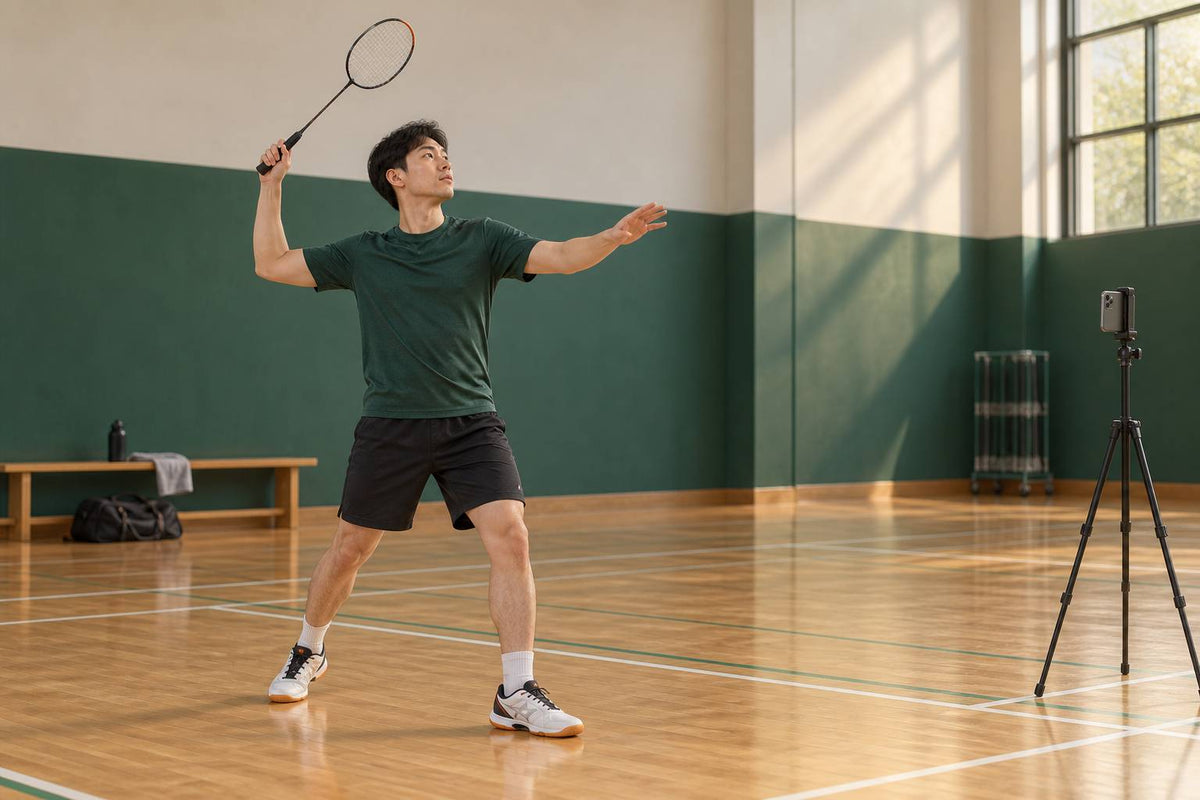
Local observation format: pick one view and one cue, then rehearse slowly. The mirror or phone view, cue, repetition count, and feed sequence below are a local observation format—not a BWF protocol.
- Choose one stroke and one cue, such as preparation, reach, or recovery.
- Use a mirror for a front view or a phone from the side or behind for the chosen cue.
- Compare a short set of rehearsals against that one cue and stop if the player cannot describe what changed.
- Once a shuttle is introduced, use a separate observation question; shadow practice alone cannot show the shuttle’s resulting flight.
Related reading: How to Feed Shuttles in Badminton: Hand Feed vs Racket Feed — for turning a rehearsed stroke into a controlled live feed.
Use shadow swings to inspect stroke shape before shuttle work
BWF coaching progression places shadow practice before suspended-shuttle work, hand or racket feeds, and more variable rally work. The Level 1 manual sequences practice from basic movement toward more complex feeding and rally conditions. The manual provides a teaching principle, not a fixed protocol. BWF Level 1 Manual

That distinction gives a local observer a clear job. Choose one part of the movement to look at, such as preparation or follow-through, and record only what that view can show. A mirror or phone can make the chosen shape easier to discuss, but neither turns the rehearsal into a score, a correction method, or proof that the next live shuttle will travel as intended.
Choose one stroke and one observation cue
BWF Level 2 describes a shadowed demonstration as showing the movement without hitting the shuttle. It says this focuses attention on stroke shape and does not let players see the shuttle’s resulting flight. The phone and mirror choices below are local observation choices, not a BWF protocol. BWF Level 2 Manual

A local rehearsal criterion can be simple and observable: the player can repeat the chosen cue slowly and describe it without guessing. That is a coaching choice, not a validated score or a promise that the same movement will hold under a live shuttle.
Move to a shuttle task when the rehearsal is reasonably competent
BWF guidance recommends adding complexity only after the prior standard remains reasonably competent. The Level 1 manual applies that progression principle to practice design. Choosing the sequence for a particular group and session is a local coaching choice. BWF Level 1 Manual

Once a shuttle is introduced, use a separate observation question; shadow practice alone cannot show the shuttle’s resulting flight. Neither cited BWF manual prescribes a rep target or a fixed multi-point test for shadow swings.
Use one local observation note
Record the stroke, the mirror or phone view, one visible cue, and the next small change to consider. The note is a local observation format, not a score, repetition quota, or claim of match transfer.
If a shuttle is later introduced, retain the cue but ask a separate question about its resulting flight. That keeps shadow-only movement inspection distinct from shuttle-contact feedback.
Questions the cited sources do not settle
- A mirror-only correction method or prescribed shadow-swing dosage.
- A claim that shadow practice alone verifies shuttle control or match transfer.


Leave a comment
This site is protected by hCaptcha and the hCaptcha Privacy Policy and Terms of Service apply.