
Last updated: July 2026 · Written by the team at Badminton House
Quick Answer: Why Does a Shuttlecock Spin?
Separate axial spin from the aerodynamic alignment that turns the cork into the flight direction.
Cork-first
Main cause: dense cork sits ahead of the light feather skirt, so drag turns the shuttle into stable cork-first flight.
Spin
Feather overlap and inclination create natural counterclockwise spin from the hitter’s view, a different motion from end-over-end turnover.
Slowdown
The same skirt that stabilizes the shuttle also creates large drag, so it slows much faster than a ball.
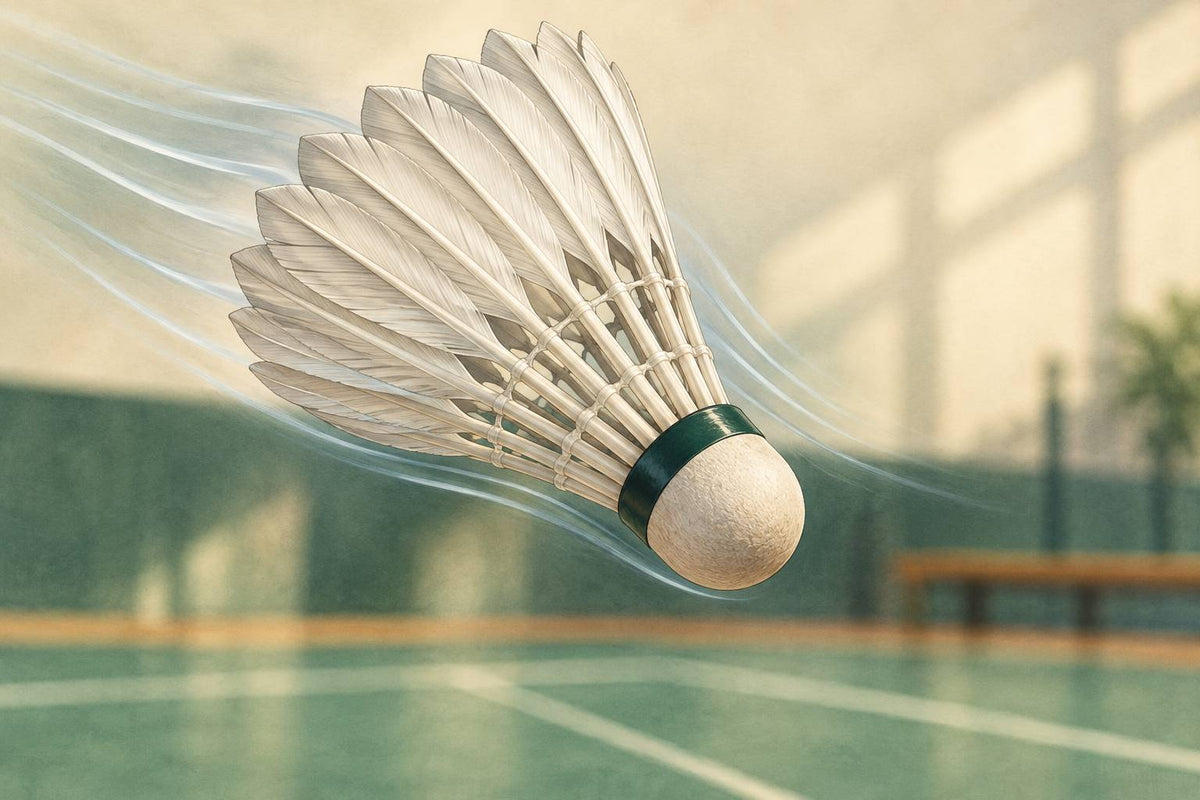
A shuttle’s dense cork, broad light skirt and overlapping feathers explain its unusual flight. Aerodynamic forces turn it into cork-first alignment, while feather geometry also produces rotation around its long axis. These are related but distinct motions.
So when people ask “why does a shuttlecock spin?”, the useful answer is not just spin — it is spin plus self-stabilizing flight.
In This Guide
The Cork-First Trick: Mass in Front, Drag Behind

A shuttlecock is a strange projectile by sports standards: after racket impact, it flips until the cork points into the flight direction. That behaviour comes from two design features working together. First, the shuttle is conical, so the feather skirt presents a large aerodynamic surface to the air. Second, its mass is uneven: the cork is dense and heavy, while the feathers are light.
In the simplified model studied by Cohen and colleagues, the centre of mass sits roughly 3 cm ahead of the centre of pressure; the separation depends on the shuttle. In plain language, the weight is concentrated near the front, while the air pushes mostly on the skirt behind it. If the shuttle leaves the racket at an angle, drag on the skirt creates a correcting turn that brings it back into alignment. Its most stable flight position is zero angle of attack: cork forward, body lined up with the airflow.
The Flip Happens Fast — But Not as a Full Loop

The flip is better pictured as a rapid correction than a tumbling loop. In high-speed footage of a typical flip, racket contact lasts about 1 millisecond. The shuttle then goes through an initial turnover in about 20 milliseconds, followed by roughly 80 milliseconds of oscillation as it settles into stable cork-first flight.
That sequence matters: turnover first, wobble second, stabilization third. An ordinary post-impact flip usually settles before completing a full turn; deliberately tumbling net shots are an exception. Instead, aerodynamic forces pull it toward alignment, it overshoots slightly, then the oscillation damps down until the cork points along the direction of travel.
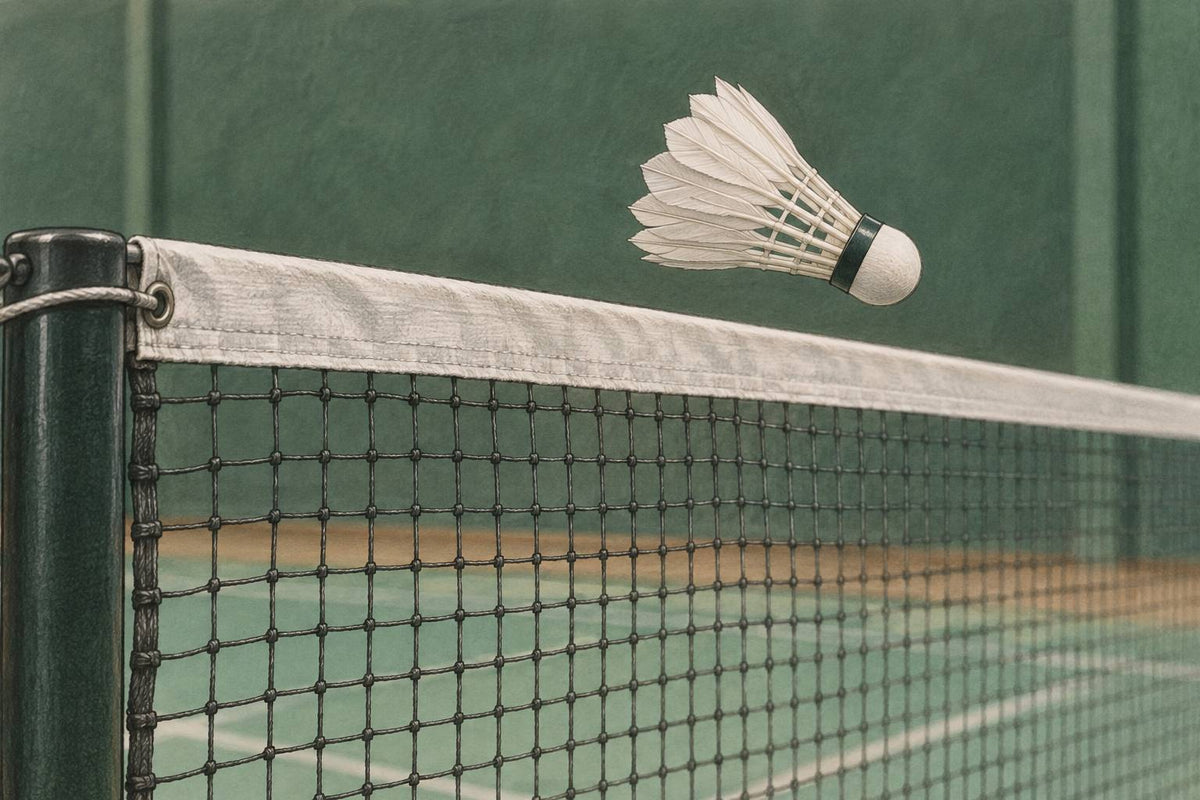
At lower hit intensity, those turnover and settling times get longer. In normal rallies, though, stabilization is so fast that the receiver usually sees an already aligned shuttle. The main exception is a delicate net drop, where delaying the flip can leave the skirt leading just long enough to make clean contact harder.
Why Does a Shuttlecock Spin?

A shuttlecock spins because a conventional feather shuttle is not a smooth, symmetrical cone. It uses sixteen overlapping feathers arranged in a conical skirt, and those feathers sit at slight angles to the airflow. As the shuttle moves away from the hitter, air passing over that overlapping feather pattern produces a natural counterclockwise rotation from the hitter’s view.
Axial rotation is distinct from the drag-driven correction that aligns the cork with the flight direction; it is not a spinning-top explanation for that alignment. It is not the same thing as deliberately brushing the shuttle on a net shot. In flight physics, the feather geometry creates the rotation; in technique, the player adds touch and racket angle to make the shuttle tumble near the tape. If that shot is what you meant, see our separate guide to badminton spinning net shots.
One small detail: if a shuttle already has pre-spin aligned with its natural rotation, its wobbling or oscillation phase can shorten slightly. That observation depends on the tested launch conditions and does not make pre-spin necessary for cork-first alignment.
Why Shuttlecocks Slow Down So Much Faster Than Balls


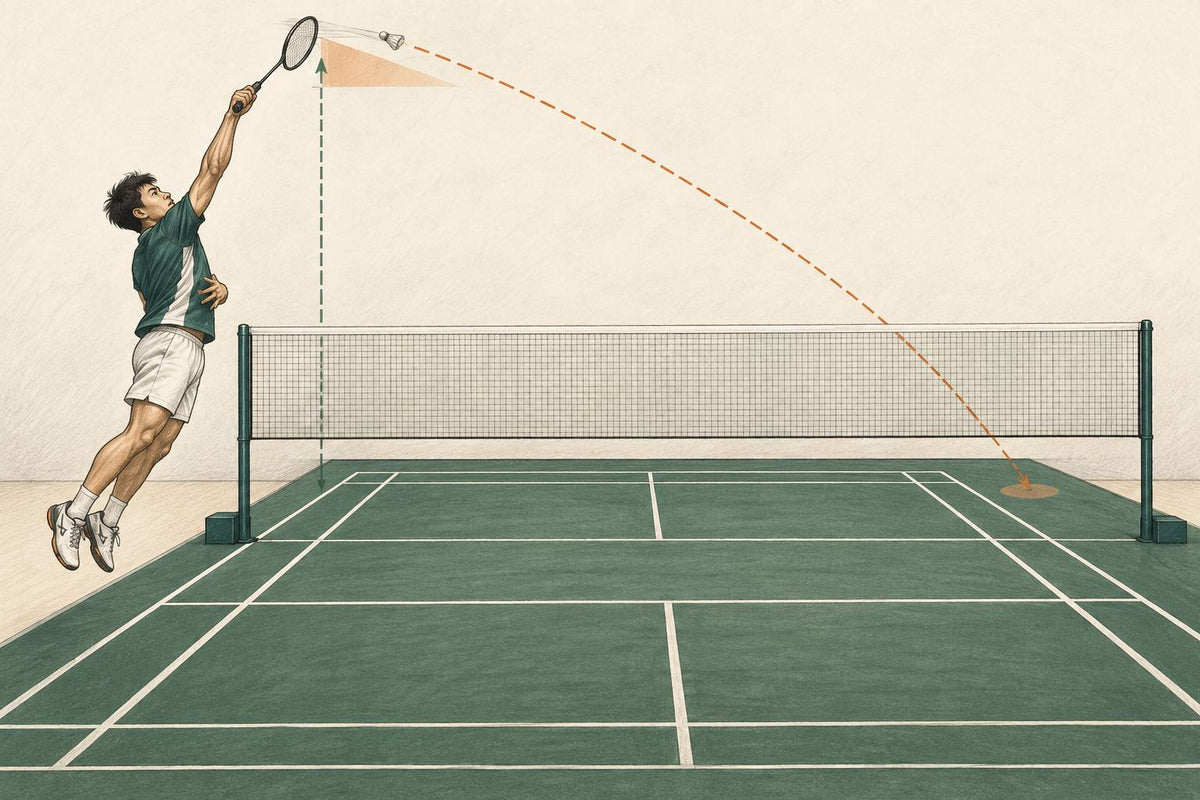
A ball is relatively compact, so once it leaves the racket it keeps much of its speed. A shuttlecock presents a large feather or skirt area to the air, so drag is much bigger and the shuttle decelerates far faster. That is why a hard smash can leave the strings violently, then seem to “stand up” and drop within the court instead of carrying like a tennis ball.
The same geometry that creates drag also has to be tuned carefully. If the skirt opening is too narrow or too wide, the shuttle takes longer to flip and longer to settle. Real shuttlecocks use an intermediate opening angle, helping them turn cork-first quickly and stabilize rather than wobble down the whole flight.
Which Shuttle Should You Choose?
For this physics question, the key choice is what you want to notice in flight: cork-first alignment, natural spin, or the rare moment before stabilization.
| Choose this if... | What it shows |
|---|---|
| You want the basic cork-first effect | Both feather and synthetic shuttlecocks share the same core weight idea: the cork is much heavier than the skirt, so the shuttle aligns cork-first. |
| You want to see spin clearly | Watch a slow-motion clear or smash — the counterclockwise rotation covered above is easiest to track under floodlights or on video. |
| You want to feel the exception | Practise tight net drops, where the delayed-flip timing described above is most noticeable under your racket. |
Get 10% off your first order
Join the Badminton House list and we’ll email you a 10% welcome code — plus training guides, technique advice, and badminton updates.
By subscribing, you agree to receive Badminton House emails and can unsubscribe anytime.
Once you see why a shuttlecock spins, flips, and settles cork-first, you start feeling the design in every clear, net shot, and lift. We play badminton ourselves, so if you are choosing shuttles for training or match play and want a second opinion, contact us and tell us how you play.
Feel the flight for yourself.
Shop ShuttlesExplore shuttle options and check live availability before you buy.

Leave a comment
This site is protected by hCaptcha and the hCaptcha Privacy Policy and Terms of Service apply.