
Last updated: June 2026 · Written by the team at Badminton House
Quick Answer: Feather vs Nylon Shuttlecocks
Check the club or event’s shuttle requirement first. Feather and nylon offer different construction, flight and wear characteristics; compare models using the shuttle type your session accepts.
Feather
Common use: feather shuttles are common in competitive play, but an event’s specified model determines what is accepted.
Nylon
Nylon can be practical for repeated casual or school use; lifespan and flight depend on the model and play.
Speed
Choose the manufacturer’s speed grade for the hall conditions, then test flight; city alone does not determine a universal 76–78 choice.
Feather and nylon construction differ, but neither the purchase price nor a broad material label tells you the cost of a session. Compare flight consistency, shuttle use and the organiser’s requirements.
This guide breaks down the differences between feather and nylon shuttlecocks, explains how to check quality, shows which speed you need in Canada, and recommends the best shuttlecock for your level and budget.
Best for tournaments
Choose tournament-grade feather shuttles with consistent flight and BWF-grade quality.
Best for club nights
Choose reliable goose feather options that balance consistency, durability, and cost.
Best for beginners
Choose nylon if durability, budget, schools, casual play, or outdoor use matters most.
Need shuttlecocks for club night or tournament play? Browse our full shuttlecock collection, free Canadian shipping on $200+.
In This Guide
Feather vs Nylon Shuttlecocks — What's the Difference?
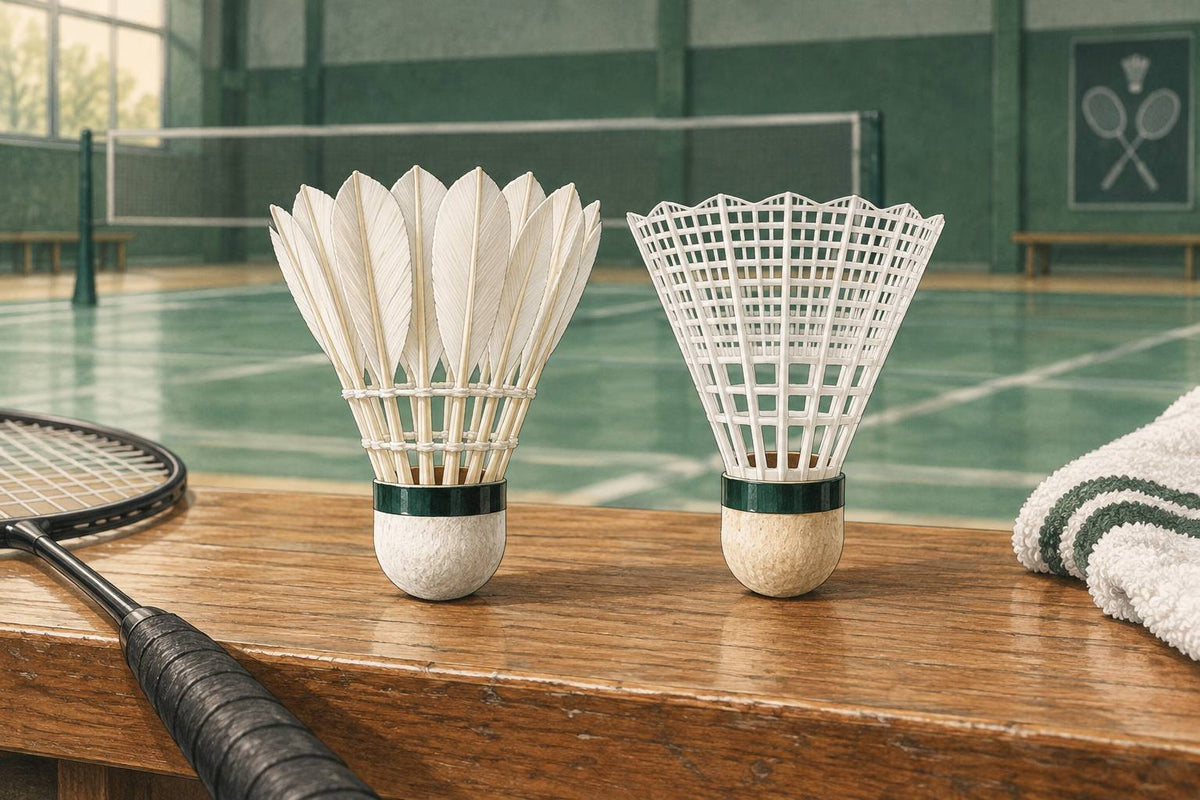
A feather shuttlecock uses 16 natural feathers around a rounded base. A conventional nylon model has a moulded synthetic skirt; base materials vary, and the MAVIS 350 uses natural cork. The BWF Laws cover both feathered and non-feathered construction, while individual events specify accepted equipment.

| Property | Feather Shuttlecock | Nylon Shuttlecock |
|---|---|---|
| Material | 16 goose or duck feathers + cork base | Nylon skirt + synthetic or cork base |
| Flight | Compare the chosen model’s flight in the hall | Model-specific flight; compare using the same shots |
| Speed control | Evaluate flight, contact and net response | Evaluate flight, contact and net response |
| Sound | Crisp, satisfying "crack" on impact | Duller, plastic-like contact |
| Durability | Varies with grade, contact, conditions and replacement criteria | Varies with model, contact and replacement criteria |
| Cost | Compare current pack price and quantity | Compare current pack price and quantity |
| Tournament use | Check the event’s specified model | Check the event’s specified model |
| Best for | Club play, leagues, tournaments, skill development | Beginners, casual play, outdoor play, schools |
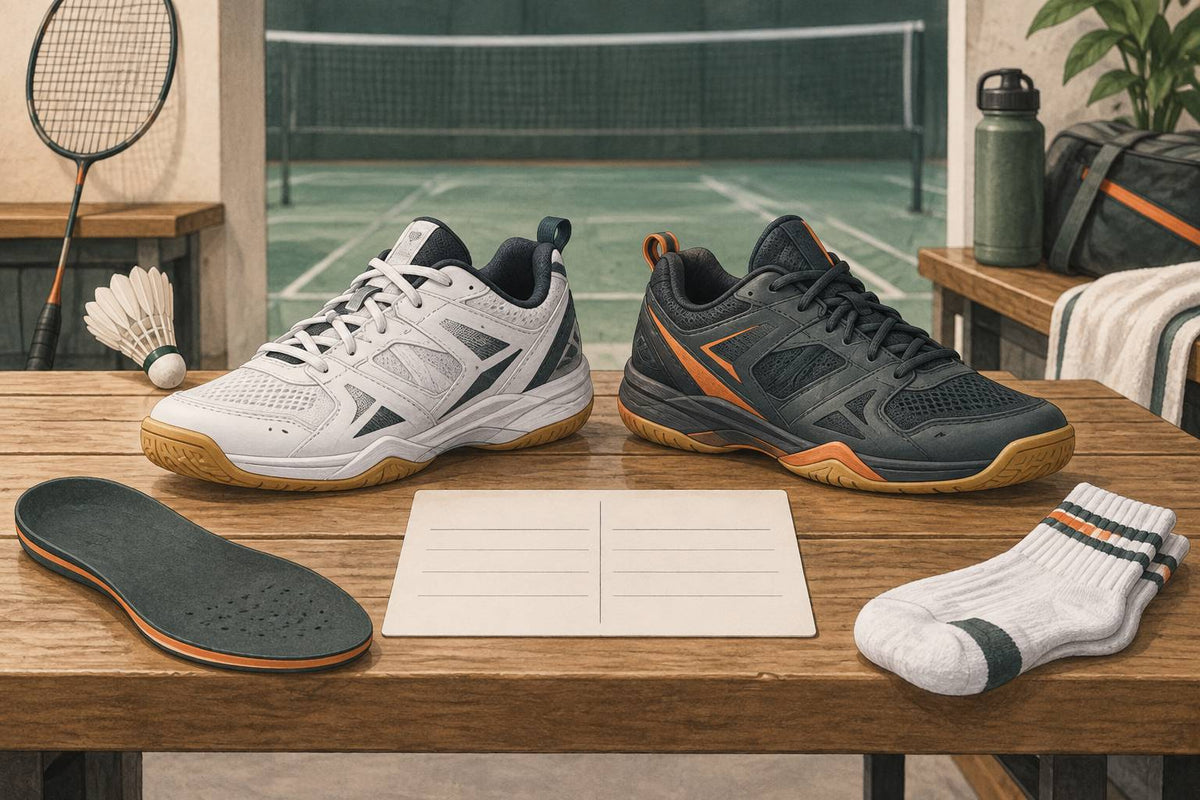
Bottom line: If you play regularly at a club and want to improve, use feather. If you're just starting, playing outdoors, or on a tight budget, nylon is the practical choice. Club nights also mean lots of lateral movement. See our Yonex vs Victor shoe comparison and court footwear.
How Do Feather and Nylon Shuttlecocks Fly Differently?

Flight depends on the shuttle’s construction and the shot. Compare matched speed grades with repeatable clears, lifts and net shots, checking length, stability and how the shuttle descends. A shuttle’s drag means its flight should not be described as a simple parabolic path.
Nylon designs differ, including how the skirt recovers after impact. Judge the model you use instead of assuming every nylon shuttle has the same flatter path.

Deception also depends on preparation and contact; there is no supported universal deceleration ratio that makes deceptive shots possible only with feather.
Building a full setup? Pair the right shuttle with our visual racket guide and Yonex vs Victor shoe comparison.
How to Check Natural Feather Shuttlecock Quality
Compare feather condition, base construction and consistency across a tube. Price or a goose-versus-duck label alone does not establish the grade.
1. Feather Type — Goose vs Duck
Goose feathers: evaluate the exact model and grade; species alone does not establish consistency, durability or tournament approval.
Duck feathers: likewise compare the stated construction and actual flight. Do not infer that all duck-feather shuttles are unsuitable for matches.
2. Cork Base — Natural vs Composite vs Synthetic
- Full natural cork: a base construction to check in the manufacturer’s specification; it does not prove tournament approval.
- Composite cork: layered construction varies by model; check the stated materials.
- Synthetic/foam: used in some constructions; do not assume every nylon shuttle has this base.
3. Quality Control — Consistency Across the Tube
Manufacturers grade shuttles for consistency. Sample more than one from a tube and assess stable flight at the required speed; no tube can promise identical flight in every condition.
Quick Quality Check — What to Look For
- Feathers: Should be uniform in shape and length. Inconsistent curvature means lower grade.
- Base: check for damage or looseness; a thumbnail dent cannot authenticate the material.
- Thread binding: The thread wrapping the feather shafts to the cork should be tight and even. Loose thread means feathers will splay out faster.
- Flight check: test for stable flight on court; rolling on a table does not replace this check.
Best Feather and Nylon Shuttlecocks in Canada (2026)
The following table preserves the guide’s model shortlist as a starting point for comparison. Confirm the exact construction, accepted event model and local availability; tiers are editorial groupings, not an official approval list.

| Tier | Yonex | Victor | Li-Ning | RSL | Aeroplane |
|---|---|---|---|---|---|
|
Tournament Confirm accepted event model |
AS-50 | Master Ace | A+600 | No. 1 Tourney | Black Label |
|
Competition Compare the model required by your league |
AS-40 | Master No. 1 | A+300 | No. 2 Tourney | Red Label |
|
Club Compare the exact model and construction |
AS-30 | Gold Champion | G700 | Classic Tourney | Green Label |
|
Training Drills and warm-up options |
AS-20 / ACB-33 | Gold No. 1 | G300 | DTL 80 | — |
|
Nylon / synthetic Casual, outdoor, beginner |
Mavis 350 | NCS / NCS Pro | Future 9 / 10 | — | — |
Compare current prices by pack quantity and actual use. Buying a racket too? Read how to spot a fake Yonex, Victor, or Li-Ning racket before checkout.
Best Value Picks
Tournament comparison: confirm the accepted model first; the listed Aeroplane and Yonex options are not a guarantee of identical flight or a fixed price saving.
Club comparison: include Yonex AS-30 in a sample-tube comparison of speed, consistency and session cost.
Feather alternative: compare Li-Ning A+300 with other locally available models; a team-use claim is not needed to assess your session.
Nylon option: compare the MAVIS 350 speed grade with your hall conditions, without assuming a fixed lifespan.
Which Nylon Shuttlecock Should You Buy in Canada?

Yonex MAVIS models provide familiar nylon options; the table below is a selection, not the entire current range. Other conventional and hybrid synthetics use different constructions, so compare the exact model.
The Yonex Mavis Ladder
MAVIS models differ in skirt design and specification. Check the exact model’s base material and regional listing instead of assuming a single construction or a complete five-model range.
| Model | Construction | Purchase check | Who it's for |
|---|---|---|---|
| Mavis 10 | Basic nylon skirt + cork base | Confirm pack quantity and availability | Schools, backyard rallies, first shuttles |
| Mavis 300 | Nylon skirt + cork base | Confirm pack quantity and availability | Budget rec play — flies slightly faster and duller than the 350 |
| Mavis 350 | Tougher nylon skirt + natural cork base | Confirm pack quantity and availability | The Canadian default — rec centres, schools, casual club nights |
| Mavis 600 | Wing Rib skirt + cork base | Confirm pack quantity and availability | Improvers — quicker skirt recovery after hits, closer-to-feather feel |
| Mavis 2000 | Wing Rib skirt + cork base | Confirm pack quantity and availability | The closest nylon gets to feather flight — serious players who need durability |
Check the current seller’s pack quantity and the manufacturer’s model specification before comparing price.
Cap Colours — the Nylon Speed System
For Yonex MAVIS 350, green means slow (22–33°C), blue medium (12–23°C), and red fast (0–13°C). These are manufacturer-specific starting ranges; test flight in your hall and account for altitude.
Which Cap Colour for Canadian Venues?
- Blue (medium): the default for heated Canadian gyms and rec centres (~18–22°C). If in doubt, buy blue.
- Green (slow): hot, humid summer sessions in community centres without air conditioning.
- Red (fast): cold arenas, garages, church halls, and drafty school gyms in winter.
Beyond Yonex — Victor, Li-Ning, and Hybrid Shuttles
Victor NCS and NCS Pro are hybrid synthetics rather than conventional one-piece nylon skirts. Check their exact construction and pack quantity; do not treat a hybrid label as proof of better flight.
Li-Ning Future 9 and Future 10 are conventional nylon shuttles (cork base, durable nylon skirt, 6-packs) sold in Canada mainly through online marketplaces. Check the live listing for current pricing.
Playing Outdoors or at the Cottage?
A calm outdoor setting may work for casual rallies, but wind changes flight. AirShuttle is designed for AirBadminton; it is not a promise of predictable play in every breeze or location.
Stocking up on nylon? Browse nylon and feather options in our shuttlecock collection. And when you're ready to step up to feather, our best feather shuttlecocks in Canada guide ranks every tube worth buying, tier by tier.
Which Shuttlecock Is Right for You?
Not sure where to start? Follow this decision chart:

Beginner / Casual
Just Starting Out
Playing once a week or less. Still learning. Playing outdoors or at a rec centre.
Pick: Yonex Mavis 350 (nylon)
Intermediate / Club
Regular Club Nights
Playing 2–3 times per week. Can rally consistently. Want to develop your game.
Pick: Yonex AS-30 or Li-Ning A+300
Competitive / League
Tournaments & Matches
Competing in provincial events or leagues. Need consistent flight and BWF-grade quality.
Pick: Yonex AS-40, Aeroplane Red Label, or RSL No. 2 Tourney
Tournament / Elite
National & International
Competing at the highest level. Use the event’s accepted shuttle model and speed.
Pick: Yonex AS-50, Victor Master Ace, or Aeroplane Black Label
How to Make Feather Shuttlecocks Last Longer
Feather shuttles wear with use. These care checks help protect them without promising a particular lifespan:
- Follow the maker’s care guidance. Do not apply a universal kettle-steaming time to every shuttle model.
- Store tubes upright with the cap on. Don't leave birdies loose in your bag. Feathers get crushed.
- Separate worn shuttles. Keep usable practice shuttles apart from fresh match shuttles.
- Protect stored tubes. Avoid crushing, heat and unsuitable storage conditions; follow the manufacturer’s guidance.
- Check storage conditions. Follow model-specific humidity advice rather than adding moisture by guesswork.
Frequently Asked Questions
"Best badminton shop in Canada. They actually know their gear and helped me pick the right string tension."
— Alex P., Calgary, AB
Get Shuttle Speed Cheat SheetFree shipping across Canada on $200+ · 14-day returns · Canadian badminton specialty shop
Get new badminton guides by email
Join the Badminton House list for occasional emails with new guides, technique tips and news from our club in Moncton.
By subscribing, you agree to receive Badminton House emails and can unsubscribe anytime.

Leave a comment
This site is protected by hCaptcha and the hCaptcha Privacy Policy and Terms of Service apply.