
Last checked: August 2026 · Written by the player-led team at Badminton House
Quick answer: slippery court
Between rallies
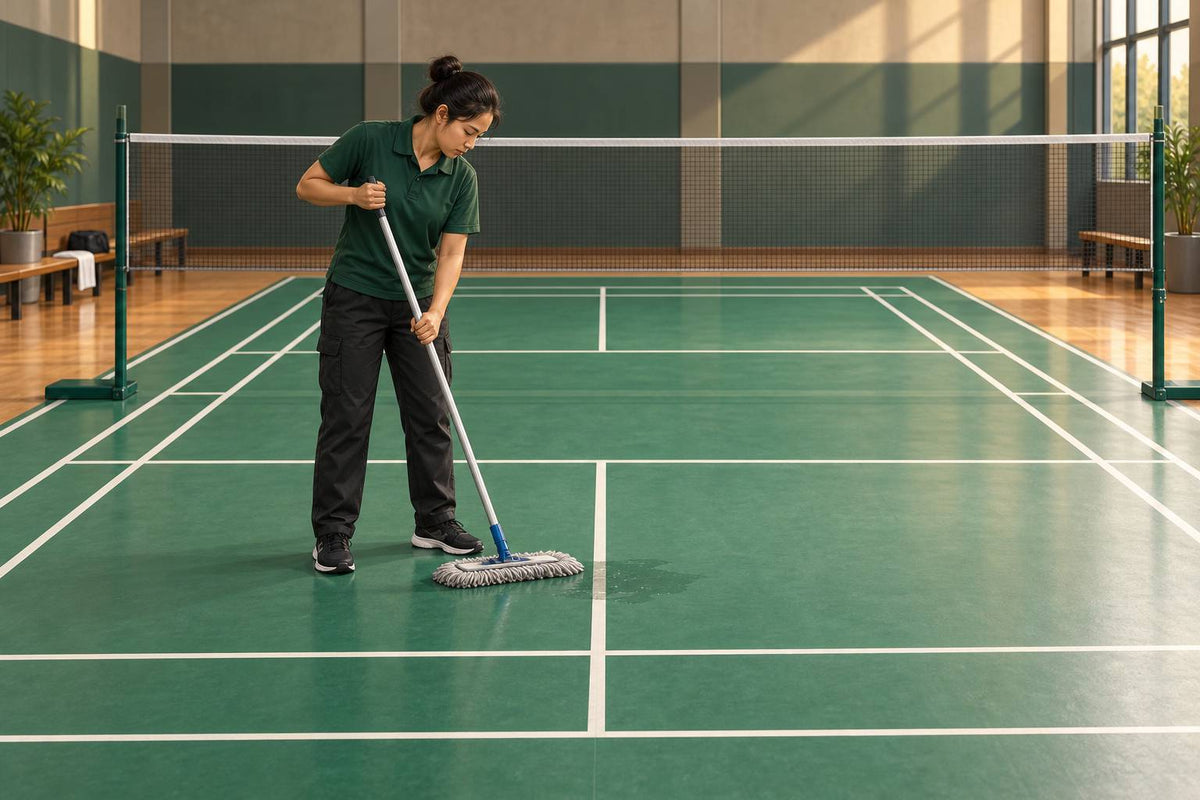
Ask for a wipe and point out the exact patch. In an umpired match, court attendants handle the mopping.
Quick wipe
The umpire may tell a player to use a foot wipe instead of bringing attendants onto court.
Unsafe condition
Play can be suspended while the court is made suitable again; the existing score stands.
A wet patch is a playing-condition issue, not an extra recovery break. In an umpired match, signal the problem after the rally, show the court attendant where it is, and return promptly once the surface is dry. If the condition makes the court temporarily unplayable, play can be suspended until the area is suitable again.
Different problem, different fix: this guide covers stoppages and wiping. For the causes of a slippery surface and steps to take before play, see our slippery badminton court guide. If the problem is your hand rather than the floor, use our guide to a grip slipping from sweat and heat.
How do you request a court wipe in an umpired match?
Wait until the rally ends, tell the umpire there is a wet patch, and show its exact location. The current BWF Instructions to Technical Officials say players indicate where mopping is needed. Without the Time Clock, they return as soon as wiping is complete and before the attendants leave; with the Time Clock, they must follow its return procedure.
The umpire controls the response. Official vocabulary includes “Use your foot to wipe the court” as well as instructions to wipe the court and show the attendant where to work. Those are umpire directions, not phrases that give a player a timeout. Read the current BWF vocabulary.
Be specific. Point to the landing area or approach step that is wet instead of waving at an entire half-court. If you brought sweat or water onto the floor, help identify the patch but do not fling moisture from your arms or clothing. BWF technical instructions treat throwing sweat or otherwise contaminating the court and its surroundings as unacceptable conduct.
When does a wipe become a suspension?
A normal wipe is brief; a court that cannot be made suitable quickly is different. The BWF Laws of Badminton let the umpire suspend play when circumstances outside the players' control require it, and permit the Referee to instruct a suspension in special circumstances. If play is suspended, the existing score stands and the match resumes from that point.
This is why the useful report is “There is water on the court,” not “I need a break.” The Laws require continuous play, make the umpire the sole judge of delay, and prohibit delay to recover strength or wind or receive advice. A genuine playing-condition problem belongs to the officials; the player reports it and gets ready to resume.
If a hazard appears during a rally
Protect yourself from an immediate fall or collision, but do not assume every self-stopped rally is automatically replayed. With no umpire, Law 14.1 permits a player to call a let to halt play; whether an unexpected wet patch qualifies under the unforeseen-or-accidental provision still requires a fair judgment.
What is a fair club-night procedure without an umpire?
Agree a simple house procedure before the first serve. It is not a replacement for the BWF Laws; it prevents a wet patch from turning into an argument. The useful default is to stop between rallies, identify the spot together, dry it with the venue's approved towel or mop, and restart on the existing score.
- Before play: identify who can fetch a mop or contact staff and where the approved cleaning supplies are kept.
- Between rallies: either side may flag a patch; both sides look at the same place before anyone wipes.
- During a rally: if an immediate hazard makes continuing unsafe, call the stop plainly and settle whether the unforeseen-situation let applies before the next serve.
- Recurring moisture: close the court, involve venue staff, and move only when another surface has been checked.
| What you find | Immediate decision | Before play resumes |
|---|---|---|
| One visible sweat drop after a rally | Keep everyone off the spot and use the approved towel or mop. | Both sides see that the exact landing area is dry. |
| A bottle spill reaches a line or run-off area | Stop using the court and involve venue staff rather than spreading the spill with shoes. | Check the full wet edge, not only the most visible centre. |
| Moisture returns in the same place | Treat it as a venue condition, close the court, and report the recurring location. | Resume there only after staff confirm that the surface is suitable. |
Do not solve one hazard by creating another. Keep bottles and the wet towel outside the run-off area, collect loose shuttles before people cross the court, and follow the venue's cleaning instructions rather than applying an unapproved spray. When the source is a leak, condensation, or moisture rising through the surface, repeated wiping is not a durable answer; close the court and let venue staff decide when it can reopen.
Keep the decision about the condition, not the score. A real patch near one front court is still a patch at 19-all. A shared process protects both sides and preserves the pace of the session.
The one-sentence version
Ask for the wipe between rallies, point to the exact spot, return as soon as it is dry, and let the umpire decide whether the situation requires more than a quick mop.


Leave a comment
This site is protected by hCaptcha and the hCaptcha Privacy Policy and Terms of Service apply.