
Last checked: August 2026 · Written by the player-led team at Badminton House
Quick answer: shuttle pickup drill
Place shuttles at planned court points, retrieve one at a time, return to a marked base, and score only clean rounds. Start the timer after the movement is repeatable; it must never reward a rushed, unstable, or rounded-back pickup.
Start here
Four points: use two front and two rear positions, four pickups per round, and a controlled return to base after each shuttle.
Score
Record the fastest clean round and how many rounds stayed technically clean. A fast messy round does not count.
Progress
Add a sixth point or imagined racket contact only after posture and foot alignment stay controlled.
A shuttle pickup drill gives a solo court session a clear route, a repeatable score, and an immediate technique check. Unlike multi-shuttle training, it needs no feeder and no hitting. Its value comes from deliberate travel and recovery, not from exhaustion.
Before you start: warm up, wear stable indoor court shoes, and clear every loose shuttle outside the planned route. Stop the timed round if pain, slipping, or loss of balance changes your movement.
How do you set up four pickup points?
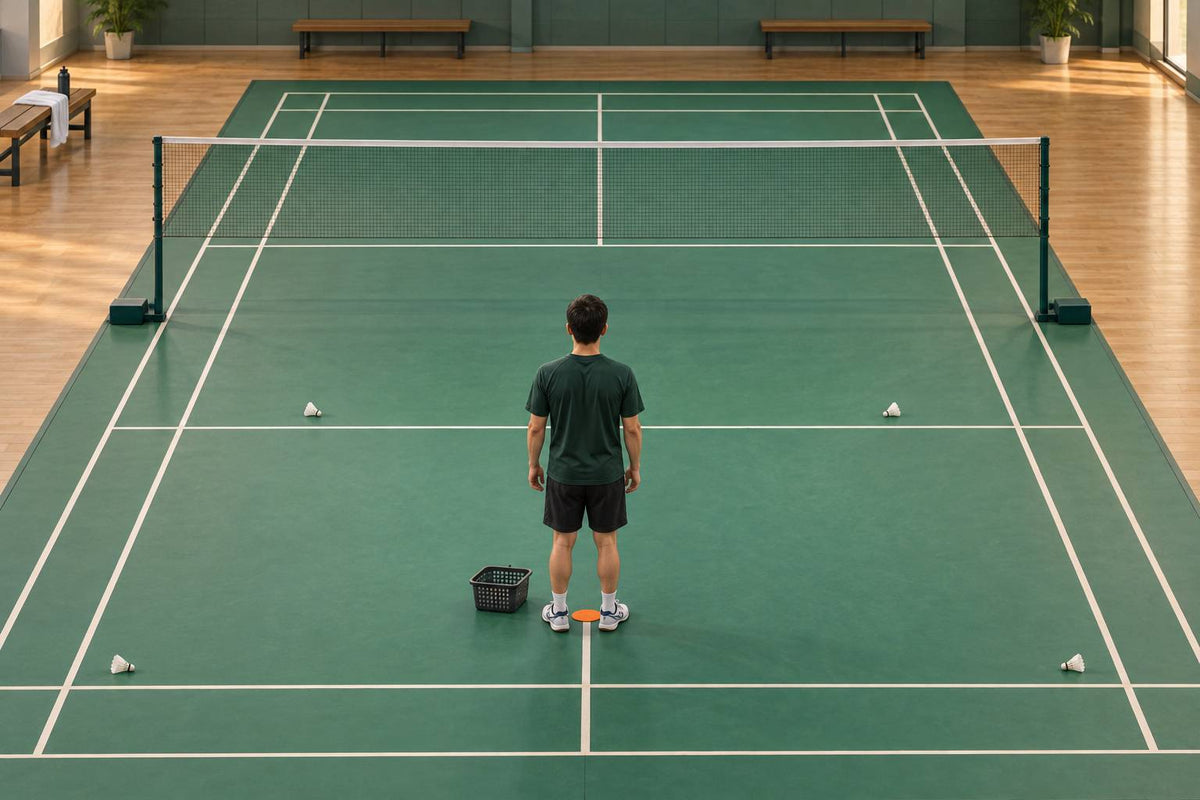
Place a base marker on the centre line about one metre behind the short service line. Put two shuttles near the front singles corners and two well inside the rear singles corners. Each point should require real movement and a controlled lowering action without forcing a dive, twist, or reach beyond balance.

| Marker | Practical placement | Movement focus |
|---|---|---|
| Base | Centre line, about one metre behind the short service line. | Brief reset before the next route. |
| Front pair | Inside each singles sideline, just behind the short service line. | Controlled forward lunge and push back. |
| Rear pair | Inside each singles sideline and well inside the back boundary. | Turn, travel, lower through the legs, then recover under control. |
Use a tube, small basket, or towel at base as the return point. Pick up one shuttle, carry it back, place it down, and reset before leaving for the next point. Do not throw shuttles toward base; the return is part of the repetition.
At a front point, use a real lunge. BWF Shuttle Time's lunge guidance describes a large stride with the lead foot pointing toward the shuttle, heel contacting first, and the lead knee tracking in the same direction as the foot. That alignment matters more than reaching farther.
What counts as one clean round?
One round is four separate journeys: base to shuttle, pickup, controlled return, and reset. Use front-right, rear-left, front-left, and rear-right on the first round; reverse the order next time so neither side always arrives under the same fatigue.
- Start at base in a relaxed ready position.
- Move to the first shuttle along the route you would use to approach that part of the court.
- At the front, lower through a lunge. At the rear, bend the knees and hips rather than folding from the waist.
- Carry the shuttle to base, place it in the container, and reset the feet.
- Stop the round if you lose balance, your lead knee collapses inward, your back rounds to scoop, or you rush the pickup.
BWF Shuttle Time includes retrieving a shuttle placed far in front as a dynamic-balance activity and asks players to repeat it on the opposite leg. See the BWF Shuttle Time guidance. That is why the pickup must look balanced before it looks fast.
Suggested first session
- Walk one untimed rehearsal round.
- Complete three clean rounds with 45–60 seconds of rest.
- Time one final round only if the earlier pickups stayed controlled.
How do you score the drill without rewarding bad movement?
Record two results: the number of clean rounds and the best clean time. The first protects the purpose of the drill; the second shows whether the same quality is becoming easier. Compare only sessions with the same layout, order, footwear, surface, and rest interval.
| Starting point | Suggested task | What counts as progress |
|---|---|---|
| New to lunging | Three front pickups per side; no timer. | Balanced pickup and recovery on both lead legs. |
| Regular club player | Four points, three timed rounds, fixed rest. | More clean rounds or the same clean time with less drift. |
| Experienced player | Six points, fixed order, four timed rounds. | A stable final round without shortened steps or rushed pickups. |
These are coaching starting points, not fitness rankings. Shorten the route if that is what preserves a sound lunge. BWF guidance for agility work is to begin slowly enough to execute it well; the timer comes second.
How do you progress the route?
Add one demand at a time while pickup quality stays intact. Keep the layout consistent for a training block and return to an easier version whenever the finish positions become unstable.
- Progression 1: require both feet to reset at base before the next departure.
- Progression 2: add two side positions for a six-point route while keeping the same container and order.
- Progression 3: make an imagined net, lift, or overhead contact at the destination before picking up the shuttle.
- Regression 1: use only the front positions and walk the return.
- Regression 2: keep four positions but remove the timer and hold a balance check at each pickup.
The common failure is scooping the shuttle with a rounded back. Shorten the placement, arrive earlier, lower through the legs, and use the lunge only where it fits. For the landing and first-step detail behind a sharper departure, read our badminton split-step guide.
Simple training log
Write the date, layout, clean-round count, best clean time, and one technical note. Across four sessions, improvement means cleaner movement at the same route before it means a dramatically lower stopwatch number.


Leave a comment
This site is protected by hCaptcha and the hCaptcha Privacy Policy and Terms of Service apply.