
Last checked: August 2026 · Written by the Badminton House player-led team.
Quick answer: stop first, then decide whether the problem is local or widespread
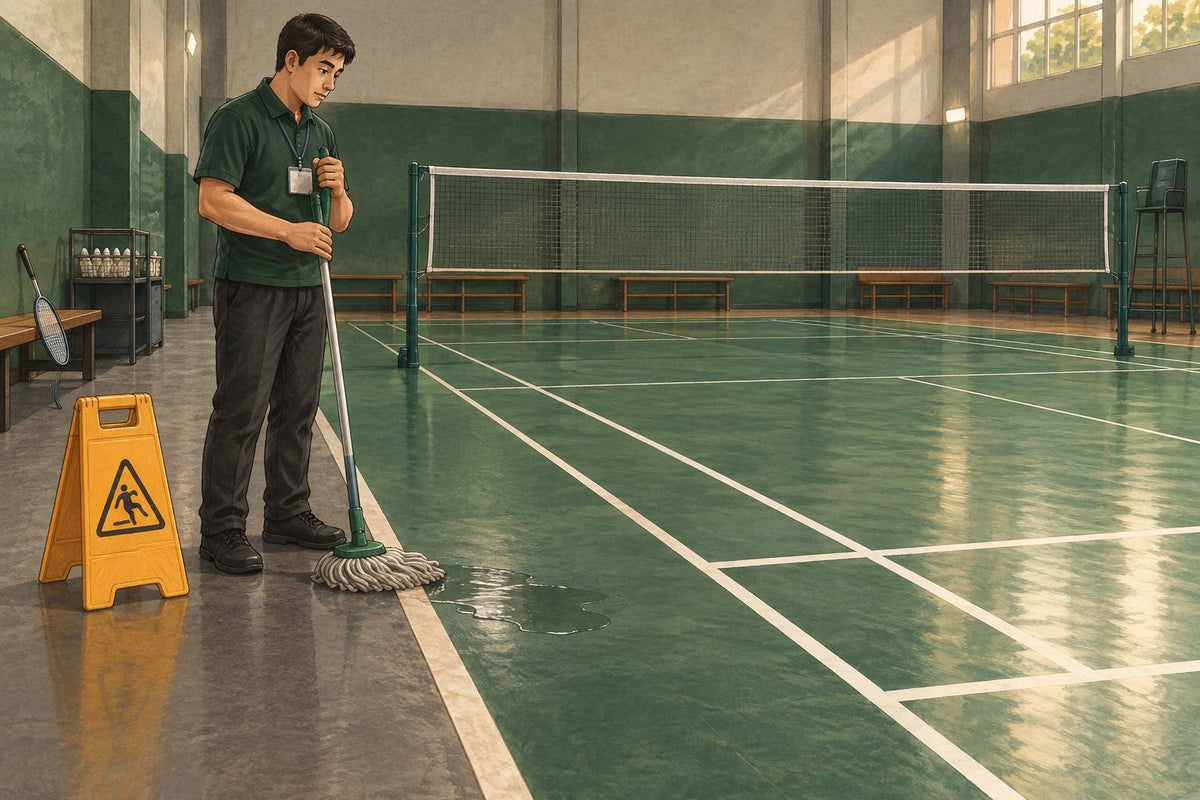
If a court feels unexpectedly slippery, stop the rally and keep people away from the patch. Look for visible liquid, grit, residue, or moisture on a shoe sole. Use the venue's normal response, then resume only when ordinary movement feels predictable. If several players slide or the problem returns, report it instead of playing through it.
A court can feel slippery for one step or for an entire session. Those are different problems. A damp patch near a service line is a local interruption. A floor that remains uncertain across several locations, even after the obvious patch is dealt with, is a facility issue until someone responsible for the surface checks it.
The useful response is not to guess at the cause from one slide. Pause, observe, clear only what the venue allows, and make the restart decision with the other players. This guide covers indoor badminton and practical club response. It is not a flooring-maintenance manual or medical advice after a fall.
Why can an indoor badminton court suddenly feel slippery?
A sudden slide means the contact between shoe and floor changed. Liquid, tracked-in grit, a dusty or damp sole, cleaning residue, or a wider surface problem can all make traction feel less predictable. Do not assume the answer is always the court or always the shoe. Inspect both before deciding what happens next.
Liquid is the first condition to rule out because it can change shoe-floor contact quickly. In a controlled walking study, fluid pressure at the interface was substantially higher with untreaded shoes than treaded shoes, and peak pressure correlated with peak slip speed. The experiment was not badminton and does not rank causes at a club, but it supports treating visible liquid as a reason to pause rather than test the patch at full speed. Read the shoe-floor fluid-pressure study.
Shoes also matter, but one outsole cannot solve every court. Controlled testing of shoes labelled slip-resistant found that available friction varied with outsole design, flooring, and contaminant condition. A clean sole is worth checking, yet no general shoe label proves that a particular court is ready for badminton. See the controlled outsole and contaminant study.
| What you notice | Next check | Restart decision |
|---|---|---|
| One slide at one visible patch | Look for moisture, a spill, grit, or debris at that point. | Only after the patch is cleared and normal movement feels predictable. |
| One player slips in several places | Check that player's soles for moisture, dust, or debris. | Only after the sole is cleaned and controlled movement is comfortable. |
| Several players slide | Treat it as a surface or maintenance concern and notify staff. | Wait for the venue to address and release the court. |
What should you do the moment someone slides?
The immediate job is to prevent a second person from entering the same hazard. Stop the rally, point out the area, and contact the venue attendant or follow the club's established court-cleaning process. Do not make a fast lunge, split step, or jump to test whether the surface is better.
- Pause play. Make the slippery area known before another rally begins.
- Check the player. Ask about pain, dizziness, head impact, or trouble bearing weight before discussing the floor.
- Identify the visible condition. Look for a wet spot, debris, residue, or moisture and dirt on the shoe that slipped.
- Use the approved response. Let the responsible person use the correct cloth, mop, or maintenance method for that installed floor.
- Restart cautiously. Once the area is cleared, begin with walking and controlled movement before normal badminton speed.
Do not improvise with household cleaner, hand sanitizer, powder, tape, or an unlabelled spray. Sports-floor guidance says to keep water and grit off the surface, wipe liquid promptly, and avoid products or procedures that can leave a floor sticky or slippery. The exact method depends on the installed floor, which is why the venue owns that decision. Review the cited sports-floor maintenance guidance.
If the slide involved a fall, the court decision and injury decision are separate. Severe pain, visible deformity, inability to bear weight, head-impact symptoms, or worsening symptoms need medical assessment. Our badminton fall-injury guide covers the immediate player check in more detail.
How do you tell a local patch from a facility problem?
A local patch is tied to one place or one shoe: visible moisture, a small piece of grit, or a sole that picked something up. A wider problem repeats across locations or affects more than one player. A towel may address an approved local cleanup; recurring loss of traction needs the facility to inspect its surface and maintenance routine.
Use this short decision check
- One exact spot, visible cause: clear it through the venue process, then reassess.
- One player, several spots: inspect and clean that shoe sole before blaming the floor.
- Multiple players or repeated slides: stop treating it as a player problem and alert the facility.
- Sticky, smeared, or uncertain surface after cleaning: keep play paused until the venue decides it is ready.
A clear-looking floor may still feel wrong, and a player should not have to prove the issue is visible before reporting it. Tell staff where the slide occurred, whether other players noticed it, whether there was an obvious patch, and whether the problem continued after the first response. Those observations are more useful than guessing that the finish is worn or the humidity is wrong.
Keep shoe care separate from facility maintenance. Clean soles help you arrive ready; the venue maintains the court. Our guide to cleaning slippery badminton shoe soles covers the player side without recommending court chemicals.
How can a group reduce repeat slips at club night?
The strongest club habit is quick reporting without embarrassment. Players should be comfortable stopping for an unexpected slide, and organizers should know how to reach the approved cleaning equipment or venue contact. The aim is not a formal floor inspection. It is to prevent the second slide that happens because the first player stayed quiet.
- Arrive in clean indoor court shoes rather than walking through wet entrances or outdoor debris immediately before play.
- Give everyone one clear reporting route: organizer, front desk, caretaker, or the venue's posted process.
- Keep players from adding cleaner, powder, tape, or other substances without facility approval.
- Record repeated trouble spots and tell the venue when the same court produces the same complaint.
- Collect loose shuttles and bottles away from the play area so a traction concern is not mixed with a trip hazard.
There is no prize for finishing a game on an uncertain surface. A short pause protects everyone using the court after you and gives staff a chance to distinguish a one-off spill from a maintenance issue. If the cause is obvious and addressed, play can return gradually. If it is not obvious, wait for the venue's decision.
Remember this
A slippery badminton court is a pause-and-check problem, not a toughness test. Stop the rally, protect the next player, use the venue's approved process, and escalate any recurring or court-wide loss of traction.

Leave a comment
This site is protected by hCaptcha and the hCaptcha Privacy Policy and Terms of Service apply.