
Last updated: July 2026 · Written by the team at Badminton House
Quick Answer: Badminton Training Load
Use session RPE as a simple retrospective estimate, then interpret your own pattern without treating any number as a medical threshold.
Log session
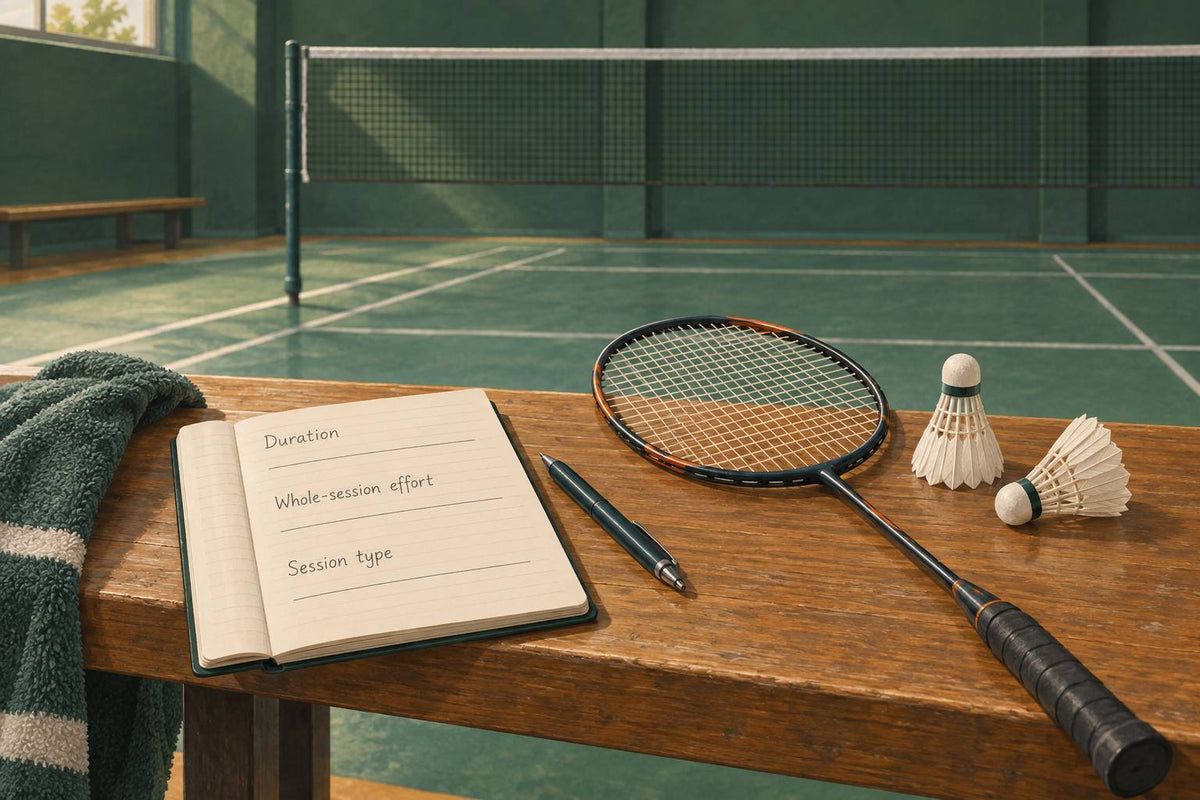
Start here: multiply minutes trained by one whole-session effort score recorded at a consistent time.
Review pattern
Compare similar weeks and session types; note changes instead of chasing a universal target.
Adjust plan
Use the log with sleep, soreness, stress, and session purpose to inform the next week.
Badminton training load gets messy fast: one session might be multi-shuttle until your legs shake, the next might be relaxed doubles where only a few rallies really bite. If you only judge by mood, you can understate a hard technical session or overreact to a long but easy one. A simple session-RPE log gives you a cleaner way to describe what your body actually experienced, without needing a wearable or lab setup.
This guide shows how to use duration and overall effort as one practical monitoring tool. The goal is not to chase a magic number. It is to spot patterns early enough to adjust the next week with more confidence.
In This Guide
Why Badminton Training Load Is Worth Logging
Badminton training load is worth tracking because the sport does not feel hard in a smooth, steady way. It is intermittent: short, high-intensity rallies are broken up by short rests, then repeated again and again. One match-play study reported mean rally and rest durations of 5.5 and 11.4 seconds, an average of 5.1 shots per rally, and a mean match heart rate of 169 bpm, or 89.0% of peak. That study-specific snapshot shows why elapsed court time alone misses part of the demand.
A simple log also helps because “badminton practice” can mean very different things. In one study of 16 male players, singles produced significantly higher mean and peak heart rates than doubles. A 90-minute singles-focused session, a doubles match night, and a technical feeding session therefore should not be treated as identical just because they fit in the same calendar block. If you already plan court, gym, and recovery days, pair this guide with our badminton weekly training plan so your notes connect to real scheduling decisions.
How Session RPE Works: Duration × Overall Effort
Session-RPE is deliberately simple: multiply the total training duration by your overall rating of perceived exertion for that session.
Session training load = minutes trained × session RPE
Example: 90 minutes × RPE 7 = 630 arbitrary load units.
The important word is overall. You are not rating only the hardest rally, the final conditioning block, or how tired your legs feel walking off court. You are giving one retrospective estimate of the whole bout’s internal load: how demanding the session felt to you.
That makes sRPE low-tech, convenient, non-invasive, and usable without heart-rate straps, GPS, or force platforms. The trade-off is that the product is heavily influenced by session duration. A long moderate hit can score higher than a short brutal interval set, so treat the number as a practical monitoring tool, not an objective physiological dose.

Make Your RPE Log Consistent Enough to Be Useful
The goal is not a perfect scientific diary; it is a repeatable habit. Ask the RPE question at the same point after every session, ideally 10–30 minutes after play. If your schedule allows, use the 30-minute mark as your standard because it helps reduce the recency bias of the last drill, game, or exhausting point.
- Use the same wording: “How hard was the whole session?” not “How tired am I right now?”
- Record the session type: match play, multi-shuttle, footwork, gym, or recovery hit.
- Pick one RPE scale: different scales can produce different raw numbers, even when the trend is similar.
- Keep timing consistent: record the rating at your chosen post-session point rather than mixing different timing windows without noting it.
After a few weeks, consistency matters more than whether another player would have rated the same session one point higher or lower.
Review Patterns Without Magic Thresholds
Once you have a few weeks of badminton training load logged, look for patterns before looking for problems. Weekly load is useful on its own, but you can also describe how evenly that load was spread across the week. Monotony is calculated as daily mean load divided by the standard deviation of daily load. Strain is weekly load multiplied by monotony.
Treat those numbers as descriptors, not verdicts. A high-monotony week simply means the daily loads were similar; it does not prove you are injured, overtrained, or safe. It can also miss important context: if sessions have similar duration and perceived exertion, monotony may look the same even when one week was mostly technical feeding and another was match-heavy.
Be even more careful with ACWR or any ratio. Do not use it as an injury predictor, guarantee, diagnostic tool, sole decision-maker, or universal threshold. If a number flags a sharp change, use it as a prompt to review sleep, soreness, stress, and recovery planning, not as a command to train or stop. For that broader view, see the badminton recovery guide.
Which Should You Choose?
Use all three phases in order. They describe a monitoring habit, not a score that clears you to train or diagnoses a problem.
| Phase | Do this | Keep in mind |
|---|---|---|
| Log session | Record duration, one whole-session RPE, session type, and the resulting arbitrary load units. | Use the same scale, wording, and post-session timing so your own entries are comparable. |
| Review pattern | Compare weekly totals, daily variation, and the mix of court, gym, match, and recovery sessions. | A change is a prompt for context, not proof of injury, readiness, or overtraining. |
| Adjust plan | Change one part of the next week when the log and your recovery notes point in the same direction. | Persistent pain, illness, or major performance changes need appropriate professional assessment, not a workload formula. |
Get 10% off your first order
Join the Badminton House list and we’ll email you a 10% welcome code — plus training guides, technique advice, and badminton updates.
By subscribing, you agree to receive Badminton House emails and can unsubscribe anytime.
Training-load logs work best when they stay simple enough to use after real practices, not just perfect weeks. Review the record regularly, change one planning variable at a time, and keep the number in its proper role: a retrospective estimate.
Replacing or comparing your current racket?
Browse Badminton Rackets


Leave a comment
This site is protected by hCaptcha and the hCaptcha Privacy Policy and Terms of Service apply.