
Last updated: July 2026 · Written by the team at Badminton House
Quick Answer: External Focus Cues for Badminton
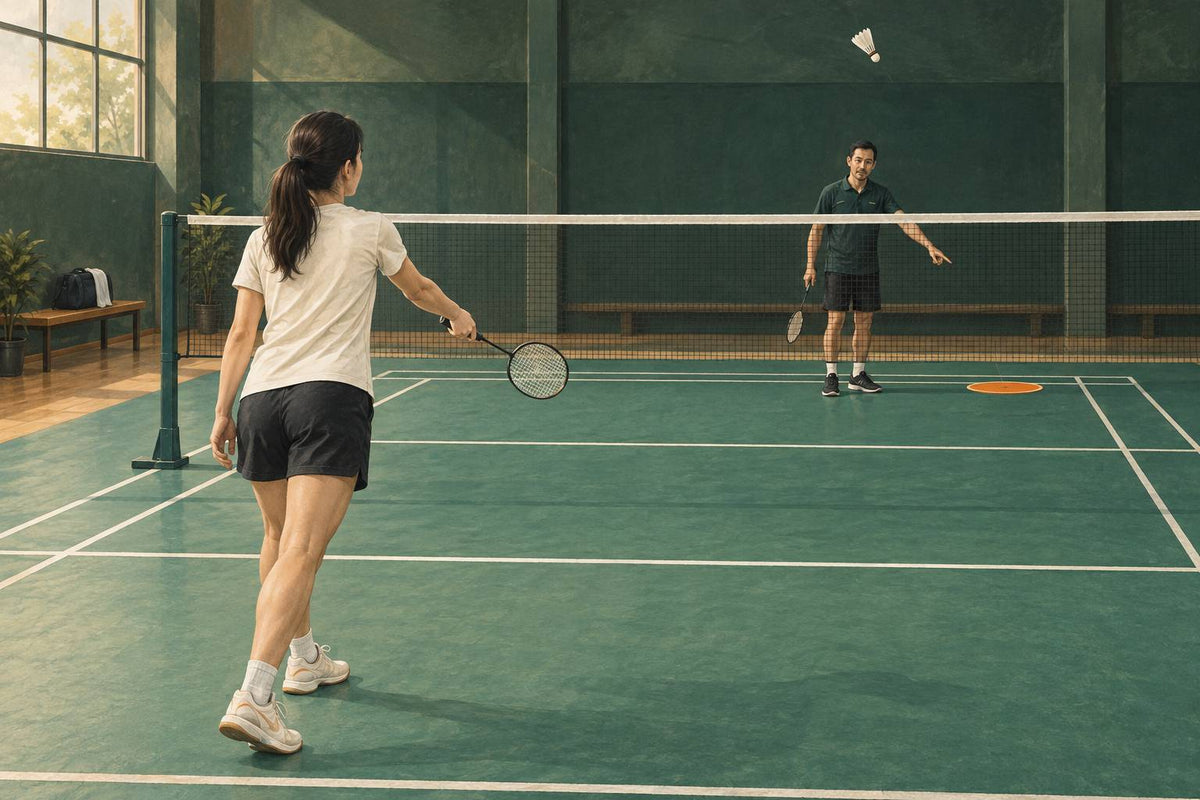
Choose the outcome the player needs to notice. Give one short cue, watch the shuttle, and change it only if the result stays unclear.
Target cue
Use for placement: name a landing zone the player can see and repeat.
Sound cue
Use for contact attention: listen for a consistent string-bed sound, not proof of perfect technique.
Trajectory cue
Use for height, pace, or flight shape: describe the line the shuttle should follow.
If your player keeps hearing “use your wrist,” “turn your shoulder,” or “step faster” but the shuttle still floats, clips the tape, or lands short, the cue may be pulling attention to the wrong place. External focus cues for badminton aim the player at the shot’s effect: where the shuttle lands, how it leaves the strings, what sound contact makes, or what flight shape it takes.
The useful coaching move is to translate mechanics into a target, sound, or trajectory the player can notice in real time, then keep adjusting until the shuttle outcome improves.
In This Guide
What External Focus Cues for Badminton Can and Cannot Claim
An external focus means the player attends to the effect of the movement in the environment: the shuttle’s flight, landing target, net tape, sound off the strings, or shape of the trajectory. An internal focus means attention goes to the body’s movement: wrist position, elbow path, shoulder turn, or finger action.
The common explanation is the constrained-action hypothesis: internal attention can invite conscious control that constrains coordination, while external attention may allow more automatic movement. That is useful for coaching language, but it is not a licence to claim external cues always win.
The caution matters in badminton. A 2024 PLOS ONE racket-sport systematic review included only 9 studies, just 1 in badminton, and most studies had a high risk of bias. Its ecological-dynamics caution is practical: focus is not one-size-fits-all. The best cue depends on the player, task, environment, and what information the shot demands.
The badminton experiments reinforce that limit. In a 2023 study, 30 adult men practised an underarm clear for four weeks. Accuracy and consistency improved, but the internal-then-external, external-then-internal, and mixed feedback groups did not differ on those outcomes. The authors said coaches should consider the learner, task, and changes in coordination rather than watching scores alone.
A 2025 study assigned 60 novices to internal, proximal external, distal net-line, or control conditions for the backhand short serve. The proximal external group scored better than control and distal focus in retention and transfer, but the study did not establish a universal external-over-internal advantage. External cues are a useful option to test, not a law.
Turn Body-Part Instructions Into Target, Sound, or Trajectory Cues
When a correction gets long, keep the diagnosis in your head and give the player a short outcome to chase. The cue should point attention toward placement, contact quality, or flight shape rather than a list of body parts.
- Target cue: Instead of “move your elbow, shoulder, and wrist like this,” try “land the shuttle on the deep corner marker.”
- Sound cue: Instead of “tighten your fingers at impact,” try “listen for one consistent sound from the string bed.” Sound directs attention to the contact outcome; it does not diagnose perfect technique by itself.
- Trajectory cue: Instead of “change your racket angle,” try “send the shuttle on a flatter line over the tape.”
Use the shortest cue that changes the shot. If players want the flight-physics background, see why shuttlecocks fly cork-first.
Cue Examples by Stroke and Skill Stage
Use one cue at a time, then judge whether the shuttle behaves better. Keep the learner’s attention on the shuttle, target, sound, or flight shape.
- Beginner: for short serve, try a proximal cue such as “send the cork cleanly from the string bed,” then add “land it just past the service line.” For an underarm clear, use “send the shuttle high to the back tramline.”
- Improving player: for drops, try “make the shuttle fall steeply inside the front service line”; for net play, “float the cork over the tape and let it tumble down.”
- More advanced learner: for smash, use “drive the shuttle through the floor target”; for drive-style exchanges, “keep the shuttle flat through the opponent’s hip lane.” A farther target can reduce unnecessary detail when the player already owns the basic movement.
Test, Adjust, and Return Attention to the Shot Outcome
Treat external focus cues for badminton as a coaching loop, not a slogan. Choose one outcome cue for the next block: a landing target, a contact sound, or a shuttle trajectory. Run a short consistent block under the same feed, then watch both the score and the shot effect.
- Keep it if accuracy, consistency, and the intended flight shape improve.
- Simplify it if the player looks overloaded or starts steering the shuttle.
- Switch it if the cue creates a worse contact, poorer recovery, or no useful change.
Brief internal cues can still help with safety, orientation, or a genuinely new movement component. Once that checkpoint is clear, return attention to what the shuttle does and test whether the outcome improves.
Which Cue Should You Choose?

Choose the cue that matches the shot outcome you want the player to notice, then keep it short enough to use during a rally.
| Cue type | Choose this if... | Judge it by |
|---|---|---|
| Target cue | The main problem is placement: serves drifting high, clears landing short, or drops missing the intended zone. | Landing location and repeatability, not how the player says the movement felt. |
| Sound cue | The player needs one external signal to attend to at contact. | A consistent string-bed sound at the intended pace, treated as attention guidance rather than diagnostic proof. |
| Trajectory cue | The shot shape matters most: height over the net, shuttle speed, or flight path. | Whether the shuttle leaves on the intended line, height, and pace. |
Good coaching cues make the next shot clearer. Diagnose the movement quietly, give the player one visible or audible outcome, and let the shuttle tell you whether the wording helped. For help translating a correction into a concise outcome cue, ask the Badminton House team.
When your practice cues point to flight, placement, and clean contact, the shuttle becomes the feedback. Keep a few reliable tubes ready for cue-based sessions.
Shop Shuttlecocks

Leave a comment
This site is protected by hCaptcha and the hCaptcha Privacy Policy and Terms of Service apply.