
Last checked: August 2026 · Written by the Badminton House player-led team.
Quick answer: what do badminton officials' signals mean?
Read the official before the signal. A line judge points to the line for in, extends both arms horizontally while calling “out” for out, and covers both eyes when unsighted. The service judge calls service faults; the umpire runs the match and applies the Laws.
Line call
Watch the line judge's hands and listen for the out call.
Service fault
The service judge owns the server's delivery, not a landing on a line.
Disagreement
Ask the umpire promptly about a question of law; do not try to influence a fact call.
This guide concerns appointed officials in an officiated match. A self-refereed club game uses a different practical arrangement, so do not turn a professional signal into an unumpired-rally rule. For that setting, see our guide to calling your own lines.
Recognize the three line-judge signals
A line judge's job is limited to the assigned line or lines. For out, the judge calls “out” clearly and extends both arms horizontally. For in, the judge says nothing and points at the line with the right hand. When unsighted, the judge covers both eyes with both hands instead of guessing.
The timing matters. A line judge waits until the shuttle touches the floor, then makes the call or signal while looking towards the umpire. The signal describes what that judge saw on the assigned boundary; it is not a score announcement, service ruling or invitation to debate.
| What you see | What it means | What not to infer |
|---|---|---|
| Both arms extended horizontally, with “out” | The shuttle landed out on the assigned line. | Another official made a service-fault call. |
| Right hand pointing at the line, silently | The shuttle landed in on the assigned line. | Silence means uncertainty. |
| Both hands covering the eyes | The line judge was unsighted. | The shuttle is automatically in, out or replayed at a player's choice. |
At a close corner, more than one line judge may be involved because each official owns a different boundary. Read the signal for the line that official was assigned. The BWF Instructions to Technical Officials set out these actions and their timing.

Know who calls what on court
Officials divide the work so one person is not trying to see every detail. The service judge calls faults made by the server during delivery. Assigned line judges decide whether the shuttle was in or out on their lines. The umpire controls the match, enforces the Laws and communicates decisions.
| Official | Primary responsibility | Not the normal job |
|---|---|---|
| Line judge | In or out on assigned lines. | Calling a server's delivery fault. |
| Service judge | Faults made by the server during delivery. | Making line calls around the court. |
| Umpire | Running the match, enforcing the Laws and resolving matters within the umpire's authority. | Replacing every assigned official's observation routinely. |
Identify the question first. “Did the shuttle land on this sideline?” belongs to the line judge. “Was the server's delivery legal?” belongs to the service judge. “How is the match administered under the Laws?” belongs to the umpire. This prevents treating every raised hand or spoken word as an umpire signal.
An umpire can overrule a line judge, but the threshold is deliberately high: in the umpire's opinion, it must be beyond reasonable doubt that the line judge clearly made a wrong call. It is not an ordinary second opinion or a player-requested replay. Law 17 of the BWF Laws of Badminton defines these responsibilities and limits.
Respond properly to a disputed decision
Address the umpire promptly and calmly when you need clarification on a question of law or procedure. Do not argue directly with a line judge or service judge about a fact call. Their assigned decision stands except for the limited overrule or review routes in the Laws.
The difference between fact and law is practical. Whether a shuttle landed in or out is a fact call assigned to the line judge. Whether a rule was applied correctly is a question of law or procedure. An appeal regarding a point of dispute must be made before the next service. If a player remains dissatisfied with a decision on a question of law, the umpire refers the appeal to the referee under Law 17.6.8.
Keep the request short: ask what was called or which rule applies. Do not signal at the official, shout instructions or recruit spectators. BWF's standardized vocabulary specifically includes directions that players must not influence the service judge or line judge. The BWF vocabulary for technical officials helps players recognize these court-management instructions.
Player rule of thumb: ask the umpire a concise question before the next service when a rule needs clarification. Accept an assigned official's fact observation unless the umpire uses the limited overrule power or an available review system decides the call.
Prepare for a volunteer service-judge assignment
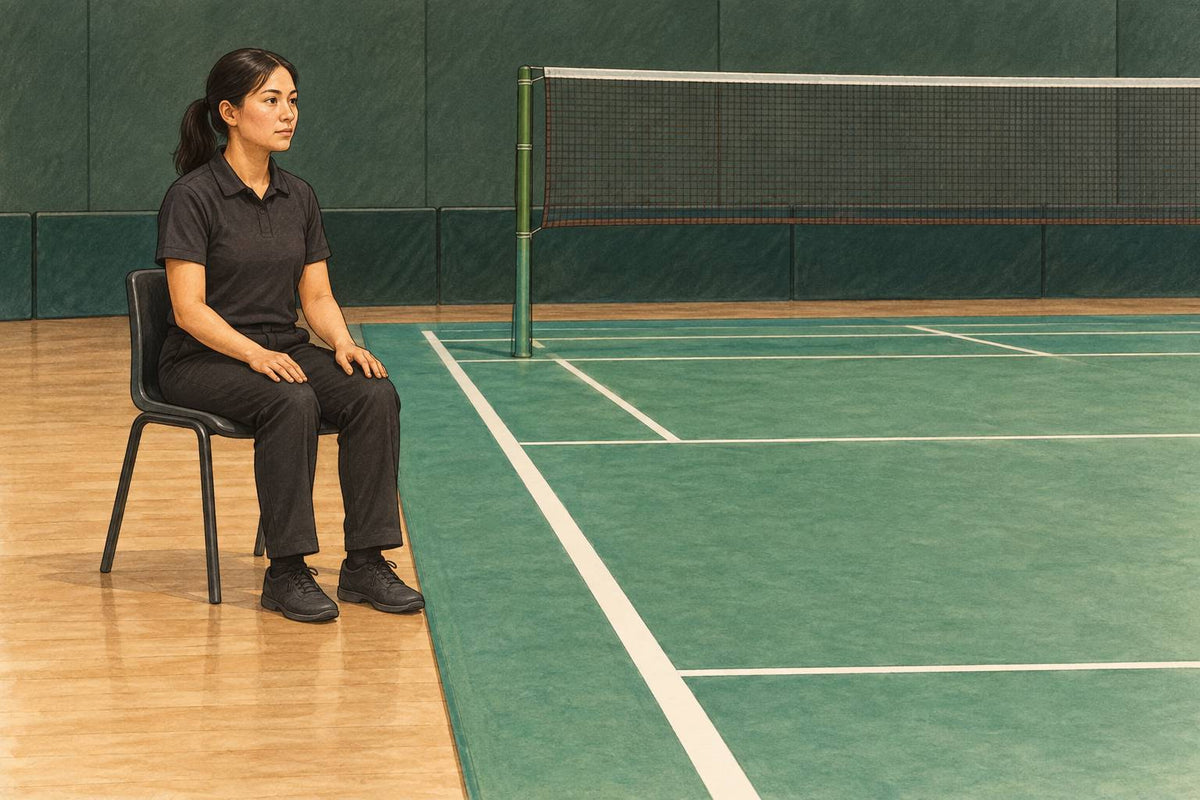
A volunteer service judge should focus on the server's delivery, use the official fault call and signal when required, and follow the referee's or umpire's event arrangements. The role is not a general second umpire. Good positioning, a steady sightline and disciplined attention matter more than trying to solve every issue.
Before play, confirm where to sit, which service laws you are expected to call, how the umpire wants signals acknowledged, and whether you will assist with shuttle delivery or removal between rallies. The technical instructions describe service-judge procedures; event logistics can vary under the referee's arrangements. If something is outside your assigned responsibility, look to the umpire rather than improvising.
- Arrive early: confirm court setup, seating and the umpire's expectations.
- Watch the server's delivery: do not follow the receiver or try to make line calls.
- Call only an assigned fault: make the official call and signal clearly enough for the umpire.
- Ask at a break: if uncertain about procedure, get direction before the next match.
For structured learning, Badminton Canada maintains an officials resource page linking to BWF manuals and umpire guidance. Use current materials and the event briefing rather than a remembered diagram.
The practical rule
Read the role before the signal: line judge for the assigned line, service judge for the server's delivery, and umpire for match control. When you disagree, ask briefly through the umpire and let the officiating structure do its job.

Leave a comment
This site is protected by hCaptcha and the hCaptcha Privacy Policy and Terms of Service apply.