
Last checked: August 2026 · Written by the player-led team at Badminton House
Quick answer
Most club and drop-in badminton has no umpire, so players call their own lines. A shuttle touching any boundary line is in. The player standing closer to where it lands owns the call, made the instant it lands, out loud or with the arms-out signal officials use. When two honest views genuinely disagree, replay the point instead of arguing it.
Related reading: Badminton Court Etiquette: Unwritten Rules to Know covers everything else about self-officiated play, from lets and net cords to sharing a busy court.
What Counts as In or Out
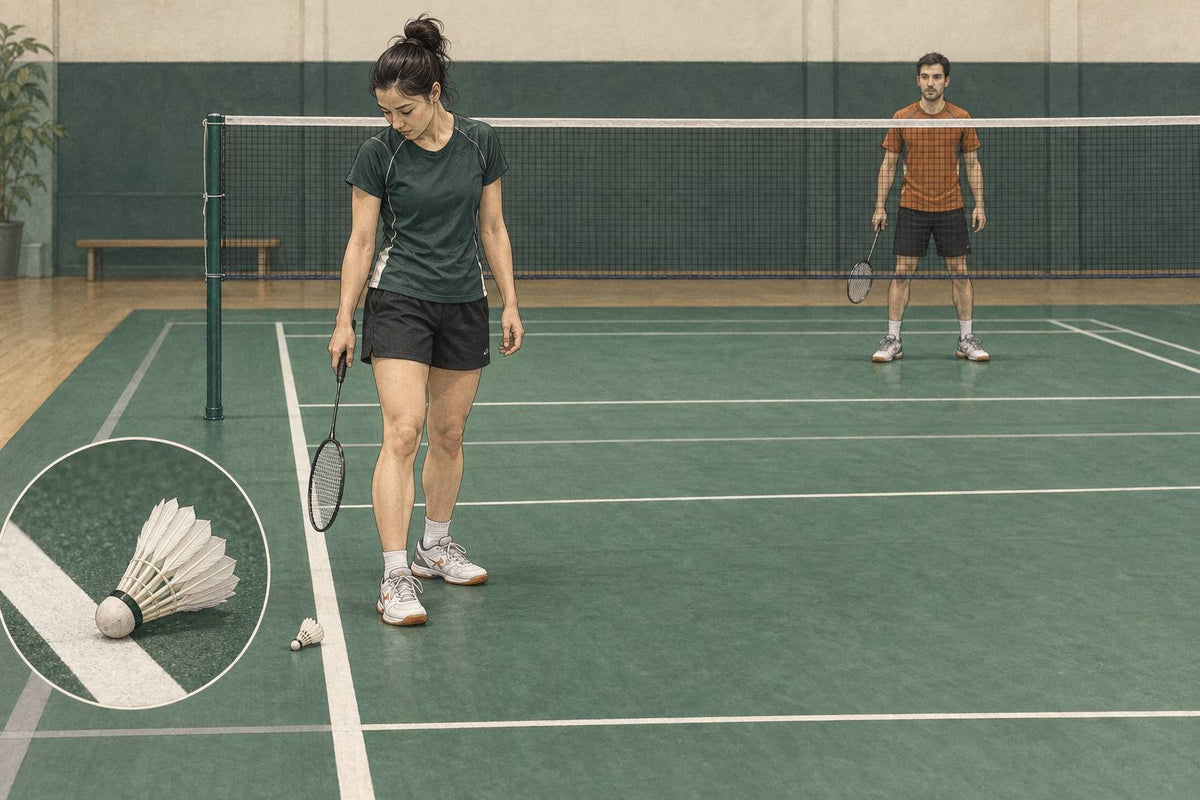
A shuttle is in the instant any part of it touches a boundary line, because the Laws of Badminton state every line belongs to the area it marks. It is out only once it lands clear of every line around that area, and the rally is already over at that instant, whatever happens next.
This surprises a lot of players: the shuttle does not need to land fully inside the court to count. Under the BWF Laws of Badminton, all court lines are part of the area they define, so a shuttle clipping the very edge of the sideline or back boundary line is in, full stop. It is a fault only when the shuttle lands outside every line bounding that area, meaning not on or within the boundary lines.
Judge the shuttle's first touch and ignore where it settles. Officials are trained to signal on the shuttle's initial point of contact with the floor, because a smash can clip the line with its base and then tip sideways a moment later; the base-first landing is still what decided the call. That instant is also when the point is decided: a shuttle stops being in play the moment it hits the floor, and the side that lands it inside the opponent's court wins the rally right there. Play on if you like. A reflex swing happens to everyone, but you cannot hit a shuttle you believe already grounded and then claim the point, because the rally was already over before your racket got there.

Who Makes the Call, and How
There is no assigned official in self-officiated play, so the player standing closest to where the shuttle lands makes the call, because that is whoever has the straightest, shortest sightline to the line. Call it immediately and clearly enough for everyone on court to hear, before the next rally starts.
This is not written into the Laws as a formal duty for players (the Laws only assign that job to a line judge, if a tournament appoints one); it is an honor-system convention. On the Timmins Badminton Club's honor-system page, players are expected to make their own line calls honestly, "regardless of whether it benefits them or their opponent." A call shouted from the far side of the net is not really yours to make: you are looking at the shuttle at an angle across six metres of court, while the player standing over the line is looking almost straight down at it.
Borrow the signal officials use so nobody has to guess what you meant, even though the Laws do not require self-officiated players to use it. For "out," per BWF's Line Judges' Manual, extend both arms fully horizontal, palms toward the court, and say "out" loud enough to carry. For "in," you can just point at the line and say nothing, since a shuttle sitting on the line speaks for itself. Either way, hold off until the shuttle has actually landed: calling a shot before it touches down is exactly the habit that gets calls contested, because it looks like you decided before you saw. The same immediacy runs the other way too: a let can only be called as it happens, never claimed once the rally is over and everyone has moved on.
Three Disputes and Exactly What to Say
Every self-officiated match eventually hits a genuine disagreement: an opponent contests your call, your own partner sees it differently, or you simply never saw where the shuttle landed. None of these needs an argument. Each has a short, specific line that resolves it and gets the next rally started.
Your opponent overrules your call. You called their shot out; they insist it was in and keep arguing. There is no umpire to make a final ruling, so nobody outranks your honest call, but insisting on it rarely settles anything. Say: "I saw it out, but let's replay it if you're not sure." The Laws let either player call a let when a match has no umpire, so offering the replay is a legitimate way to end the point, without conceding that you were wrong.
Your own partner disagrees with you. You called it out; your partner thought it was in, and the disagreement is on your own side of the net. Do not let opponents watch you argue it out in front of them. Say to your partner, quickly: "You had a better look, I'll go with you," or, if neither of you is confident, "we're not sure, so it's in." A split call on your own side is exactly the uncertainty the honor system is built to settle: discuss calmly and give the shuttle the benefit of the doubt.
A shuttle dies behind you while you are driving through it. You are moving forward into a flat exchange, and the shuttle you thought you were about to intercept has already grounded somewhere behind you. You did not see it land, so do not guess. Say: "I didn't see that one land, did you?" and defer to whoever on court actually had eyes on it. If nobody had a clear look, treat it the way Badminton Bible's guide to lets and officials both handle a genuinely unsighted call: play a let and serve again. Neither side gets to claim a point nobody actually saw.


Leave a comment
This site is protected by hCaptcha and the hCaptcha Privacy Policy and Terms of Service apply.