
Last checked: August 2026 · Written by the Badminton House player-led team.
Quick answer: who serves next in doubles?
Use two checks. The serving side's own score tells you the court: even means right and odd means left. The right to serve follows a fixed four-player sequence set at 0-0. Your pair changes service courts only after winning a point while already serving.
Court
Read your score: 0, 2, 4 and 6 serve from the right; 1, 3, 5 and 7 serve from the left.
Win on serve
The same server scores, changes service courts and serves again.
Win receiving
Your side gains the point and serve, but neither partner changes service courts first.
Doubles serving order is not a fresh choice after every rally. At the start of a game, the four players create a fixed cycle. Once you know the initial server and initial receiver, the Laws determine who follows whenever service changes hands. A score can identify the court but cannot always identify the person.
This guide is only about the bookkeeping. For the wider format, see our badminton rules and scoring guide. For where the non-serving partner may stand during delivery, see where a doubles partner can stand at serve.
Your score tells you the service court
Start with the serving side's score, not the receiving pair's score. If the serving side has zero or another even number, its server uses the right service court. At an odd score, the server uses the left. The receiver is the player diagonally opposite. These are the court rules in BWF Law 11.1.
| Serving side's score | Server stands in | Receiver stands in | Cue |
|---|---|---|---|
| 0, 2, 4, 6... | Right service court | Diagonally opposite right court | Even = right |
| 1, 3, 5, 7... | Left service court | Diagonally opposite left court | Odd = left |
Say the serving score aloud before the delivery. “Six-four” means the side with six serves from its right. It does not matter that the opponents have four or that your pair was receiving one rally earlier.
If the serving side wins the rally, it scores and the same server uses the alternate court next. If the receiving side wins, it scores and becomes the new serving side. That side does not change its respective service courts before the new serve.
Know when partners change courts
The accurate habit is: players do not change their respective service courts until their side wins a point while serving. After that serving-side win, the same server moves to the alternate court and the partner occupies the other one. The receiving pair stays in its existing service courts.
If the receiving side wins, it gets the point and becomes the serving side without swapping first. The player due under the sequence serves from the court already occupied, which must align with the new serving-side score when the order has been followed correctly.
Service-court labels are bookkeeping for delivery, not movement restrictions during the rally. Once the service is returned, either partner may hit the shuttle from any position on that side of the net under Law 11.2. Partners do not have to stay in left-right lanes while playing the point.
Follow the fixed four-player sequence
At 0-0, name the initial server and initial receiver. From then on, the right to serve passes in the exact Law 11.4 order: initial server; initial receiver's partner; initial server's partner; initial receiver; then back to the initial server. A run of points does not reset the cycle.
Memorize the circle, not the score: first server → receiver's partner → server's partner → receiver → repeat. The score tells that person left or right; the circle tells you who holds the shuttle.
Suppose Alice serves first for Pair A and Ben receives first for Pair B. The turnover sequence is Alice, then Ben's partner Bo, then Alice's partner Ava, then Ben, then Alice again. One player may serve several consecutive rallies while that side keeps winning, but after a turnover the next person in the four-place circle takes over for the new serving side.
Law 11.5 also says no player may serve or receive out of turn or receive two consecutive services in the same game, except as provided in Law 12 or when a fault for misconduct is called. The sequence protects the order even when a long run makes the positions hard to remember.

Worked example: 0-0 through 6-4
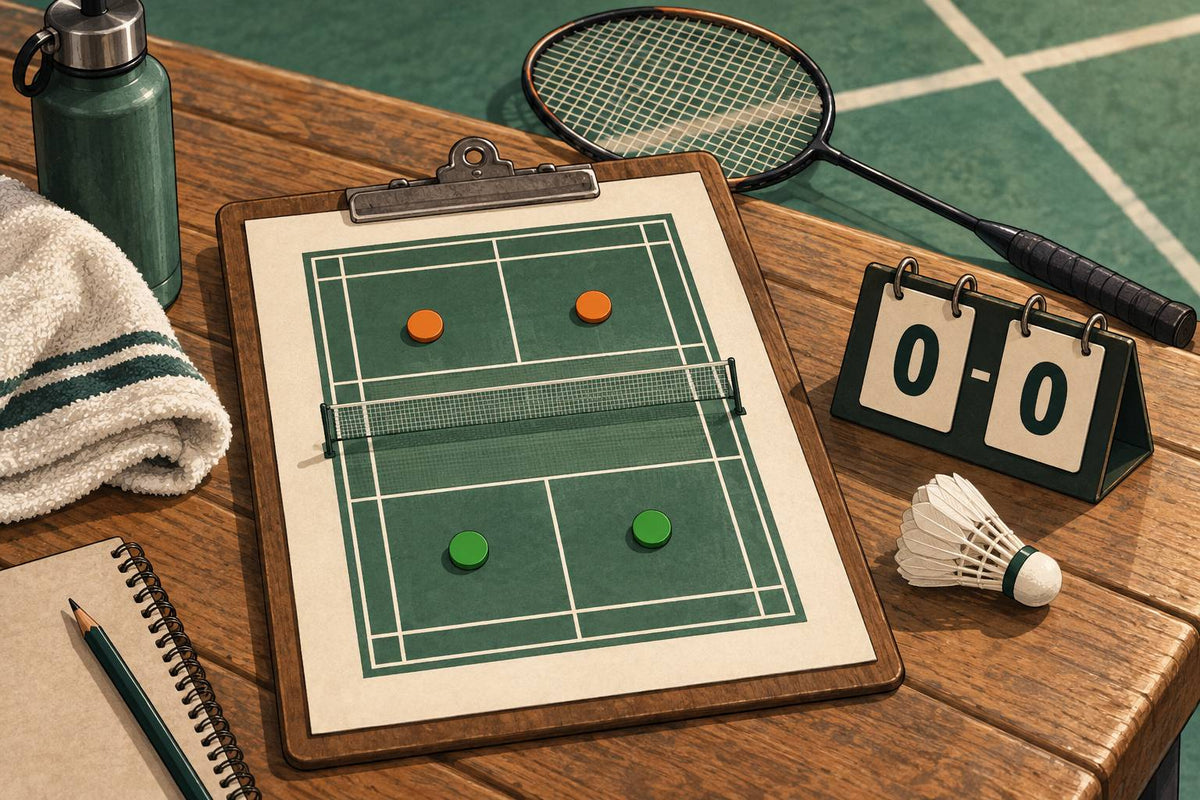
Use Alice and Ava for Pair A; Ben and Bo for Pair B. At 0-0, Alice is the initial server in A's right court and Ben is the initial receiver in B's right. The winner column records the rally just finished; the last column shows the next delivery.
| Winner | Score | What changes | Next delivery |
|---|---|---|---|
| Start | 0-0 | Initial arrangement | Alice, right, to Ben |
| A | 1-0 | A wins serving; A changes courts | Alice, left, to Bo |
| B | 1-1 | B wins receiving; B stays put | Bo, left, to Alice |
| B | 1-2 | B wins serving; B changes courts | Bo, right, to Ava |
| A | 2-2 | A wins receiving; next is Ava | Ava, right, to Bo |
| A | 3-2 | A wins serving; A changes courts | Ava, left, to Ben |
| B | 3-3 | B wins receiving; next is Ben | Ben, left, to Ava |
| B | 3-4 | B wins serving; B changes courts | Ben, right, to Alice |
| A | 4-4 | A wins receiving; cycle returns to Alice | Alice, right, to Ben |
| A | 5-4 | A wins serving; A changes courts | Alice, left, to Bo |
| A | 6-4 | A wins serving; A changes again | Alice, right, to Ben |
At 6-4, Alice is still serving because Pair A kept winning while she held service. If Pair B wins the next rally, B scores 5 without changing courts first, and Bo is next in the sequence. Bo serves from B's left court because B's score is odd.
Correct an order error without changing the score
A service-court error occurs when someone serves or receives out of turn or from the wrong service court. Correct it when the shuttle is not in play and keep the existing score under BWF Law 12.
Finish the rally if the shuttle is already in play, then pause. Use the serving-side score to choose right or left, rebuild the cycle from the initial server and receiver, and continue. Our wrong service court guide covers the correction in more detail.
For the next game, the side that won the previous game serves first, and either partner on that side may be chosen as the first server. Either opponent may likewise be chosen as first receiver. Name them before 0-0 and a new four-person sequence begins.
The one-minute reset
Say the serving side's score. Even means right; odd means left. Then identify the initial server and receiver. The next player in the four-person circle serves from that score's court.

Leave a comment
This site is protected by hCaptcha and the hCaptcha Privacy Policy and Terms of Service apply.