
Last checked: August 2026 · Written by the player-led team at Badminton House
Quick answer
Crossminton drops badminton's net entirely: two 5.5 m squares sit 12.8 m apart, and a heavier "speeder" is driven flat and fast between them instead of lifted and dropped over a tape. The wrist speed and flat-exchange reactions carry over to badminton. The net game and its movement patterns still need badminton-specific practice.
Start with the court and the serve
Two rule changes, no net and a heavier shuttle, explain almost everything else in this comparison, from the gear to how a rally actually gets won.
How Does a Crossminton Court Compare to a Badminton Court?
Crossminton is played between two squares, each 5.5 m by 5.5 m, set up facing each other 12.8 m apart. There is no net and no sideline between the squares: the open shuttle-passing zone between them is bounded only by the two squares' own lines, not by any tape or fixed corridor.
The serve line sits 3 m back from each square's front edge (a smaller 4 m version, 9 m apart, is used at the U12 age group with a 2 m serve line). Outside those markings the game is built to travel: the International Crossminton Organisation's own rulebook sets the same dimensions worldwide, and its equipment page notes that courts can be set up on almost any surface and packed away just as fast, which is why a set can appear on a gym floor one week and an open field the next.
The sport carries a second name worth knowing, since clubs and search results still use it: the ICO's own site confirms crossminton was called Speed Badminton until the federation renamed it in 2016.
The rulebook accounts for both settings a court might use. It faults a shuttle that touches the venue's ceiling or side walls exactly as it faults one that lands outside the square's own lines, so an indoor set played under a low gym roof needs the same overhead care a badminton player already gives a rafter or a light fixture.
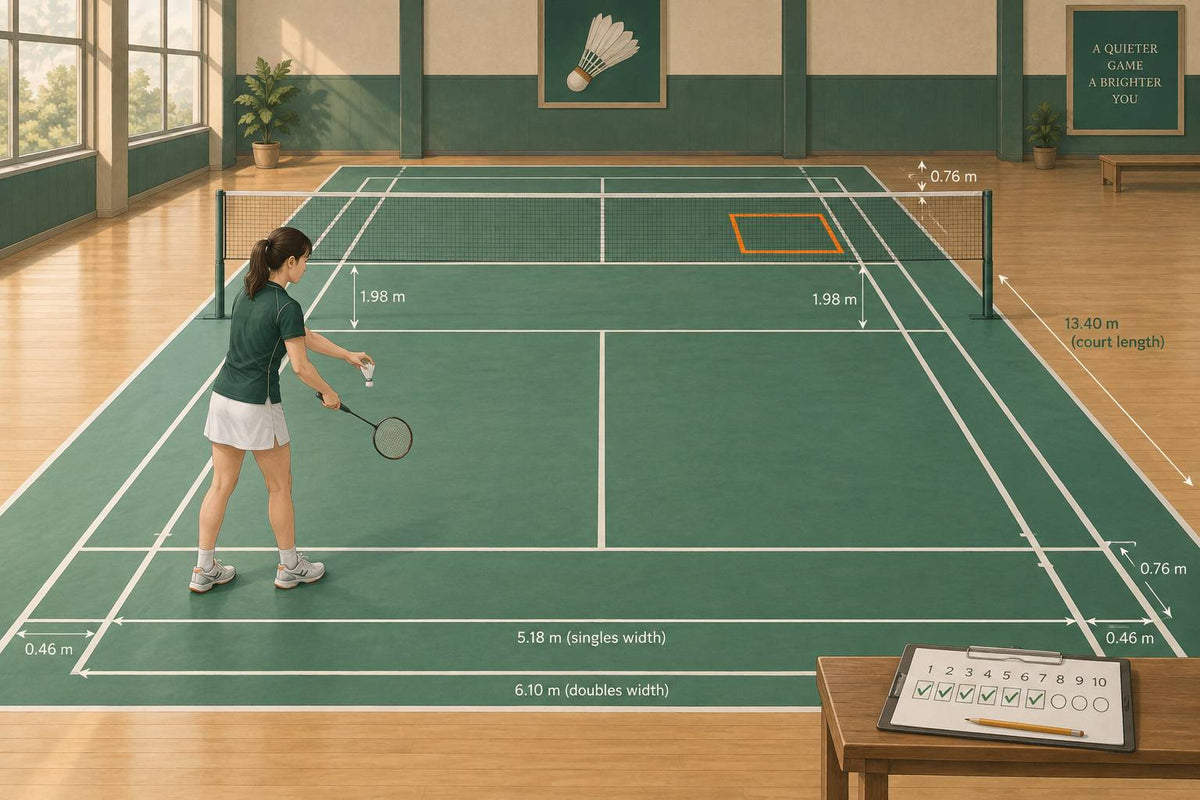
Badminton, by contrast, is played across one continuous rectangle with a net down the middle. There is no second square to run to and no shuttle-passing gap to cross; every shot has to clear the net and land inside a single shared boundary, which is exactly the constraint crossminton removes.

How Does the Speeder Compare to a Badminton Shuttlecock?
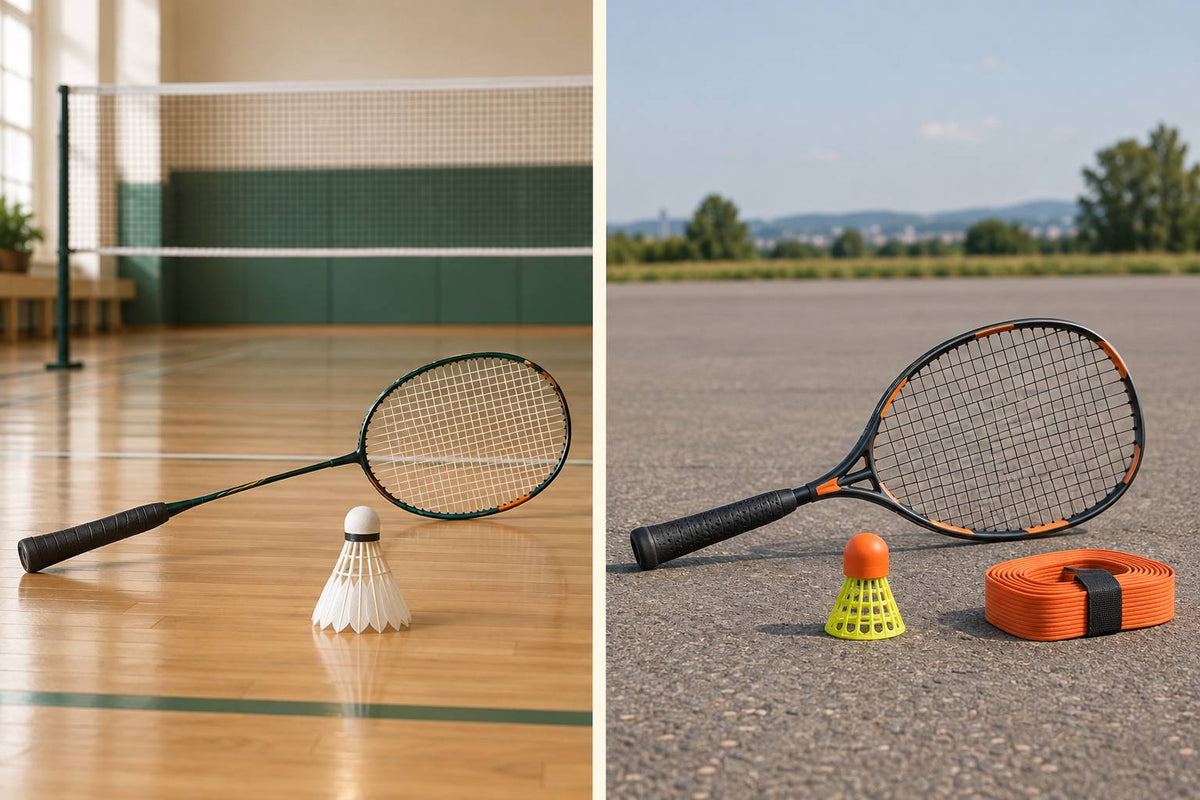
Crossminton's shuttle, called a speeder, is a solid-capped projectile weighing 8 to 10 g, roughly double a badminton feather shuttle's 4.74 to 5.50 g. That extra mass and a semi-spherical thermoplastic cap in place of feathers make it fly noticeably faster and flatter, so rallies favour a driven, low trajectory rather than a floated one.
Its racket is boxed in too: crossminton rules cap the frame at 61 cm long with a head no bigger than 650 cm², built for repeated flat swings rather than one big loop. The same rulebook allows a different speeder in strong wind once the tournament organiser and head umpire agree, which tells you the standard speeder is expected to hold its line outdoors in ordinary conditions.
A badminton shuttle carries the opposite trade-off. Sixteen feathers set around a cork base weigh only 4.74 to 5.50 g under the current Laws of Badminton, light enough to float, spin, and stall the way a solid-capped speeder cannot. That is exactly what a lift, a drop shot, or a defensive clear needs, and exactly why the same shuttle is far more sensitive to any draught indoors.
How Do Serving and Scoring Differ?
A crossminton set is won by the first side to 16 points, and a match is the best of three sets. Each side serves three points in a row, alternating every point once the score reaches 15-15. The serve must be struck from behind a line 3 m back from the square's front edge, below the server's own wrist.
| Rule | Crossminton | Badminton |
|---|---|---|
| Serve contact point | Below the server's own wrist at contact | Below a fixed 1.15 m from the court surface |
| Serve rotation | Three serves per side, then the serve passes | Serve stays with whoever won the last point |
| Points to win | 16, win by 2 from 15-15, no stated cap | 21, win by 2 from 20-20, capped at 30 |
| Match format | Best of 3 sets | Best of 3 games |
Badminton's serve law works on a different reference point. Under the current Laws of Badminton, contact has to stay below a fixed 1.15 m from the court surface, a court-relative limit rather than one measured off the player's own hand. The scoring cap differs too: a badminton game locks in a winner at 29-all, capping a game at 30 points outright, while the ICO rulebook sets no equivalent ceiling for a crossminton set.
The serve rotation is the sharper contrast for anyone who has only played badminton. Rally-point scoring keeps a badminton serve with whoever just won the last point. Crossminton instead works through a fixed block of three serves per side before the serve passes, whether or not those serves win rallies, so a server can lose a point and simply serve again on the next turn until the block runs out.
Why Does a Crossminton Rally Move So Differently From a Badminton Rally?
Because there is no net to clear, crossminton has no real equivalent to badminton's lift, its steep drop shot, or its net kill. Play stays flat and driven instead, which erases two habits that define badminton tactics: sending a shuttle high to buy recovery time, and killing a loose reply just over the tape to end a rally fast.
The clearest gap shows up at the front of the court. Badminton rewards a split step timed to the opponent's contact and a lunge into the net for a tight reply near the tape; crossminton has no tape to approach, since a shot dying short in open space still has to travel 12.8 m before an opponent can attack it. Players who spend a season camping deep and driving the speeder flat, a habit crossminton never punishes, often arrive back on a badminton court with their weight on the back foot and no lunge ready.
Practise that habit: Badminton Split Step: Move Faster on Court covers the exact timing crossminton never asks you to train.
Contact point drifts too. A crossminton rally rewards meeting the speeder early and flat, at or below shoulder height, because there is nothing to lift it over. Badminton keeps asking for the opposite: a high strike point on a clear or a smash, and a soft, late touch on a net shot, both timed around a net that crossminton simply does not have.
Does Playing Crossminton Help or Hurt Your Badminton?
Crossminton sharpens the reflexes badminton rewards in flat exchanges: faster grip changes, a quicker forearm snap, and better reaction time when a shot arrives with no arc to read. It does nothing to build badminton's net game, its lifts, or the forward recovery that a netted court demands, so treat it as a supplement rather than a substitute.
What carries over
- Fast forehand-to-backhand grip changes, trained by a rally where the racket face has to flip with no warning.
- Wrist and forearm rotation under load, since a heavier speeder needs more snap than a feather shuttle to drive flat.
- Reaction time on a flat, fast exchange, the same skill a badminton drive or a quick net exchange calls on.
What you will need to rebuild
- Split-step timing and recovery for badminton’s shorter, net-divided court.
- Lunging into the tape for a tight net shot, a movement with no equivalent across 12.8 m of open space.
- A higher, earlier contact point: crossminton's flat habit undercuts the lifted clears and steep drops badminton needs.
- Forward weight and recovery, in place of the rearward stance a net-free game never punishes.

Leave a comment
This site is protected by hCaptcha and the hCaptcha Privacy Policy and Terms of Service apply.