
Last checked: August 2026 · Written by the player-led team at Badminton House
Quick answer
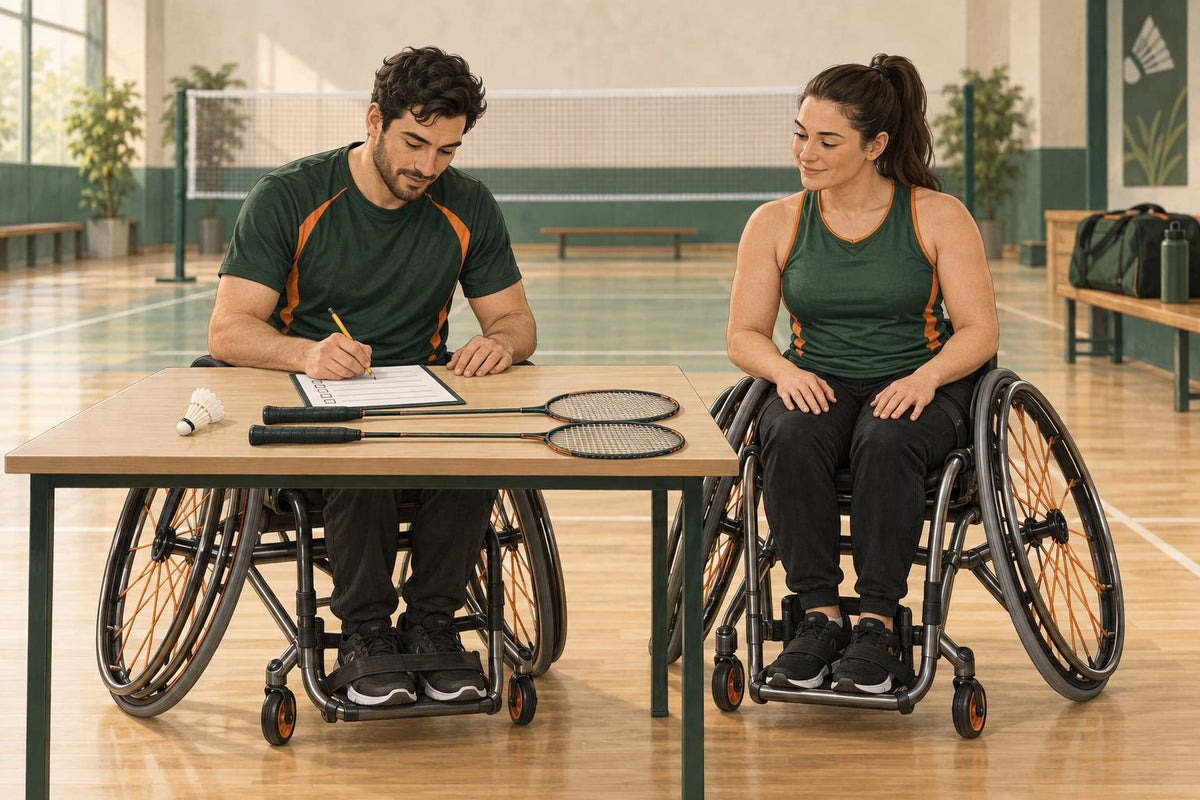
A para badminton doubles pair may combine two sport classes only when the pairing fits inside a capped point total: wheelchair pairs cap at 3, most SL3-to-SU5 combinations cap at 8, and short-stature doubles stays within SH6 only. Wheelchair pairs also play on a permanently reduced court in both singles and doubles, while standing pairs use the full-size doubles court even when one partner plays half-court in singles.
Start with What are the six sport classes?
Learn the six classes, check a real pairing against the point-cap table, and read how the court itself changes for wheelchair and half-court matches before you commit to a partner.
What are the six para badminton sport classes?
Para badminton groups every player into one of six official sport classes based on impairment type and severity: WH1 and WH2 for wheelchair users, SL3 and SL4 for standing players with lower-limb impairment, SU5 for upper-limb impairment, and SH6 for short stature. Classification sets a player's class, and doubles pairings build on top of it.
WH1 covers players who need a wheelchair for the whole match and usually have impairment across both lower limbs and trunk function. WH2 also requires a wheelchair, but with minimal or no trunk impairment and a lesser leg impairment, which is why WH2 counts as the less-impaired half of a wheelchair pairing.
SL3 and SL4 both play standing. SL3 covers impairment in one or both legs with poor balance; SL4 covers a lesser version of the same impairment, with only minimal balance loss on walking or running. SU5 is the one upper-limb class: impairment in an arm or hand, with standing mobility otherwise intact. SH6 is short stature from a genetic condition often described as dwarfism, and plays standing on a full court.
| Class | Mobility | Typical impairment |
|---|---|---|
| WH1 | Wheelchair | Both lower limbs and trunk function |
| WH2 | Wheelchair | One or both legs, little or no trunk impairment |
| SL3 | Standing | One or both legs, poor balance |
| SL4 | Standing | Lesser leg impairment, minimal balance loss |
| SU5 | Standing | Upper limb (arm or hand) |
| SH6 | Standing | Short stature |
The Paralympic classification summary uses this same six-class structure. BWF's own rulebook calls the class with the higher number in a pairing the less impaired, or higher, class, and the class with the lower number the more impaired class. That numbering convention is the foundation for the point system in the next section.
How do the point-total rules decide who can pair up in doubles?
BWF's Para Badminton General Competition Regulations let a doubles pair combine two sport classes only inside a capped total of class points, using only the exact pairings the regulation names for that draw. Wheelchair pairs cap at 3 points, most SL3-to-SU5 combinations cap at 8, and men's doubles also has a wider SU5 category with no stated cap.
The regulations call a pair drawn from two different sport classes a Combined Pair, and the group of classes it is drawn from a Combined Class. Five combined classes exist for doubles, and each names its own exact list of legal pairings rather than leaving the math open-ended.
| Combined class | Draws | Max class points | Allowed pairings |
|---|---|---|---|
| WH1-WH2 | Men's, women's, mixed | 3 | WH1/WH1, WH1/WH2 |
| SL3-SU5 | Men's | 8 | SL3/SL3, SL3/SL4, SL4/SL4, SL3/SU5 |
| SL3-SU5 | Women's, mixed | 8 | SL3/SL3, SL3/SL4, SL3/SU5, SL4/SL4 |
| SU5 | Men's | Not stated | SL3/SL3, SL3/SL4, SL3/SU5, SL4/SL4, SL4/SU5, SU5/SU5 |
| SH6 | Men's, women's, mixed | In-class only | SH6/SH6 |
Run the numbers on a real pairing before committing to a partner (BWF Para Badminton General Competition Regulations, Regulation 8.8.2). A men's pair of an SL3 player (3 points) and an SU5 player (5 points) totals 8, which fits both the men's SL3-SU5 category and the wider men's SU5 category, so that pair can enter whichever draw the tournament runs that week. A women's pair of an SL4 player (4 points) and an SU5 player (5 points) totals 9, over the women's and mixed cap of 8, so that specific pairing cannot enter the SL3-SU5 combined class at all; the SL4 player needs a different partner, such as another SL4 or an SL3.
The cap also quietly rules out pairings that look plausible on paper. Two WH2 players sum to 4, over the WH1-WH2 cap of 3, so a WH2/WH2 pair is not part of that combined class; those two players need a WH1 partner each, or a straight WH2 draw if the tournament runs one. As a reading aid, each class's own digit happens to equal the points it contributes to a pair's total (WH1 as 1, WH2 as 2, SL3 as 3, SL4 as 4, SU5 as 5), which lines up with every capped figure in the table above. The regulation itself never states that pattern outright, so treat it as a quick sanity check, and confirm the pairing against the enumerated list rather than the arithmetic alone.
Two more details are worth knowing before you enter. Men's doubles gets that extra SU5 category, opening the door to SL4/SU5 and SU5/SU5 pairs with no equivalent in women's or mixed doubles today. And a player from a more-impaired class who enters a lower-impairment combined class, such as a WH1 player entering a WH2 event, can be moved back into their own class by the referee or technical delegate during draw management, if that class needs the extra entries to run an official event.

Does a para doubles pair play on a different court?
Yes, and the difference splits along class type, not draw. Wheelchair pairs (any WH1-WH2 combination) always play a dedicated, permanently reduced court in both singles and doubles, while Standing Class SL3 plays a reduced half-court format only in singles; SL3 doubles and every other standing class use the same full-size court.
The BWF Laws of Badminton set this out in two separate diagrams. Law 1.1.1 puts Wheelchair Badminton on its own court shape for both formats: Diagram D for singles and Diagram E for doubles. Law 1.1.2 is narrower: it gives Standing Class players a reduced half-court layout, Diagram F, but only for singles, and the diagram's own caption ties it specifically to SL3. The law then adds the line that settles doubles: all other standing classes play the standard court for both singles and doubles. Since no half-court doubles diagram exists for any standing class, an SL3 doubles pair plays the same full court as SL4, SU5 and SH6 pairs.
That split carries through into how a wheelchair court is actually built for play. Officials tie only the top third of the net to the post on wheelchair courts, which lets players pass underneath the net when they change ends instead of wheeling all the way around the post. Standing courts that host a half-court match get their own preparation: an extra marked line for the half-court situation, Line Judge and Coach's chairs repositioned for the sport classes playing half-court, and an added chair beside the umpire's chair for SL3 players to use during intervals (BWF Instructions to Para Badminton Technical Officials).
If you only remember one line from this section, remember this: half-court is a singles format for Standing Class SL3, not a doubles rule. A mixed SL3-SU5 doubles pair plays the full doubles court exactly like an SL4-SU5 or SU5-SU5 pair does, and the court only shrinks once wheelchair players are on it.
How does a mismatched pair split the court, and what should you check before entering?
A mismatched doubles pair rarely splits the court evenly, and the split follows each partner's actual mobility rather than tradition. The less-impaired partner typically covers more ground and the rearcourt attack, while the more-impaired partner holds a fixed zone where the shot mostly needs racket-arm speed rather than a full lunge or recovery step.
In a WH1-WH2 pair, the WH2 player usually takes rearcourt smashes and covers more of the court's width, since stronger trunk control supports faster chair movement. The WH1 partner, with more limited trunk control, holds a set lane and leans on racket-head speed rather than chasing width. The same follow-the-shuttle logic used in standing doubles still applies, just executed inside each player's own physical range; our doubles positioning and rotation guide covers that underlying logic in more depth.
In an SL3-SU5 pair, the SU5 player has full standing mobility (their impairment sits in an arm or hand), so they cover the whole court, backcourt smashes included. The SL3 partner, whose leg balance is limited, holds the forecourt and net, where shots reward racket-arm control and reaction speed over a full lunge. SH6 doubles works differently: because that draw stays in-class, both partners share the same sport class, so the pair splits the court by formation and shot selection, the way any two evenly matched standing players would.
Checklist for a combined-class pair
- Confirm both players' current classification. A class can be reviewed and changed between tournaments, so do not assume last season's number.
- Add the two class numbers and compare the total to the cap for your draw: 3 for wheelchair, 8 for most SL3-to-SU5 combinations.
- If the total is over the cap, look for a different partner or an in-class pairing rather than entering a category you do not qualify for.
- Expect a possible reassignment. A more-impaired player entering a lower-impairment class can be moved into their own class by the referee or technical delegate if that event needs entries to run officially.
- Train the coverage pattern that matches your real combination, not a generic script. A wheelchair pair also needs to practice the net-pass-under change of ends; a standing pair does not.
A doubles entry built on a verified class total, checked against the right court format, leaves one less thing to argue about on tournament morning.

Leave a comment
This site is protected by hCaptcha and the hCaptcha Privacy Policy and Terms of Service apply.