
Last updated: July 2026 · Written by the team at Badminton House
Quick Answer: Badminton Knee Support
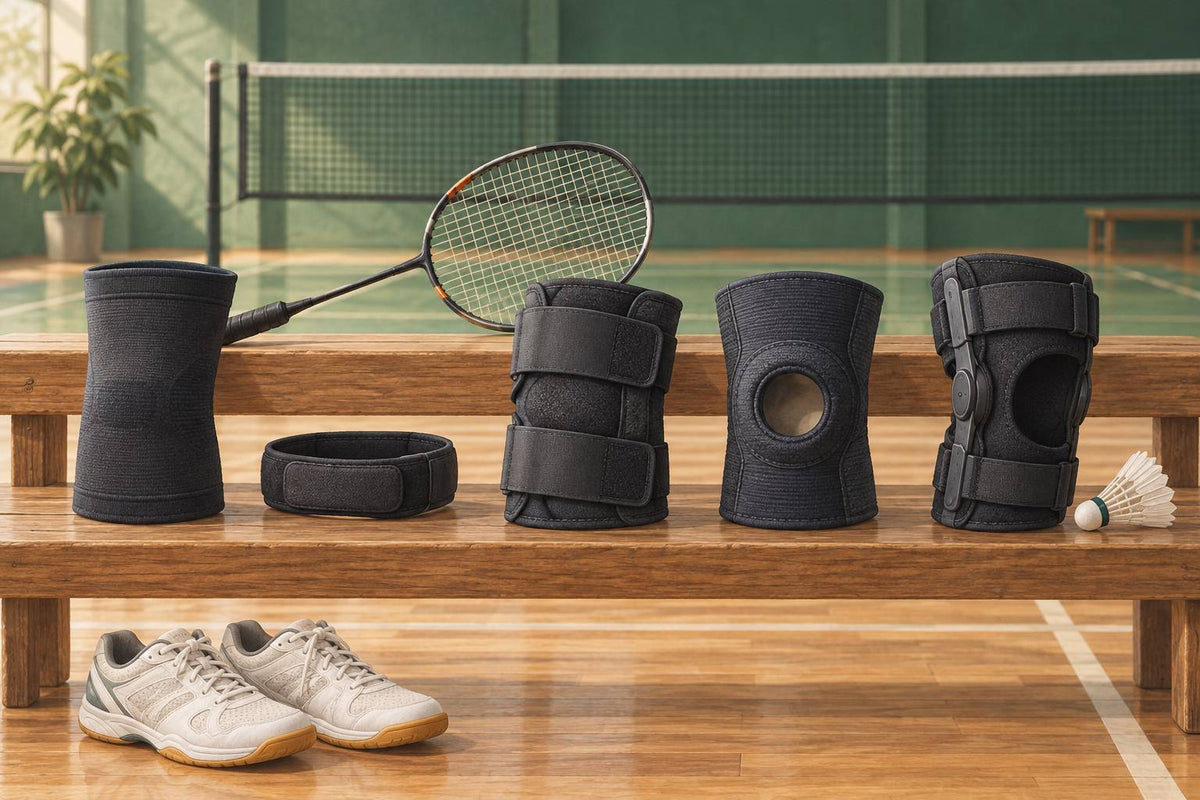
Choose the least bulky support that matches the problem: sleeve for mild court discomfort, strap for patellar-tendon pain, and a brace or professional fitting when you need more than light support.
Sleeve
Best default: a compression sleeve is the simplest badminton knee support for mild discomfort because it adds warmth, compression, and proprioceptive feedback without rigid bulk.
Strap
A patellar strap is more targeted: it applies pressure below the kneecap and is commonly used for jumper’s knee, runner’s knee, patellar tendonitis, and patella-tracking issues.
Brace
Use a wraparound, open-patella, or hinged brace only when you need more support; hinged braces are usually for serious injuries or post-surgery situations, so get healthcare guidance for anything beyond mild support.
If your knee starts talking during lunges, split steps, jump smashes, or long club nights, it is tempting to search for a badminton knee support and hope the right sleeve or brace solves it. Sometimes support can help: a compression sleeve may add warmth and light feedback, a patellar strap may target pressure below the kneecap, and a wraparound brace may feel more secure during movement.
But badminton is hard on knees because it is fast, stop-start, and lateral. A support is not a cure for pain that comes from training overload, weak landing mechanics, poor warm-up habits, or shoes that are not built for indoor court movement. This guide breaks down the main knee support types so Canadian players can choose more intelligently—and know when to fix the bigger issue first.
If your knee feels unstable, swollen, sharp, or painful enough that you are changing how you move, get assessed by a qualified healthcare professional before trying to play through it. For mild, familiar discomfort, the right support may be useful—but it should sit alongside better shoes, smarter load management, strengthening, and softer landings.
Fix the court-contact point first. Badminton House does not carry knee braces, but proper indoor court footwear is often the better first upgrade for lateral movement and landing confidence. Browse badminton footwear in Canada—free shipping within Canada on orders over $200.
In This Guide
- When does a badminton knee support help—and when doesn’t it?
- 1. Compression sleeves: light support for mild court discomfort
- 2. Patellar straps: targeted pressure below the kneecap
- 3. Wraparound braces: more support without hinged bulk
- 4. Patellofemoral and open-patella supports: kneecap-focused options
- 5. Hinged braces: high protection, usually not a casual court pick
- Fix shoes, landings, and training load before relying on a brace
- Which badminton knee support should you choose?
When does a badminton knee support help—and when doesn’t it?
Badminton is tough on knees because every rally asks for starts, stops, lunges, split steps, jumps, and recovery steps on a hard indoor court. In a study of 150 players at the 2018 BWF European Senior Championships, 221 injuries were observed; the lower limb accounted for the largest share at 40.3%, and the knee made up 22.44% of lower-limb injuries.
A badminton knee support can be useful when the issue is mild discomfort, warmth, compression, a bit of sensory feedback, or extra confidence while you ease back into play. It is not a cure for poor landing mechanics, overloaded training weeks, worn-out shoes, or pain that needs assessment.
Use a knee support as a tool, not the whole plan.
- Reasonable use: mild anterior knee discomfort, light swelling sensation, warmth, compression, or confidence during controlled play.
- Be cautious: pain that changes your footwork, sharp pain, instability, significant swelling, or symptoms that keep returning.
- Fix the cause: review mechanics, training load, warm-ups, strengthening, and footwear in our knee pain badminton guide.
For Canadian court players, the most common mistake is treating the brace as the first fix. If your shoes slide, feel dead under the heel, or are running shoes instead of non-marking indoor court shoes, your knee is still absorbing avoidable stress on every lunge and recovery step. Start with proper badminton footwear and the shoe advice in Badminton Shoes vs Running Shoes, then use a sleeve, strap, or brace only if it matches the symptom you are managing.
Badminton House does not carry knee braces or knee supports, so this guide is meant to help you understand the main support types before you buy from a Canadian pharmacy, medical-supply retailer, or clinic-recommended source.
1. Compression sleeves: light support for mild court discomfort
Compression sleeves are the lightest common badminton knee support option. They are tight elastic sleeves that lightly squeeze the knee, add warmth, and can help the joint feel more “aware” during movement. For a badminton player, that usually means mild support during warm-up, club-night doubles, or the later games in a long session when your legs start to feel less sharp.
A sleeve may help decrease mild pain, stiffness, and inflammation while you stay active, especially if your knee feels a bit irritated but not unstable. It may also improve proprioception: your sense of where the knee is in space. That matters in badminton because you are constantly braking, lunging, recovering, and landing from small jumps rather than moving in a straight line.
- Best fit: mild, general knee discomfort where you still move normally and do not feel the knee giving way.
- Court feel: low bulk, easy to wear under shorts or track pants, and less likely to interfere with quick split steps than heavier braces.
- Limit: a sleeve is not a rigid brace. Its skeletal support is minimal, so it should not be treated as protection for a serious injury or unstable knee.
The key point is that sleeves are mostly functional and neuromuscular, not structural. Evidence suggests the benefit may be more noticeable in fatigued knees, which fits real badminton: your landing mechanics and recovery steps often get messier near the end of a two-hour session. A sleeve can make the knee feel warmer and more secure, but it does not replace strength work, load management, or cleaner footwork.
Fit matters. Choose a sleeve that feels snug and secure without numbness, pinching, or bunching behind the knee. If it slides down during lunges, it is not doing much. If it changes your stride, makes you hesitant to bend, or leaves deep pressure marks, it is too restrictive for court play.
If your knee discomfort shows up mainly during lunges, jump-smash landings, or quick side-to-side recovery, also look beyond the sleeve. Worn or running-style shoes can make badminton movement harder on the joints, so proper indoor court footwear is often the better first gear fix. See our guide to badminton shoes vs running shoes or browse badminton footwear if your shoes are sliding, collapsing, or overdue for replacement.
Bottom line: choose a compression sleeve when you want light warmth, compression, and confidence for mild court discomfort. Do not choose it as your main solution for sharp pain, swelling, instability, or pain that keeps returning every session; that is when you should get assessed and work through the causes covered in our knee pain badminton guide.
2. Patellar straps: targeted pressure below the kneecap

A patellar strap, sometimes called a patellar band, is a focused type of badminton knee support that sits just below the kneecap. Instead of covering the whole knee like a compression sleeve, it applies pressure across the patellar tendon — the tendon at the front of the knee below the patella.
Players often look at this style when their discomfort feels concentrated at the front of the knee, especially around jumping, lunging, split-step loading, and repeated push-offs. Patellar straps are commonly used for jumper’s knee, runner’s knee, patellar tendonitis, Osgood-Schlatter disease, and patella tracking concerns.
When a patellar strap may make sense
- Your discomfort is mainly below the kneecap rather than deep inside the joint or on the side of the knee.
- You want targeted tendon pressure without the warmth and full-knee coverage of a sleeve.
- You can wear it snug and secure without it feeling too tight or distracting during court movement.
- You are also addressing the bigger causes: training load, landing mechanics, warm-up, strength, and proper court shoes.
The important caveat: front-of-knee pain is not one single condition. Pain below the kneecap, pain around the kneecap, and pain that appears only after long sessions can have different causes. A strap may reduce symptoms for some tendon-related issues, but it should not become a way to keep playing through pain that is getting worse.
If the pain is persistent, unclear, sharp, swollen, or changing how you move, get it assessed instead of self-diagnosing it as “jumper’s knee.” For a broader look at causes and prevention habits, see our knee pain badminton guide.
3. Wraparound braces: more support without hinged bulk
A wraparound or dual-wrap badminton knee support is the middle ground between a simple compression sleeve and a hinged brace. It is most useful for athletes with mild to moderate knee pain who want more support than a sleeve, but do not want the bulk of a hinged brace during court movement.
For badminton, that middle ground matters. You still need to lunge, split-step, recover, and rotate quickly. A wraparound brace can be easier to put on and remove than a tight sleeve, can be worn while training, and avoids the heavier structure of a hinged brace.
| Best fit | Why it helps on court | Watch for |
|---|---|---|
| Mild to moderate knee discomfort | More support than a sleeve without moving straight to a hinged brace. | It should not be used to ignore worsening pain or keep playing through an injury. |
| Players who dislike tight pull-on sleeves | Most wraparound designs use elastic or Velcro-style straps, making them easier to adjust, put on, and remove. | The brace should feel snug and secure, not painfully tight. |
| Training sessions and club nights | A lower-bulk option is less likely to interfere with normal badminton footwork than a large hinged brace. | If the brace changes how you land, lunge, or push off, it is not helping your movement quality. |
How to choose one for badminton movement
- Prioritize fit over maximum support. A brace that slides down during rallies or pinches when you bend your knee will distract you and may alter your movement.
- Check bend comfort. Badminton knees move through deep lunges, low defensive positions, and repeated split-steps, so the brace needs to stay comfortable when flexed.
- Keep it breathable enough for long sessions. Comfort and breathability matter because a support only helps if you can wear it consistently through training.
- Use it as support, not a fix. If pain is more than mild, keeps returning, or makes you change your footwork, get assessed instead of simply tightening the brace.
Badminton House does not carry knee braces, so look to Canadian medical retailers, pharmacies, or a healthcare provider for the brace itself. For the court-equipment side of knee comfort, make sure your shoes are built for indoor lateral movement; our badminton footwear collection and guide to badminton shoes vs running shoes are the better place to start before you rely on any brace.
If your knee pain is tied to jumping, lunging, or repeated hard landings, pair any support with the basics covered in our knee pain badminton prevention guide: smarter loading, better landings, and strength work matter more than strapping the knee tighter.
4. Patellofemoral and open-patella supports: kneecap-focused options

Patellofemoral knee supports are the kneecap-focused category: they are designed to protect and support the patella and the front of the knee. For badminton players, that usually means front-of-knee discomfort during lunges, jump landings, split steps, or repeated stop-start movement on indoor courts.
The key decision inside this category is whether you want an open-patella or closed-patella design. They can look similar at first glance, but they feel different once you start moving.
| Design | What it does | Badminton fit |
|---|---|---|
| Patellofemoral support | Supports the kneecap and the front of the knee. | Worth considering when the issue feels centred around the kneecap rather than general warmth or light compression. |
| Open-patella brace | Leaves an opening around the kneecap, which can relieve knee pressure and add kneecap support for tracking. | Often the more logical choice if the brace is meant to guide the kneecap during lunges, recovery steps, and repeated changes of direction. |
| Closed-patella brace | Covers the kneecap and provides even compression across the patella and the rest of the knee. | Better if you mainly want a uniform compressed feel instead of a kneecap cutout or tracking-focused support. |
In plain court terms: choose a patellofemoral or open-patella support when the problem feels specific to the kneecap area. Choose a closed-patella version when you want the whole front of the knee to feel evenly compressed. If the discomfort is sharp, worsening, swollen, or tied to a specific injury, do not try to solve it by buying a stronger brace; get assessed before returning to full-speed badminton.
This is also where players should be careful with labels. “Front of knee pain” is not one single diagnosis. Patellar tendon irritation, kneecap tracking issues, and other causes can feel similar when you are doing lunges and jump landings. If you are trying to narrow down likely causes, see our Knee Pain Badminton Guide for the broader prevention and return-to-play picture.
Before using any kneecap-focused support in a match, test it in realistic badminton movements: split step, forward lunge, side lunge, chasse recovery, and a few controlled jump landings. If the support slips, bunches behind the knee, changes your landing mechanics, or makes you hesitant to move, it is not helping your game.
Badminton House does not carry knee braces or knee supports, so use this section as buying guidance for Canadian pharmacies, medical retailers, or a professional fitting. For gear that directly affects court movement, start with proper indoor badminton footwear from our Footwear collection, and review Badminton Shoes vs Running Shoes if you are still playing in running shoes.
5. Hinged braces: high protection, usually not a casual court pick
A hinged knee brace is the high-protection end of the badminton knee support spectrum. Instead of just adding compression or a strap below the kneecap, it uses side hinges to help keep the knee aligned as it bends. That can matter after surgery, after a more serious injury, or when an athlete has been told they need extra protection during knee flexion.
For normal club play, though, a hinged brace is usually not the first pick. Badminton demands fast split steps, lunges, recovery steps, jumps, and rotation. A bulky brace can feel restrictive, and if your issue is mild soreness or early patellar tendon irritation, the simpler options earlier in this guide are usually the more practical starting point.
| Hinged brace may make sense when... | It is probably too much when... |
|---|---|
| You are returning after surgery or a more serious knee injury. | You only want light warmth, compression, or confidence during casual rallies. |
| A healthcare provider has told you the knee needs added protection or alignment support. | Your discomfort appears only after high training volume, poor landings, or playing in the wrong shoes. |
| You have a more advanced knee condition where bracing is part of a managed return-to-play plan. | You are trying to use a brace to push through pain instead of reducing load and fixing the cause. |
The big rule: if you think you need more than mild support, do not self-prescribe based only on what feels “strongest.” Some knee braces need custom fitting, and some are provided only with a prescription. A physiotherapist, sports medicine clinician, or physician can help you decide whether a hinged brace is appropriate and how it should fit your return to badminton.
Badminton House note: We do not currently stock knee braces or knee supports. If you need a hinged brace, work with a healthcare provider or a Canadian medical retailer/pharmacy rather than guessing. For court-specific causes of knee stress, also review Knee Pain Badminton Guide: Causes, Fixes & Gear in Canada and make sure your footwear is built for lateral indoor movement.
If your knee feels unstable, locks, gives way, swells after play, or hurts enough to change your footwork, treat that as a medical question first and a gear question second. A brace can be part of the plan, but it should not be the plan.
Fix shoes, landings, and training load before relying on a brace
A badminton knee support can be useful, but it should not become permission to keep playing through pain. If your knee hurts during lunges, jump smashes, split steps, or recovery steps, treat the support as a short-term aid while you fix the bigger court-play inputs: footwear, landing mechanics, training load, warm-up habits, and strength.
Before you buy or rely on a knee support, check these first
- Use proper indoor court shoes. Badminton involves repeated side-to-side braking, lunging, and quick direction changes. If you are still using running shoes on court, start with the explanation in Badminton Shoes vs Running Shoes, then compare current options in our badminton footwear collection.
- Land softer. On jump-smash work and rear-court recovery, aim to land quietly with your knees slightly bent instead of stiff-legged. A brace cannot fix harsh, repetitive landings.
- Warm up before hard rallies. Cold Canadian gyms can make players rush into full-speed movement too quickly. Build heat gradually before explosive lunges, jumps, and multi-shuttle drills.
- Stretch and recover after intense activity. Patellar tendon issues are linked to repeated jumping and running loads, so rest after hard sessions matters. Do not keep playing through pain just because a sleeve makes the knee feel warmer or more secure.
- Strengthen the legs, especially the quadriceps. Treatment for patellar tendinitis begins with physical therapy to strengthen the quadriceps muscles that straighten the knee. If pain is recurring, a proper strengthening plan matters more than upgrading from one support style to another.
The most player-first sequence is simple: reduce painful load, improve shoes and movement quality, rebuild strength, then use a badminton knee support only if it helps you return safely and comfortably. If you have swelling, instability, sharp pain, or pain that keeps coming back, get assessed by a qualified healthcare professional before choosing a brace.
A quick note on availability
Badminton House currently does not stock knee braces or knee supports. If you need a sleeve, strap, stabilizer, or brace, source it from a Canadian specialty medical retailer, pharmacy, or healthcare provider. For badminton-specific gear we can help with, start with proper court footwear; orders over $200 ship free within Canada.
Which badminton knee support should you choose?

Start with the least bulky option that matches the problem you are trying to manage. A badminton knee support can help with comfort, compression, kneecap tracking, or protection, but it should not be used to hide worsening pain or replace strength work, better landings, and proper court shoes.
| Choose this | Best fit for badminton | What it actually does | Be careful if... |
|---|---|---|---|
| Compression sleeve | You want light support for mild discomfort, warmth, or a steadier knee feel during club play. | A sleeve provides warmth and compression, can support proprioception, and may help reduce pain, stiffness, and inflammation. It is mainly functional and neuromuscular, not rigid structural support. | You need real stability after a significant injury. A sleeve is not the same thing as a brace. |
| Patellar strap | Your discomfort is focused just below the kneecap, especially with jumping, lunging, or repeated take-offs. | A strap applies pressure to the patellar tendon below the kneecap and is commonly used for conditions such as jumper’s knee, runner’s knee, patellar tendonitis, Osgood-Schlatter disease, or patella tracking issues. | Your pain is diffuse, sharp, swelling, or unclear. Not all front-of-knee pain is patellar tendinopathy, so get assessed instead of guessing. |
| Wraparound brace | You want more support than a sleeve, but you do not want the bulk of a hinged brace for training. | Wraparound and dual-wrap braces are used by athletes with mild to moderate knee pain, are easy to put on and take off, and can be worn while training without hinged-brace bulk. | You are returning from surgery or a more serious injury. That is when a higher-protection brace and professional guidance matter more. |
| Open-patella or patellofemoral support | Your issue is kneecap-focused: front-of-knee discomfort, pressure around the kneecap, or tracking concerns. | Open-patella designs can relieve kneecap pressure and add support for proper tracking. Patellofemoral braces protect and support the kneecap and front of the knee. | You are not sure whether the kneecap is the source. A closed-patella brace gives more even compression at the kneecap instead of targeted pressure relief. |
| Hinged brace | You need high protection, alignment help, or are managing a more serious injury or post-surgery return. | Hinged braces are often used post-surgery and for athletes needing a higher level of protection; they help keep the knee aligned as it bends. | You only want casual support for normal court play. A hinged brace is usually more protection and bulk than most players need. |
| Shoes, landings, and load | Choose this first if discomfort shows up after long sessions, hard landings, or playing in the wrong footwear. | Prevention basics include not playing through pain, resting after intense activity, warming up and stretching, strengthening the quadriceps, landing softly with knees slightly bent, and using non-slip shoes suitable for indoor sport. | A brace feels like the only thing keeping you on court. Read the Knee Pain Badminton Guide and consider getting assessed. |
Badminton House does not carry knee braces or supports, so for braces, straps, or medical-grade supports, look to Canadian specialty or medical retailers, pharmacies, or a healthcare provider’s recommendation. If your setup problem is footwear, compare proper indoor court options in our badminton footwear collection and review Badminton Shoes vs Running Shoes; Canadian orders over $200 ship free.
Final comfort rule: whatever you choose should feel snug and secure without being too tight, and it should be breathable enough to wear for a full session. If a support changes your movement, causes numbness, digs into the back of the knee, or makes you trust the brace more than your leg, it is the wrong fit for badminton.
Get new badminton guides by email
Join the Badminton House list for occasional emails with new guides, technique tips and news from our club in Moncton.
By subscribing, you agree to receive Badminton House emails and can unsubscribe anytime.
A badminton knee support can be useful, but it should not be the only answer. If your knee pain is sharp, worsening, swollen, or changing how you move, get it assessed before pushing through another session. For gear-side help, we play badminton ourselves and can help you think through court shoes, grip, racket setup, and training-load questions — contact Badminton House anytime.
Before you rely on a brace, make sure your shoes are built for badminton footwork.
Indoor court shoes are the better first upgrade for Canadian players dealing with hard gym floors, lunges, split steps, and fast lateral movement.
Shop Badminton Court ShoesFree shipping in Canada on $200+ · 14-day returns · Canadian badminton specialty shop


Leave a comment
This site is protected by hCaptcha and the hCaptcha Privacy Policy and Terms of Service apply.