
Last updated: August 2026 · Badminton House
Quick answer
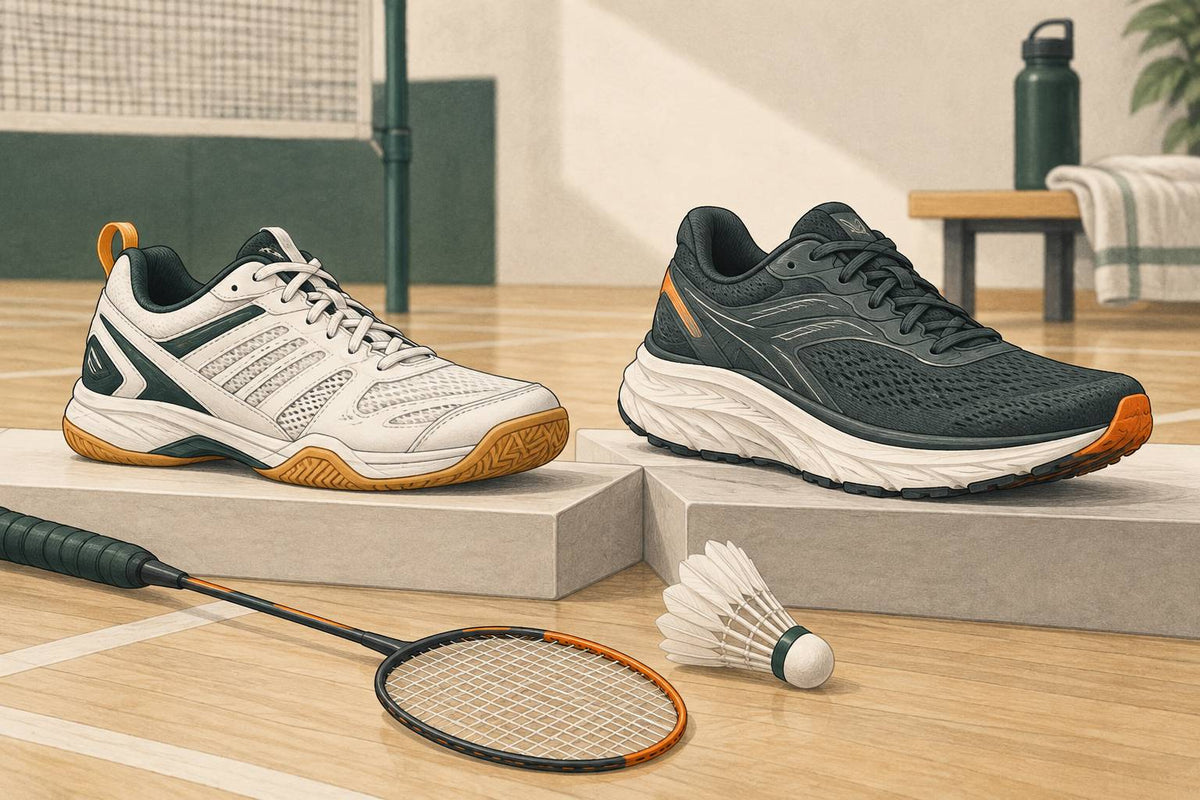
Choose suitable indoor court shoes for badminton. Most running shoes prioritize repeated forward strides rather than lateral stops and lunges. Check the exact outsole, fit and gym policy; a running-shoe label alone does not prove that a sole marks the floor.
Volleyball, squash or other indoor court shoes may work if their fit, lateral support and outsole suit badminton and your gym permits them. The table below gives starting checks, not guarantees for every model.
Can I Use the Shoes I Already Own?
| Shoe | Verdict | Why |
|---|---|---|
| Running shoes | No | Often forward-focused with a cushioned platform; verify the exact outsole and lateral support. |
| Squash shoes | Yes | Often a suitable low court design; check fit, traction and the exact outsole. |
| Volleyball shoes | Yes | Often designed for indoor court movement; cushioning, height and fit vary. |
| Indoor court shoes | Usually | Confirm non-marking status, suitable grip and lateral support. |
| Basketball shoes | At a push | Model-dependent weight, platform and support; check court suitability rather than assuming. |
| Tennis shoes | Check model | Some hard-court models are explicitly non-marking; confirm the exact model and gym policy. |
| Training / cross-trainers | Better than running, still no | Some models have a stable platform, but outsole grip and lateral suitability still need checking. |
| Casual / street shoes | No | Outdoor grit and unsuitable support or traction can make them a poor court choice. |
Confirm non-marking status from the model specification and follow your gym’s policy; informal sole tests are not proof. See our non-marking shoe guide. For example, the ASICS technical brochure identifies a non-marking outsole on the hard-court Court FF 3 Novak.

The Difference, Feature by Feature
| Badminton shoe | Running shoe | |
|---|---|---|
| Built for | Lunging, stopping, changing direction sideways | Repeated forward strides in a straight line |
| Sole | Indoor court outsole with model-specific non-marking specification and grip | Road or trail compound and tread vary; do not infer marking from category |
| Heel height | Low — keeps your foot close to the floor | Tall and soft. Modern cushioned models exceed 40 mm of stack under the heel |
| Lateral support | Lateral upper and platform features intended to support direction changes | Forward-stride emphasis; lateral support varies by model |
| Cushioning | Model-specific cushioning; Yonex reports 28% more shock absorption and 62% more repulsion for Power Cushion+ versus standard EVA in material testing, not an injury-reduction result | Full-length soft foam optimised for repeated impact, not stability |
Why the Tall Soft Heel Is the Problem
Cushioning, platform height, upper support and fit work together; more cushioning alone does not establish court suitability.
A study of 15 university basketball athletes found greater rearfoot inversion and peak inversion velocity during lateral shuffling in thicker-midsole shoes. It compared basketball shoes and measured movement, not badminton injury rates; it cannot establish that every running shoe causes ankle sprains.
For badminton, assess whether the shoe feels secure during controlled stops, side steps and lunges. A forward-running design may not provide the lateral handling you need.
Footwear is one part of preparation alongside floor condition, movement, fatigue and training. No shoe choice guarantees protection from injury.
The Other Direction: Can You Use Badminton Shoes for the Gym?
Some court shoes suit general gym activities, depending on their construction and the exercise.
For lifting, assess platform firmness, fit and the demands of the lift; badminton branding alone does not make a shoe suitable. General circuits also require appropriate traction and support.
For sustained running, choose footwear intended for that activity. Outdoor use can wear court outsoles and bring debris back onto indoor floors.
Keep a clean court-only pair when your gym requires it; grit and other floor contamination can affect traction.
Common Questions
Can I wear running shoes for badminton?
Suitable indoor court shoes are the better default. Most running models prioritize forward movement; verify the exact outsole and support without assuming every sole marks or predicting an injury.
What is the difference between badminton and running shoes?
Badminton shoes generally emphasize multidirectional court movement; running shoes emphasize repeated forward strides. Platform, support and outsole details vary by model.
Can I use training or gym shoes?
Check the exact model’s lateral support, traction and non-marking specification. A training-shoe label alone does not establish suitability for badminton.
Are volleyball or squash shoes OK for badminton?
They can be suitable if their fit, support and outsole meet your court needs and gym policy. Check the model rather than assuming all shoes in either sport are the same.
Are badminton shoes good for the gym?
Some models suit lifting or circuits, but assess platform, fit and the exercise. Choose running footwear for sustained running and keep indoor soles clean.
Do I really need badminton-specific shoes as a beginner?
You need suitable indoor court shoes, but they need not be badminton-branded. A well-fitting squash, volleyball or other court model can work when its support and outsole suit the session.
Ready to buy a proper pair? Our beginner shoe guide covers budgets, sizing and widths.

Leave a comment
This site is protected by hCaptcha and the hCaptcha Privacy Policy and Terms of Service apply.