
Last updated: July 2026 · Written by the team at Badminton House
Quick Answer: Knee Pain in Badminton
For most badminton knee pain, start by reducing painful court load, cleaning up lunge mechanics, and using dedicated cushioned indoor court shoes; do not play through worsening or mechanical symptoms.
Default
Best first step: back off the sessions that trigger pain, warm up properly, shorten overreaching lunges, keep the knee controlled over the foot, and build quad/hamstring strength for better shock absorption.
Shoes
Use badminton-specific non-marking shoes with cushioning and lateral support. Browse badminton footwear for current court-shoe options, and check the product page for sizes before ordering.
Red flags
If your knee locks, catches, gives way, swells within 24–48 hours, hurts with twisting, or will not bend or straighten normally, pause badminton and get assessed by a physiotherapist or doctor.
Knee pain in badminton can be frustrating because it often shows up in the exact movements that make the sport fun: explosive first steps, deep lunges, jump smashes, sharp stops, and recovery steps back to base. The knee is one of the most documented lower-extremity injury sites in badminton, and common overuse patterns include patellofemoral pain syndrome and patellar tendinopathy.
This guide is for Canadian players trying to understand why their knees hurt on court, what habits may be increasing load, when the pain sounds more like jumper’s knee versus a warning sign after a twist, and where shoes, fit, replacement timing, and support gear fit into the picture. It is not a diagnosis. If your knee feels mechanically unreliable after a twist, use the warning-signs section and get assessed before pushing through another session.
The practical goal: reduce avoidable knee stress without turning you into a cautious, flat-footed player. Better lunge mechanics, smarter training volume, proper warm-ups, and badminton-specific non-marking court shoes can all help you move more confidently.
Start with the surface between you and the court. If your current shoes feel dead, slippery, or unstable on side lunges, browse our badminton footwear collection. All prices are in CAD, with free shipping in Canada on orders over $200.
In This Guide
- Why Does Badminton Cause Knee Pain?
- What Lunge Mechanics Raise Knee Load?
- Jumper’s Knee vs. Meniscus Warning Signs
- What Court Habits Reduce Knee Stress?
- What Shoe Cushioning and Support Should You Look For?
- How Should Badminton Shoes Fit, and When to Replace Them?
- Canadian Gear Checkout Notes
- Which Knee Pain Badminton Fix Should You Choose?
Why Does Badminton Cause Knee Pain?
Badminton knee pain is common enough that it deserves more than a generic “sports injury” answer. Research on badminton biomechanics identifies the knee as one of the most documented lower-extremity injury sites in the sport, with many problems coming from accumulated loading rather than one obvious collision or fall.
Two knee issues come up again and again for badminton players: patellofemoral pain syndrome and patellar tendinopathy, often called jumper’s knee. Both are closely tied to repeated high-load movements (the exact kind of movements you use when you lunge to the front court, jump for an overhead, stop hard, twist, recover, and repeat the rally again).
Think of knee pain badminton as a load-management problem first. Technique, strength, training volume, court surface, and footwear all affect how much stress reaches the knee. If you are still wearing running shoes indoors, start with our guide to badminton shoes vs running shoes.
The front of the knee is especially relevant. Anterior knee pain is commonly documented among badminton players, and research on badminton lunges found that the chondral layer of the patellar cartilage takes the highest load during lunge movements. In plain English: the area behind and around the kneecap can be repeatedly stressed when your footwork is late, your landing is stiff, or your training load rises too quickly.
That is why this guide focuses on badminton-specific knee stress rather than listing every possible injury. Lunges, jumping, twisting, and sudden direction changes create a very different pattern of knee loading than steady running or casual gym training. The goal is to help you recognize which habits reduce load, which symptoms need respect, and which gear choices can support better movement, not to scare you off the sport.
If your pain is sharp, worsening, or linked to a twist under load, see the warning-signs section below.
What Lunge Mechanics Raise Knee Load?

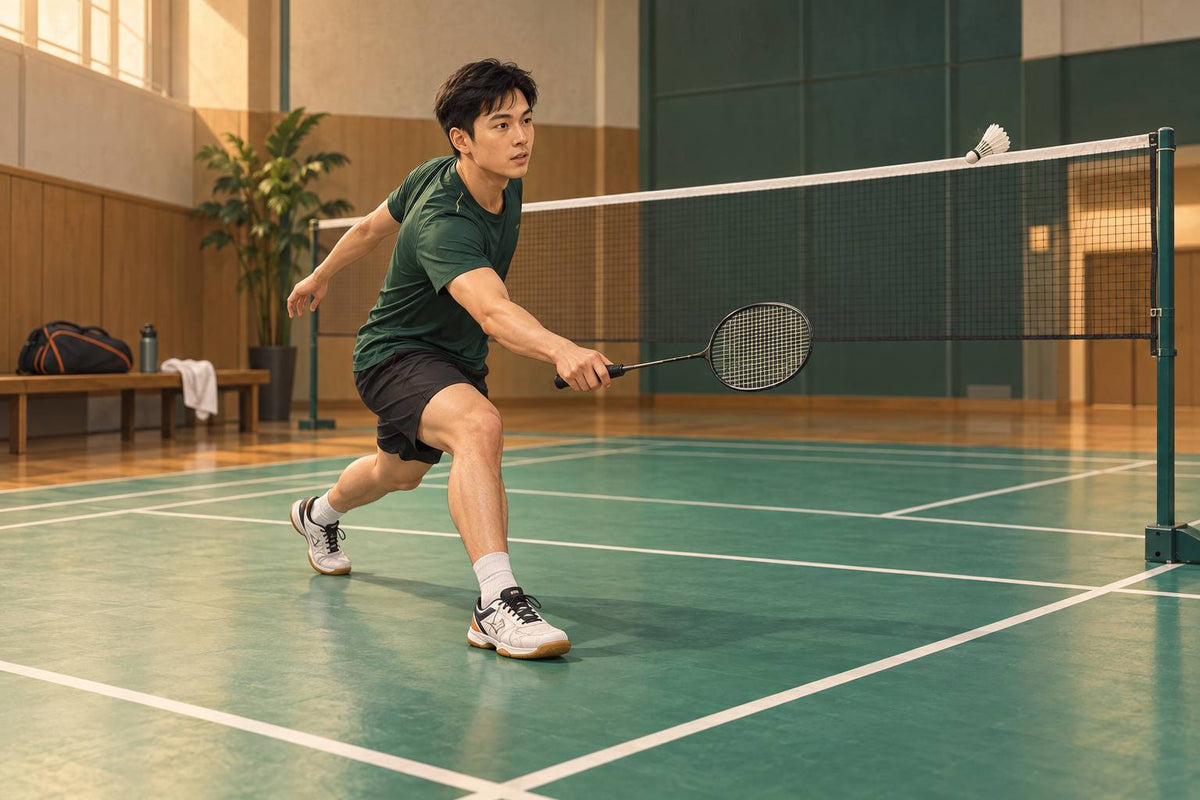
When players search for knee pain badminton, the lunge is usually part of the story. Badminton lunges are not just long steps. They combine fast braking, heel impact, knee bending, and push-off under time pressure. That is why the same movement that helps you reach a tight net shot can also build up stress around the front of the knee.
In one badminton lunge study, the left-forward lunge produced a first vertical impact force of about 2.34 ± 0.52 body weights and a maximum anterior-posterior shear force of 1.48 ± 0.36 body weights, higher than backward lunges. In plain language: the front leg is taking a large downward hit, while also controlling front-to-back braking forces.
Distance matters too. Compared with a 1.5-times-leg-length lunge, maximum-distance lunges significantly increased knee flexion and both vertical and anterior-posterior ground reaction forces. Reaching farther may win a rally, but it also asks the knee to absorb more load (especially if the foot lands late, the trunk collapses forward, or the player has to push back explosively).
| Lunge detail | Why it can raise knee load | Practical cue |
|---|---|---|
| Long forward reach | Maximum-distance lunges increase knee flexion and ground reaction forces compared with shorter lunges. | Use fast recovery steps and split-step timing so you are not forced into a desperate last-second reach. |
| Knee drifting past the toe line | A forward knee position can increase the demand on the front of the knee during braking. | On forward lunges, aim to keep the knee from travelling past the toe line, especially during controlled drills. |
| Stiff landing when tired | Fatigue can reduce knee flexion and increase leg stiffness, which may elevate lower-limb loading. | If your landings get noisy or rigid late in a session, shorten the rally drill, take a reset, or switch to lower-intensity footwork. |
| Weak shock absorption | Weak quadriceps and poor landing mechanics are linked with patellar tendonitis risk in badminton players. | Build strength in the quadriceps and hamstrings so the leg can absorb force instead of dumping it into the knee joint. |
Simple on-court self-check. During net-lunge drills, listen for heavy heel slaps, watch whether the knee shoots past the toes, and notice whether your last 10 reps look stiffer than your first 10. Those are signs to reduce distance, slow the drill, or rest before chasing more volume.
The goal is not to avoid lunging — badminton requires it. The goal is to make each lunge more repeatable: arrive earlier, land under control, keep the knee tracking cleanly, and stop before fatigue turns a controlled movement into a stiff impact.
Jumper’s Knee vs. Meniscus Warning Signs

Not every case of knee pain in badminton feels the same. A gradual ache below the kneecap after lunges and jumps points to a different problem than a knee that pops, locks, catches, swells, or gives way after a twist. Use this comparison as a decision helper — not a diagnosis.
Quick Decision Helper: Tendon Pain or Meniscus Red Flag?
If symptoms are mechanical (locking, catching, giving way, twist-related joint-line pain, or swelling that persists), book a physiotherapist or doctor assessment before playing through it.
Get checked
Red flags: locking, persistent swelling, giving way, difficulty bending or straightening, or pain after a forceful twist on a bent, loaded knee.
Monitor load
Gradual, load-related pain just below the kneecap that is tender to touch and worse with squatting or jumping is more consistent with jumper’s knee patterns.
| What you notice | More like jumper’s knee | More like a meniscus warning sign |
|---|---|---|
| Onset | Gradual build-up from repeated loading, jumping, landing, and hard court sessions. | Often linked to a twist, pivot, or rotation while the knee is bent and carrying body weight. |
| Pain location | Pain below the kneecap, with focal tenderness at the inferior pole of the kneecap. | Pain along the knee joint line, especially when twisting, turning, pivoting, or bearing weight. |
| Provoked by | Squatting, jumping, repeated lunges, and high-load activity tolerance dropping over time. | Twisting, pivoting, deep bending, or trying to fully bend or straighten the knee. |
| Mechanical symptoms | Usually described as load-related tendon pain rather than locking or catching. | Popping, locking, catching, buckling, or “giving out” are common warning signs. |
| Swelling | May feel stiff or sore with ongoing load, especially if you keep pushing through symptoms. | Swelling can develop within 24–48 hours after the injury and should be treated seriously if it persists. |
What to do if it sounds like jumper’s knee
Jumper’s knee, also called patellar tendinitis or patellar tendinopathy, involves the tendon that connects the kneecap to the shinbone. In badminton, the pattern often shows up as a gradual loss of tolerance for jumping, lunging, and squatting rather than one dramatic incident.
- Do not keep forcing full sessions through worsening pain. Symptoms can get worse over time when players continue training or playing through them.
- Reduce the painful load first. Relative rest, stretching and strengthening, and correcting movement issues are common non-operative care themes.
- Get a plan if it is not settling. Physical therapy commonly begins with quadriceps strengthening, and a physiotherapist can help progress loading safely for badminton footwork.
Badminton-specific takeaway. Tendon pain often rewards smart load management; meniscus-type symptoms need assessment. If your knee locks, swells, gives way, or hurts with twisting, pause play and see a physiotherapist or doctor.
When to stop guessing and book an assessment
A meniscus issue can feel less like “soreness” and more like the knee is not moving normally. Displaced torn tissue and swelling can affect how the knee tracks and how the thigh muscles support it, which is why giving way or buckling matters.
- Locking or catching: the knee feels stuck, blocked, or unable to move smoothly.
- Giving way: the knee buckles or feels unreliable under body weight.
- Twist-related joint-line pain: pain appears when pivoting, turning, or bearing weight after a twist.
- Swelling within 24–48 hours: especially if it does not settle or returns after activity.
- Difficulty bending or straightening: you cannot comfortably regain normal knee range of motion.
If those symptoms are present, treat the next match as less important than getting the knee assessed. Many meniscus tears are managed without immediate surgery when there is no locking or swelling, but the presence of locking, persistent swelling, giving way, or twist-related symptoms is a strong reason to see a physiotherapist or doctor before returning to hard games.
What Court Habits Reduce Knee Stress?
The best knee-pain fix is not one magic brace or one shoe upgrade. For badminton, the prevention basics are boring but important: warm up properly, build strength around the knee, use appropriate support when needed, and stop treating early pain as something to “play through.”

Court-habit checklist
- Warm up before hard rallies. Badminton knee injuries are linked to jumping, twisting, sharp stops, and direction changes, especially when the knees are not ready for abrupt impact.
- Strengthen your quadriceps and hamstrings. Stronger front- and back-thigh muscles help the leg absorb shock instead of dumping every landing and lunge into the knee joint.
- Clean up landing mechanics. Weak quadriceps and improper landing mechanics can contribute to patellar tendonitis, so controlled landings matter as much as big jumps.
- Use support when appropriate. Knee support can be part of prevention, but it should not be used to mask worsening pain or compensate for rushed footwork.
- Back off early jumper’s-knee symptoms. If pain below the kneecap and stiffness keep increasing, pushing through more training can make symptoms worse over time.
Warm up like the first rally matters
A badminton warm-up should prepare you for the actual movements that stress the knee: split steps, forward lunges, recovery steps, jumps, sharp stops, and changes of direction. The goal is not just to feel “warm”; it is to make your first hard lunge less sudden for the tendon and joint.
If your knee pain usually appears in the first few games, that is a clue to slow the ramp-up. Start with easier movement, then gradually add deeper lunges, faster recoveries, and higher jumps instead of going straight into full-speed doubles defence or smash-and-net drills.
Build the shock absorbers: quads and hamstrings
Your quadriceps help straighten the knee and control landing forces; your hamstrings help balance the knee and hip during deceleration. Strengthening both muscle groups improves shock absorption and helps protect the joint during repeated lunges and jumps.
This matters especially for players with front-of-knee pain. Weak quadriceps and poor landing mechanics are both linked with patellar tendonitis in badminton players, and patellar tendinopathy is usually a load-management problem: too much jumping, lunging, or hard stopping for what the tendon can currently tolerate.
"If your knee only feels good after it warms up, do not ignore that signal. It may be your tendon asking for better load management, not more rallies."
Do not turn mild jumper’s knee into a season-long problem
Jumper’s knee often starts as gradual, load-related pain below the kneecap. It may feel manageable at first, especially once you are moving, but pain and stiffness can get worse over time if you keep playing or training through symptoms.
A smarter habit is to reduce the highest-load pieces first: repeated jump smashes, deep emergency lunges, long multi-shuttle sessions, and back-to-back hard club nights. If pain keeps returning, or if you are changing your movement to protect the knee, get assessed by a qualified health professional before it becomes your new normal.
Next gear check: once your warm-up, strength, and load habits are under control, footwear becomes the next big variable. The next section explains what to look for in badminton shoe cushioning and support for knee-stress reduction.
What Shoe Cushioning and Support Should You Look For?

Shoes will not “fix” knee pain on their own, but they are one of the easier equipment variables to control. Badminton includes repeated jumping, sharp stops, side lunges, and high-impact landings, so players dealing with knee irritation should look for two things first: cushioning that helps manage landing shock, and reinforced lateral support that keeps the foot more stable during side-to-side movement.
The key is to choose badminton-specific indoor court shoes, not running shoes. Running shoes are built mainly for straight-line movement; badminton shoes need to handle braking, split steps, lunges, and quick recoveries on indoor courts.
What to check in a knee-friendly badminton shoe
- Cushioned midsole: look for badminton-specific impact protection under the heel and forefoot, especially if your knees feel worse after jump smashes or long defensive rallies.
- Lateral stability: reinforced side support helps reduce shoe deformation during side lunges and hard recoveries.
- Non-marking outsole: required by many indoor courts and useful for controlled grip on gym floors.
- Secure midfoot fit: if your foot slides inside the shoe, your knee may have to deal with extra rotation and braking stress.
Court-shoe example: Babolat Shadow Tour Men’s Badminton Shoes – Orange
check product pageCheck the product page for current price, sizes, and sale status · Approx. 295 g in size 9
For players prioritizing cushioning and support, the Shadow Tour is one court-shoe option to compare. Its Kompressor dual-density EVA midsole uses KPRS-X cushioning, described as absorbing harsh impact forces and keeping joints protected. It also has a Michelin non-marking outsole for indoor court grip and Power Straps for midfoot support.
View Babolat Shadow Tour DetailsIf you prefer to compare all current shoe options first, start with the Badminton House footwear collection. Treat any specific shoe model as one input alongside fit, cushioning, and lateral support rather than the whole solution to knee pain.
| Feature | Why it matters for knee load |
|---|---|
| Impact cushioning | Helps manage the repeated shock from jumps, split steps, and forward lunges. |
| Lateral reinforcement | Supports the foot during side lunges and quick direction changes, where unstable shoes can fold or slide. |
| Secure midfoot hold | Reduces in-shoe movement during braking and recovery steps. |
| Non-marking indoor outsole | Gives badminton-appropriate court traction without marking gym floors. |
Bottom line: if your knee pain is linked to load, landings, or long sessions, start by checking whether your shoes are still cushioning properly and supporting lateral movement. If symptoms are sharp, worsening, swollen, locking, catching, or giving way, treat that as a medical assessment issue rather than a shoe-shopping problem.
How Should Badminton Shoes Fit, and When to Replace Them?
A lot of knee-friendly shoe advice starts with cushioning, but fit and shoe age matter just as much. A shoe that is too long lets your foot slide into the toe box on lunges; a shoe that is too narrow can make you land awkwardly; and an old outsole or dead midsole can turn every stop into a harsher impact.
The 5 mm toe-room check
Badminton shoes should fit snugly with about 5 mm of room in front of the toes. That is less spare space than many players leave in casual shoes, because badminton has repeated braking, split steps, and forward lunges. If your foot slides forward inside the shoe, your knee and ankle have to manage a less stable landing.
- Try them with your real badminton socks. Sock thickness changes the fit enough to matter.
- Check heel hold. Your heel should not lift noticeably when you split step or push off.
- Check the forefoot during a side lunge. The upper should hold your foot on the platform instead of letting it spill over the edge.
If you are comparing shoe categories, our guide to badminton shoes vs running shoes explains why indoor court construction matters for lateral movement.
Look for lateral support, not just softness
A soft shoe can feel comfortable in the store but still perform poorly on court if it twists or deforms during side lunges. For badminton, reinforced lateral support helps keep the shoe from collapsing when you plant hard to the side. That matters because a collapsing shoe can change your knee angle right when load is highest.
A practical test: lace the shoe properly, step into a controlled side lunge, and watch whether your foot stays centred over the outsole. If the upper folds over or your foot rolls past the edge, the shoe is not giving you the platform you want for repeated badminton footwork.
| Gear check | What you want | Why it matters for knees |
|---|---|---|
| Toe room | About 5 mm in front of the toes | Reduces sliding on hard stops and forward lunges |
| Heel hold | Secure heel with no obvious lifting | Improves stability when you push off or recover |
| Side support | Upper and outsole resist deformation in side lunges | Helps keep the knee tracking over a stable base |
| Midsole feel | Still has bounce under the heel and forefoot | Dead cushioning makes impacts feel harsher |
When to replace badminton shoes
If you train 2–3 times per week, a practical replacement window is every 6–8 months. That timeline can be shorter or longer depending on body weight, footwork style, court surface, and how often you rotate shoes, so use the condition checks below rather than the calendar alone.
- The gum rubber has hardened. If the outsole feels slick or plasticky instead of tacky, grip and braking quality can suffer.
- The bounce has disappeared. If the shoe feels flat under the heel or forefoot, the midsole may no longer be absorbing impact the way it did when new.
- The upper has stretched or folded. If side lunges push your foot over the edge, the shoe is no longer giving reliable lateral support.
- The wear is uneven. A badly worn heel or forefoot can change how you land, especially when you are tired.
For players dealing with foot shape or heel-comfort issues alongside knee soreness, the guide to badminton shoes for flat feet, heel pain, and plantar fasciitis is the better next read.
Insoles, knee sleeves, and supports
Insoles and knee supports can be useful for some players, but treat them as support tools (not a fix for poor mechanics, worn-out shoes, or pain that keeps getting worse). If you are using an insole, make sure it does not make the shoe too tight or raise your heel so much that your foot becomes less stable inside the shoe.
availability note
For insoles, knee braces, or knee supports, check Canadian badminton specialty retailers, your local club’s pro shop, or a qualified clinician if you are managing an injury. Choose based on fit, comfort, and professional advice rather than treating support gear as a shortcut.
Bottom line: start with a snug, stable badminton shoe; replace it when the outsole or cushioning is done; and use insoles or supports only when they improve comfort without making your foot less secure on court.
Canadian Gear Checkout Notes
Badminton House prices are listed in CAD, and orders over $200 ship free within Canada. If you are already replacing court gear, browse badminton footwear and add only the other badminton items you actually need in the same checkout.
Which Knee Pain Badminton Fix Should You Choose?
Use this as a practical decision helper, not a diagnosis. The key split is whether your knee pain behaves like gradual load irritation, a technique/fatigue issue, or a mechanical warning sign that needs professional assessment.
| Choose this path | If this sounds like you | What to do next |
|---|---|---|
| Dial back load first | Pain builds gradually below the kneecap and is worse with jumping, squatting, or high-load play. | Treat it like a possible jumper’s-knee pattern: reduce aggravating volume, avoid pushing through worsening symptoms, and prioritize quad-focused rehab with a qualified professional. |
| Fix lunge mechanics | Your knee pain shows up most on deep forward lunges, late reaches, or tired rallies. | Shorten overreaches where possible, keep the knee from travelling past the toe line on forward lunges, and build quadriceps and hamstring strength so your legs absorb impact better. |
| Get assessed promptly | You feel locking, catching, popping, giving way, joint-line pain when twisting, or swelling after a loaded twist. | Pause badminton and see a physiotherapist or doctor. Those mechanical symptoms fit the meniscus warning-sign bucket more than simple post-match soreness. |
| Upgrade court shoes | Your shoes feel flat, unstable in side lunges, or you are still using running shoes for badminton footwork. | Choose dedicated non-marking badminton shoes with cushioning and lateral support; see the shoe section above for cushioning tech, fit, and replacement timing. If you are shopping now, the Babolat Shadow Tour Men’s Badminton Shoes are the current court-shoe option to check, or browse the footwear collection. |
| Check fit and support | Your feet slide inside the shoe, the upper collapses during side lunges, or cushioning no longer feels responsive. | Use the fit and replacement checklist above before buying another pair. If you need insoles or knee support, ask a qualified clinician or your local club’s pro shop for sport-appropriate options. |
| Change court habits | Pain appears after long sessions, hard stops, repeated jumping, or playing through fatigue. | Warm up properly, manage session volume, and take fatigue seriously because stiffer, less-flexed landings can raise lower-limb loading. |
For a deeper footwear comparison, see Badminton Shoes vs Running Shoes and Best Badminton Shoes for Flat Feet, Heel Pain, and Plantar Fasciitis.
Get 10% off your first order
Join the Badminton House list and we’ll email you a 10% welcome code — plus subscriber-only restock alerts, giveaways, and honest gear advice from players.
By subscribing, you agree to receive Badminton House emails and can unsubscribe anytime.
We play badminton too, so we know knee pain is not just a “fitness” problem. It changes how confidently you split-step, lunge, recover, and compete. If you are unsure whether your shoes, fit, footwork, or training load are contributing, contact us and we’ll help you think through your setup before you buy.
"For knee pain in badminton, start with the big three: cleaner lunges, smarter load management, and proper indoor court shoes built for impact and lateral movement."
— Badminton House gear advice
Shop Badminton FootwearFree shipping on $200+ · 14-day returns · Canadian badminton specialty shop

Leave a comment
This site is protected by hCaptcha and the hCaptcha Privacy Policy and Terms of Service apply.