
Last checked: August 2026 · Written by the player-led team at Badminton House
Quick answer
The cited experiment used calibrated stringing and frequency-based checks; it does not establish that feel or sound alone gives a player an exact string-tension value. BWF Laws do not prescribe a player-facing post-stringing test.
Start with why feel and pitch cannot yield an exact number
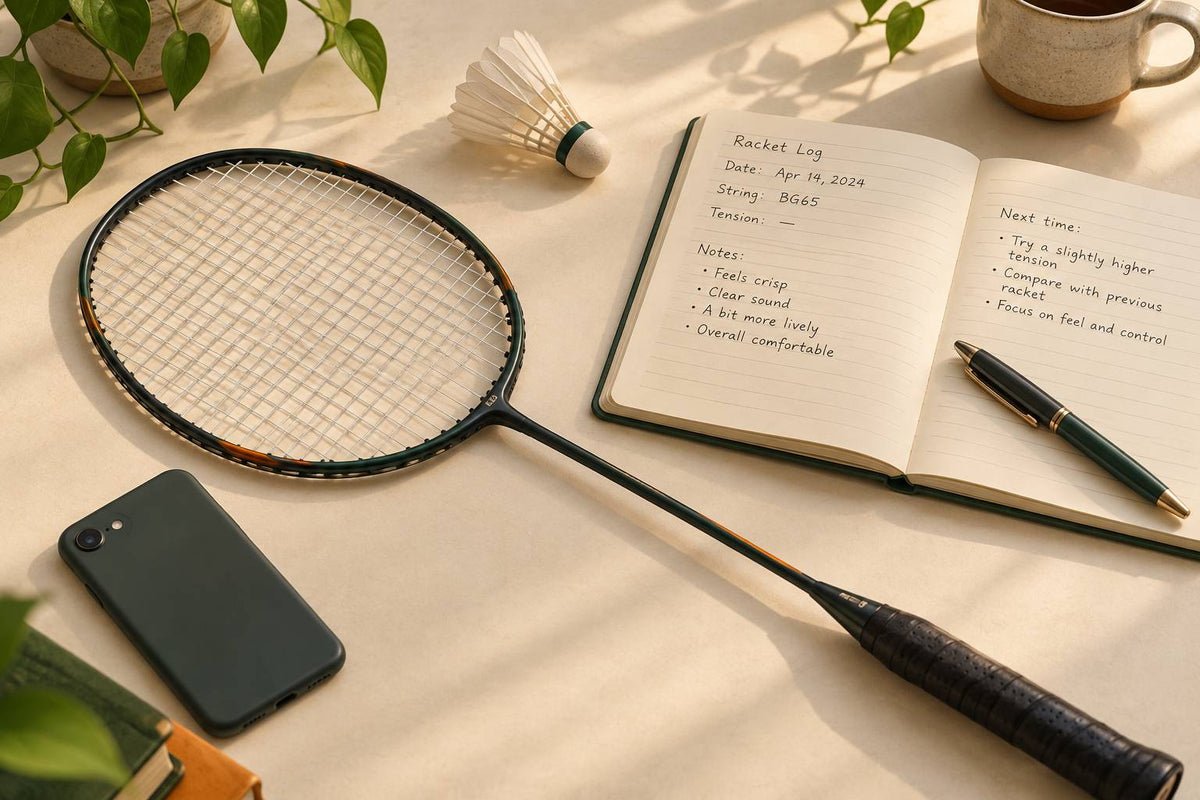
Local frame log: treat feel or a pluck as a non-numeric personal observation, not an exact tension reading. The cited study used calibrated stringing and frequency checks under its own setup; it does not validate every consumer method.
- Record the exact racket, string, stated tension, date, and any recent restring before noting feel or pitch.
- Label a pluck or hand-feel note as a personal observation; do not use it to assign a number to a different frame.
- When an exact figure matters, ask a qualified stringer what method and setup they used and record it; this study does not establish that a personal pluck, squeeze, or app used outside its setup gives the same measurement.
- Keep BWF Laws separate from personal tension measurement; they do not provide a player-facing tension test.
Related reading: How to Check Badminton Racket Stringing Quality After a Restring — for a post-restring inspection that does not pretend to measure tension.
Why feel and pitch cannot yield an exact number
The cited experiment does not establish that a player can derive an exact string-tension value from feel or sound alone. Its methods use calibrated stringing and frequency-based checks rather than feel or sound as a tension measurement. string-tension study

What the cited research used instead
The cited tension study used a stringing machine calibrated by technicians and confirmed its set tensions after stringing through sound-frequency analysis using a Gosen ERT300 String Tension Measurement Tester and Racquet Tune. Those methods describe the study’s own setup; they do not establish the accuracy of consumer methods outside it. string-tension study

The study controlled more than a court-side pluck. It used 10 badminton rackets—five for testing and five spares—examined racket weight, shaft stiffness, and moment of inertia, used five fixed pull-tension settings, and confirmed tension through sound-frequency analysis. Those details describe its experimental setup, not a universal conversion for a player’s racket. string-tension study
Keep a player’s observation in its proper category and ask a qualified stringer what method and setup they used when a number affects a restringing decision.
What BWF Laws do not set about tension
BWF Laws define the racket stringed area but do not prescribe a player-facing post-stringing tension test or a required tension value. The Laws address racket construction rather than a tension-measurement protocol. BWF Laws of Badminton

Use this distinction on court
Record the frame, string, stated tension, stringing date and preparation method in one field, then put your own feel or sound observation in another. Compare the same racket with its earlier record and mark any setup change. When a number matters, ask the stringer what was measured and how; neither a personal pluck nor BWF construction rules supplies that answer.
Study limit
The cited study describes a calibrated machine and frequency checks in its own experiment. It reports that feeling or sound cannot provide an exact string-tension value, and it did not test generic apps or other consumer setups.
Questions the cited sources do not settle
- Exact pounds or kilograms from squeezing, plucking, or listening.
- A universal pitch-to-tension conversion or accuracy claim for an app without its validated setup.
Player-first advice for your next indoor session


Leave a comment
This site is protected by hCaptcha and the hCaptcha Privacy Policy and Terms of Service apply.