
Last checked: August 2026 · Written by the Badminton House player-led team.
Quick answer: Prakash Padukone, 1980
Prakash Padukone was the first Indian to win the All England men's singles title. Pullela Gopichand followed in 2001. A documented coaching line then connects Padukone's student Gopichand with Saina Nehwal and PV Sindhu, but the relationship does not assign every later result to one coach.
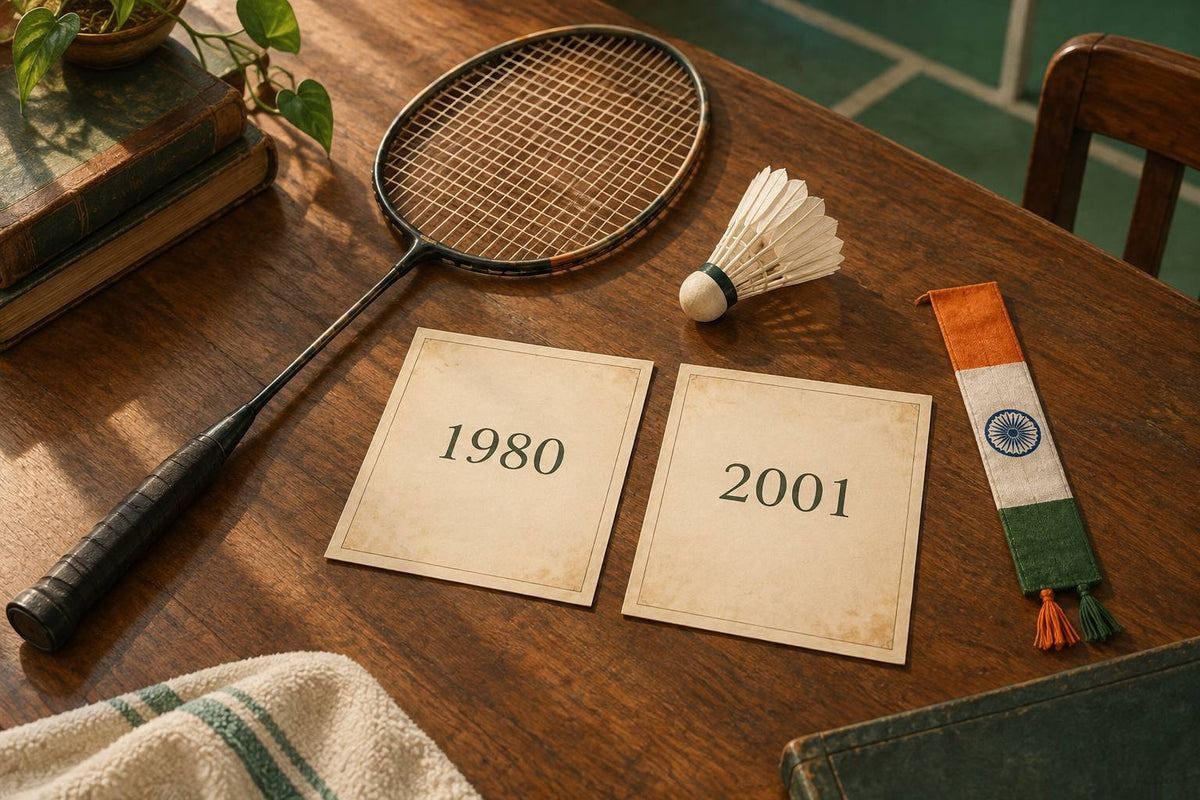
1980
Padukone: first Indian All England men's singles champion.
2001
Gopichand: India's next men's singles champion in the official record.
After
Coaching: verified relationships connect the two champions with later leading players.
Who was the first Indian All England champion?
According to Badminton England's April 2025 All England facts and records, Prakash Padukone was the first Indian men's singles champion, winning in 1980. That discipline is the verified scope of the common shorthand. Pullela Gopichand became the next Indian winner in 2001.
That record lists “Prakash Padukone (India)” for 1980 and “Pulella Gopichand (India)” for 2001. It misspells Gopichand's given name; the standard spelling is Pullela.
The list makes the “first” claim checkable: Padukone is the earliest Indian in its men's singles champions chronology. Other Indian milestones in team events, doubles, junior competition, or different tournaments are separate records.
| Year | Verified milestone | What it establishes |
|---|---|---|
| 1978 | Padukone won Commonwealth Games gold | A major recorded result before the All England title |
| 1980 | Padukone won All England men's singles | The first Indian champion in that discipline |
| 2001 | Gopichand won All England men's singles | The next Indian champion in the official list |
| Later | Gopichand's coaching record includes Nehwal's and Sindhu's Olympic medal campaigns | A documented teaching line to major later players |
Badminton history contains singles, doubles, mixed doubles, junior, team, Olympic, World Championship, ranking, and national records. A result in one category cannot silently stand for all of them. The narrow answer is the durable answer: player, discipline, tournament, and year.
The first three rows also show why the order matters. Padukone's 1978 Commonwealth gold comes before the three European wins named for March 1980. Gopichand's All England entry appears in 2001, not as part of that 1980 cluster. The coaching relationship connects the people without collapsing the 21-year competitive gap.
For another example of how named records shape badminton history, our guide to the first badminton rules separates documented dates from the stories that later grew around them.
What else is verified about Padukone's 1980 run?
A Government of India profile places the All England title inside a larger competitive record. It says Padukone reached world No. 1 at age 25, won Commonwealth Games gold in 1978, and won the Danish Open, Swedish Open, and All England Championships in March 1980.
Those milestones appear together in the Press Information Bureau's 2018 profile of Prakash Padukone. They show that the All England win was part of a documented high-level career rather than an isolated date in a winners table.
The record does not establish that the March title caused the No. 1 ranking, and the events should not be forced into a causal sequence the source does not give. The useful point is simpler: by 1980, Padukone's named achievements included major results in several countries and the first Indian All England men's singles title.
How the verified results frame 1980
The 1978 Commonwealth Games gold is the earliest dated milestone in the government profile. Its next cluster is unusually specific: Danish Open, Swedish Open, and All England wins in March 1980, followed in the same profile by the world No. 1 statement. Read together, the dates show sustained international results around the championship year.
The source gives no match scores, opponents, or round-by-round route, so those details do not belong in this record. What it does give is enough to place the All England title inside Padukone's competitive career. He arrived in 1980 with a Commonwealth title already recorded and left that March with three named European tournament wins.
Padukone's later work also appears in the profile. It says he coached Indian teams and co-founded a badminton academy with centres in Bangalore and Mumbai. That change from player to coach is the bridge to Gopichand, whom the same source names among his students.
What Gopichand added in 2001
Gopichand's title sits 21 calendar years after Padukone's in the official list. It is the second confirmed Indian marker in this specific men's singles story. The gap prevents an easy tale of uninterrupted dominance: the two entries belong to different careers and competitive eras.
Their connection becomes historical evidence only when another source identifies it. The government profile says Padukone later coached Indian teams and names Gopichand among his students. That supports a player-to-coach link. It does not make Padukone solely responsible for Gopichand's 2001 championship or everything Gopichand later built.
How should the Padukone-to-Gopichand coaching lineage be described?
The defensible chain is narrow: the government profile names Gopichand among Padukone's students, and a Sports Authority of India release connects Gopichand's coaching work with the Olympic medal campaigns of Saina Nehwal and PV Sindhu. This documents relationships across generations, not one continuous academy or exclusive pathway.
Padukone's profile supplies the first link: he coached Indian teams, and it names Gopichand among his students. A Sports Authority of India release supplies the second: it identifies Gopichand as national badminton coach and connects his work with Nehwal's and Sindhu's Olympic medal campaigns.
Gopichand's coaching role in the official record
That independent government account supports Gopichand's player-to-coach transition. It places Nehwal's 2012 and Sindhu's 2016 Olympic medal campaigns inside his coaching record without claiming that he worked alone or that one coaching relationship explains either result.
The same release reports Gopichand's view that successful models involve coaches, sports science, and athletes, with people doing the on-court work involved in decisions. That description is a useful counterweight to a one-person lineage story: Gopichand spoke about a working system even while the release highlighted his own role.
He was speaking to newly appointed Sports Authority of India assistant directors, so the subject was how a coaching system operates rather than how one athlete won one match. The release reports his emphasis on people doing the field work, supported by sports science and athlete input. In this chronology, that is the clearest official description of Gopichand after his playing career.
By this point the sequence has changed twice. Padukone moved from champion to coach. Gopichand moved from Padukone's student to All England champion, then to national coach. Nehwal and Sindhu appear as players in Gopichand's coaching environment, each with her own competitive record.
The four roles in the documented line
| Person | Recorded player result | Recorded coaching link |
|---|---|---|
| Prakash Padukone | 1978 Commonwealth gold; 1980 All England champion; world No. 1 at 25 in the government profile | Coached Indian teams; Gopichand named among his students |
| Pullela Gopichand | 2001 All England men's singles champion | Student of Padukone; national coach linked to Nehwal's and Sindhu's Olympic medal campaigns |
| Saina Nehwal | 2012 Olympic medal campaign | The campaign appears in Gopichand's Sports Authority coaching record |
| PV Sindhu | Rio silver, 2019 world title, Tokyo bronze | Gopichand named in national and development roles among several coaches |

What do later player results add to the lineage?
Later results show that the documented coaching line reaches athletes with Olympic medal campaigns of their own. The Sports Authority release connects Nehwal with the 2012 Games and Sindhu with 2016; the Sindhu profile then records her 2019 world title and Tokyo bronze. The records also show why those achievements cannot be reduced to one coach.
The Sports Authority of India release places Nehwal's 2012 Olympic medal campaign in Gopichand's coaching record. That is the supported connection used here. The source does not supply the medal colour, discipline, or match details, so this account does not add them.
The Government of India's Tokyo bronze report and PV Sindhu profile record silver at Rio 2016, bronze at Tokyo, and “World Champion, 2019.” They identify Park Tae Sang as personal coach, Gopichand as national coach, and list multiple grassroots, development, and elite coaches.
The same profile gives a more detailed development path. It says Sindhu began at age eight under Mehboob Ali, later joined the Gopichand academy, and worked with named grassroots, development, and elite coaches. Gopichand appears as national and development coach; Park appears as personal and elite coach for the period described.
The profile separates roles at the time it was issued: Park Tae Sang is listed as personal coach and Gopichand as national coach. Its development list also names grassroots, academy, and elite coaches at earlier stages. The record therefore keeps Gopichand in Sindhu's history without treating him as her only coach during the Tokyo cycle.
The result sequence after Gopichand's title
| Year | Player and result | Source record |
|---|---|---|
| 2012 | Saina Nehwal, Olympic medal campaign | Sports Authority of India |
| 2016 | PV Sindhu, Rio 2016 Olympic silver | Government of India profile |
| 2019 | PV Sindhu, world champion | Government of India profile |
| 2021 | PV Sindhu, Tokyo Olympic bronze | Government of India report |
What each later milestone adds
Nehwal's 2012 Olympic campaign arrives 11 years after Gopichand's All England title and in a different competition. The Sports Authority release places that campaign in Gopichand's coaching record, linking it to the chronology without transferring the result to the coach or turning a coaching role into sole credit.
The wording stays deliberately narrow: player, Olympic year, and documented coaching connection. That precision keeps Nehwal's campaign distinct from the men's All England titles while placing a dated athlete result beside the coaching record.
Sindhu adds a sequence rather than a single date. The government profile records Rio silver in 2016, the world title in 2019, and Tokyo bronze in 2021. It also calls her the first Indian woman to win two Olympic medals. By listing Park Tae Sang as personal coach and Gopichand as national coach, the same document preserves both the results and the division of roles around them.
The Tokyo report includes the deciding match detail: Sindhu beat He Bing Jiao 21–13, 21–15 for bronze. It places that result beside her Rio silver and 2019 world title, then identifies her training base as the Gopichand academy and GMC Balayogi Sports Complex. Those details anchor the final stage of the chronology in one dated profile.
The same source separates the people around that result. Park Tae Sang is the personal coach named for the Tokyo cycle; Gopichand is the national coach; earlier coaches are listed by development stage. The coaching lineage reaches the medal record, but the profile itself presents a team around the athlete.
Readers continuing with Sindhu can use our PV Sindhu racket and gear guide for the separate question of what can be verified about her equipment.
The last dated result in this account is Sindhu's Tokyo bronze in 2021, recorded with her personal and national coaches named in separate roles. Those distinctions keep the athlete's medal at the centre of the record. They leave the titles and medals with the players.


Leave a comment
This site is protected by hCaptcha and the hCaptcha Privacy Policy and Terms of Service apply.