
Last updated: July 2026 · Written by the team at Badminton House
Quick Answer: When Were the First Badminton Rules?
Use 1893 for the first broadly recognised, association-backed rulebook; earlier dates identify foundational rules rather than one common code.
1893
Best answer: On 13 September, the Badminton Association approved one code after clubs had used different courts, net heights and local rules.
1877
Often cited for the Bath Badminton Club’s first written rules, although accounts dispute the club’s formation date.
1873
Poona: the earliest rules were framed in India, forming the foundation for later English revisions.
Last updated: July 2026
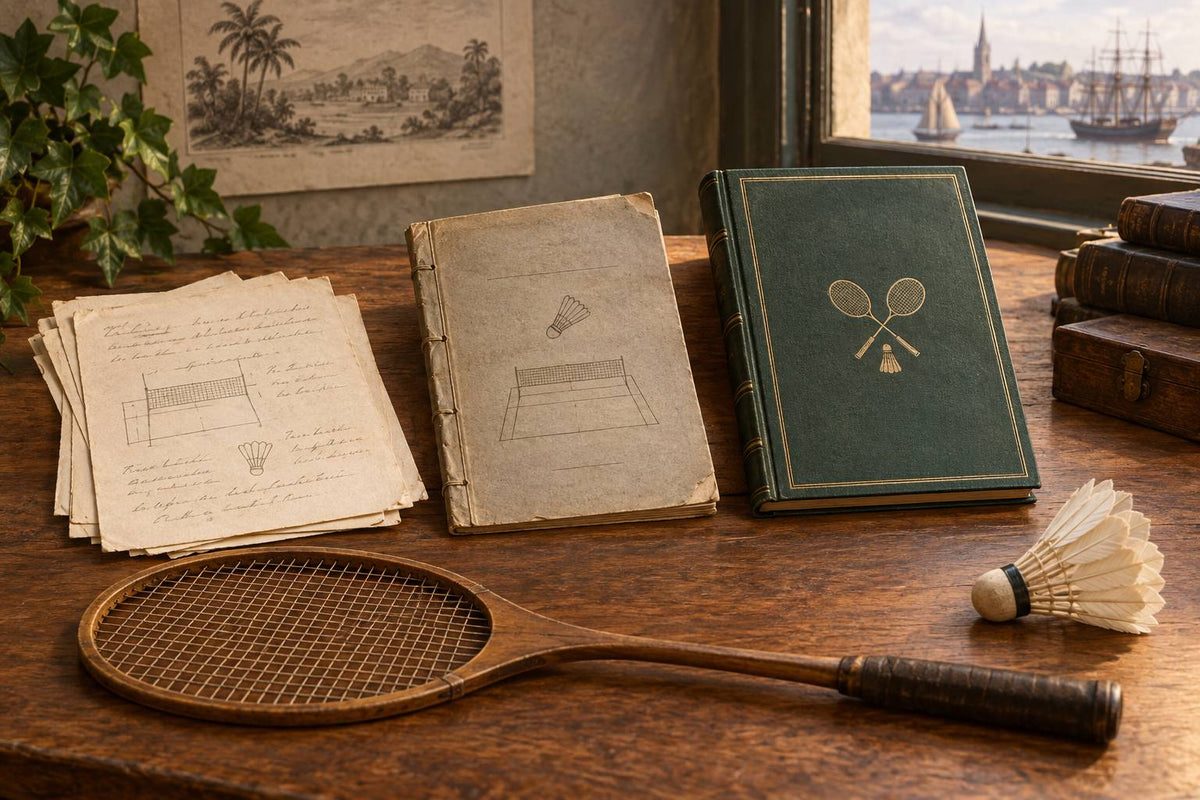
It helps to separate origin from standardisation. That distinction prevents a common historical mistake: the first badminton rules were not created from scratch in Portsmouth in 1893. Players had already used Poona rules in British India, and J. H. E. Hart revised that code for the Bath Badminton Club in 1887 before Hart and Bagnel Wild revised it again in 1890. Portsmouth mattered because clubs still differed over fundamentals such as court dimensions and net height. On 13 September 1893, representatives meeting at Dunbar in Southsea formed the Badminton Association and agreed rules for both the organisation and the game. Follow the dates as a practical timeline—Poona, Bath, then Portsmouth—and badminton’s shift from local custom to a shared rulebook becomes much easier to understand.
In This Guide
The first badminton rules began with Poona
Badminton’s earliest competitive form is associated with Badminton House in Gloucestershire. In 1860, London toy dealer Isaac Spratt published Badminton Battledore – a New Game, a pamphlet about battledore and shuttlecock as played there. No copy is known to have survived, so its rules cannot be reconstructed. A clearer glimpse appeared in 1863, when The Cornhill Magazine described sides playing across a string suspended about five feet above the ground.
The game’s first rules are generally traced to British players in India, who framed the Poona code in 1873. Poona—now Pune—gave the early game one of its common names. English players continued following the rules used in British India until 1887.
The timeline is not perfectly settled. One account credits the newly formed Bath Badminton Club with written rules in 1877, while another identifies Karachi in 1877 as the first attempt to create a code. These competing dates describe steps toward codification; Poona remains the principal starting point for the rules later revised in England.
1887 and 1890: Hart rewrites the Poona code
Until 1887, players in England generally followed rules inherited from British India. J. H. E. Hart, a pioneer of the game in India and later a member of the Bath Badminton Club, substantially revised that code in 1887. His work adapted the earlier Poona framework for English club play rather than inventing an entirely separate game.
The process did not stop with one draft. In 1890, Hart worked with Bagnel Wild on another revision. These two dates matter because they show that badminton’s laws were already being refined before clubs created a single governing association in 1893.
A dating caution: historical accounts disagree over whether the Bath Badminton Club formed in 1877 or 1887. That unresolved discrepancy should not obscure the better-supported sequence: Hart revised the rules in 1887, then Hart and Wild revised them again in 1890.
1893: one association and one rulebook in Portsmouth
Major S. S. C. Dolby, honorary secretary of Southsea Badminton Club, led the campaign for a common code. In August 1893, he wrote to every known badminton club and arranged a notice in The Field, inviting representatives to form a “Badminton Association.”

The meeting began at 2 p.m. on 13 September 1893 at Dunbar, Waverley Grove, Southsea, near Portsmouth. Delegates representing nine clubs unanimously formed the world’s first badminton association. They framed and approved rules for the organization, then discussed and decided the rules of the game. Publication was entrusted to F. H. Ayres of London.
Why it mattered: Clubs had previously altered printed codes or followed local customs. Court size and net height varied enormously, while some clubs played doubles, trebles or quadruples. The Portsmouth agreement replaced that patchwork with one recognized authority and rulebook.
What standardisation changed after 1893
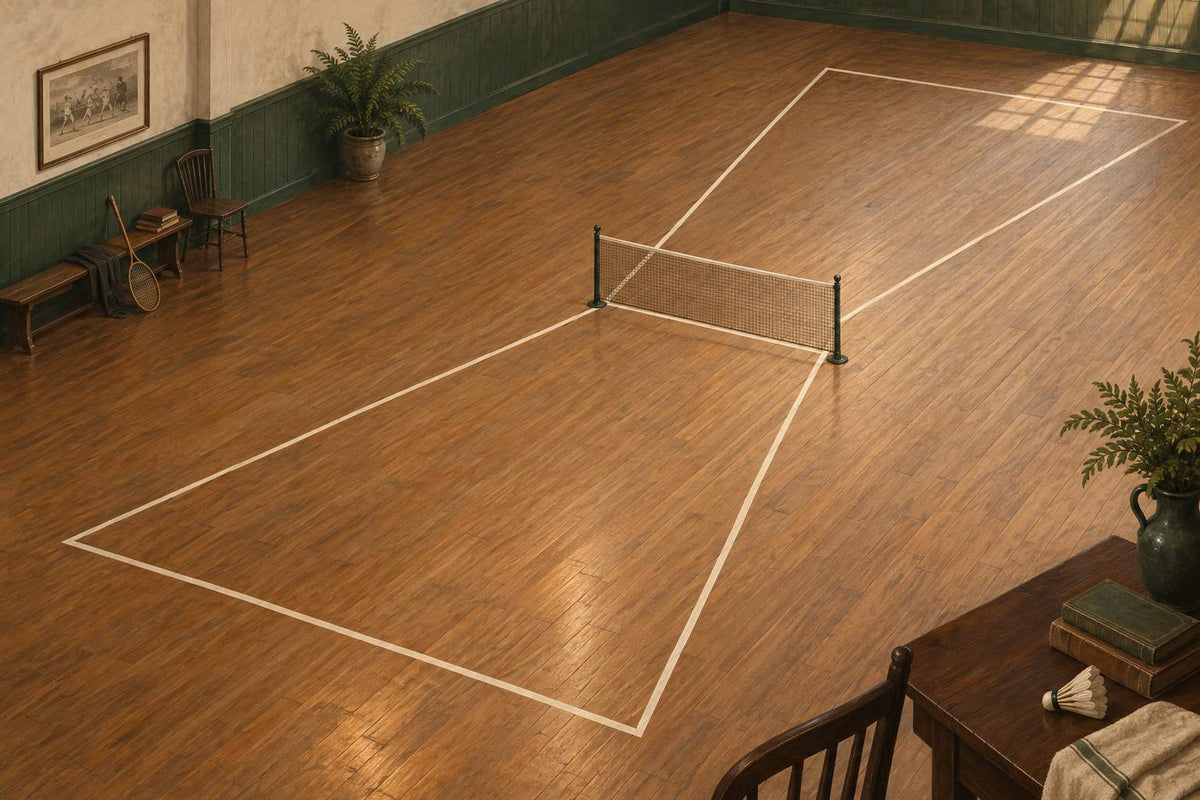
Standardisation created a common base, not a frozen rulebook. In 1901 the waisted court gave way to the rectangular 20-by-44-foot layout still recognizable today; see the court dimensions and lines guide. Laws for six- and eight-handed games were deleted in 1907. The 15-ace, serve-only system was replaced by 21-point rally scoring in 2006, while December 2018 replaced the below-waist service judgment with a fixed 1.15 m criterion. An approved 3×15 system is proposed to become standard on 4 January 2027, with 3×21 retained as an approved domestic alternative.
| Early code | Later changes |
|---|---|
| Net, marked court and service areas; below-waist underhand serve; doubles; 15-ace serve-only scoring | Rectangular court; fewer team formats; rally scoring; fixed-height service judgment; approved 3×15 transition |
The 1911 code also specified a 16-feather shuttle; explore modern feather and synthetic shuttlecock options.
Which Date Should You Call the First Badminton Rules?
The best answer depends on what “first” means in your context. Use the milestone that matches the claim rather than treating every date as interchangeable.
| Choice | Choose this if… |
|---|---|
| 1873 Poona rules | You mean the earliest framed rules identified in the main historical account. |
| 1887/1890 Bath revisions | You mean Hart’s substantial English revision and the later rewrite with Bagnel Wild. |
| 1893 association rules | You mean the first rules approved for a unified association and intended to replace differing local practices. |
For a one-line answer, distinguish origin from standardisation: Poona supplied the early code; Portsmouth supplied the association-backed rulebook.
Get 10% off your first order
Join the Badminton House list and we’ll email you a 10% welcome code — plus training guides, technique advice, and badminton updates.
By subscribing, you agree to receive Badminton House emails and can unsubscribe anytime.
The next time you serve, remember that you are playing within a framework refined across generations. We play badminton ourselves, and we are always happy to turn rules or equipment questions into practical advice. If you need help finding what fits your game, contact us.
Early badminton laws specified the shuttle’s construction. Explore modern feather and synthetic shuttles and check live availability.
Explore Shuttlecocks

Leave a comment
This site is protected by hCaptcha and the hCaptcha Privacy Policy and Terms of Service apply.