
Last checked: August 2026 · Written by the Badminton House player-led team.
Quick answer: run a fixed-set session
Give every available shuttle a job before practice, use only the assigned pool for each block, then collect and re-sort the full set.
Sort
Start here: assign match-flight, controlled-drill, or retire labels before the first exchange.
Run
Use cooperative single-shuttle work first, then move to a short game-like block.
Finish
Clear the playing area, re-sort every shuttle, and record the finish counts for the next plan.
Badminton training shuttles are easier to manage when the session starts with allocation instead of guesswork. This guide turns the set already in front of you into a simple operating worksheet. It does not estimate how many shuttles a player or group should use.
The method is deliberately editable: sort first, reserve a pool for each kind of work, run the blocks in order, and re-sort at the end. Keep that sequence if your available count or session length differs from the worked example below.
Looking for a different practice format? See our separate guide to multi-shuttle drills for badminton training. This article stays focused on allocating a fixed set.
How should you sort training shuttles before practice?
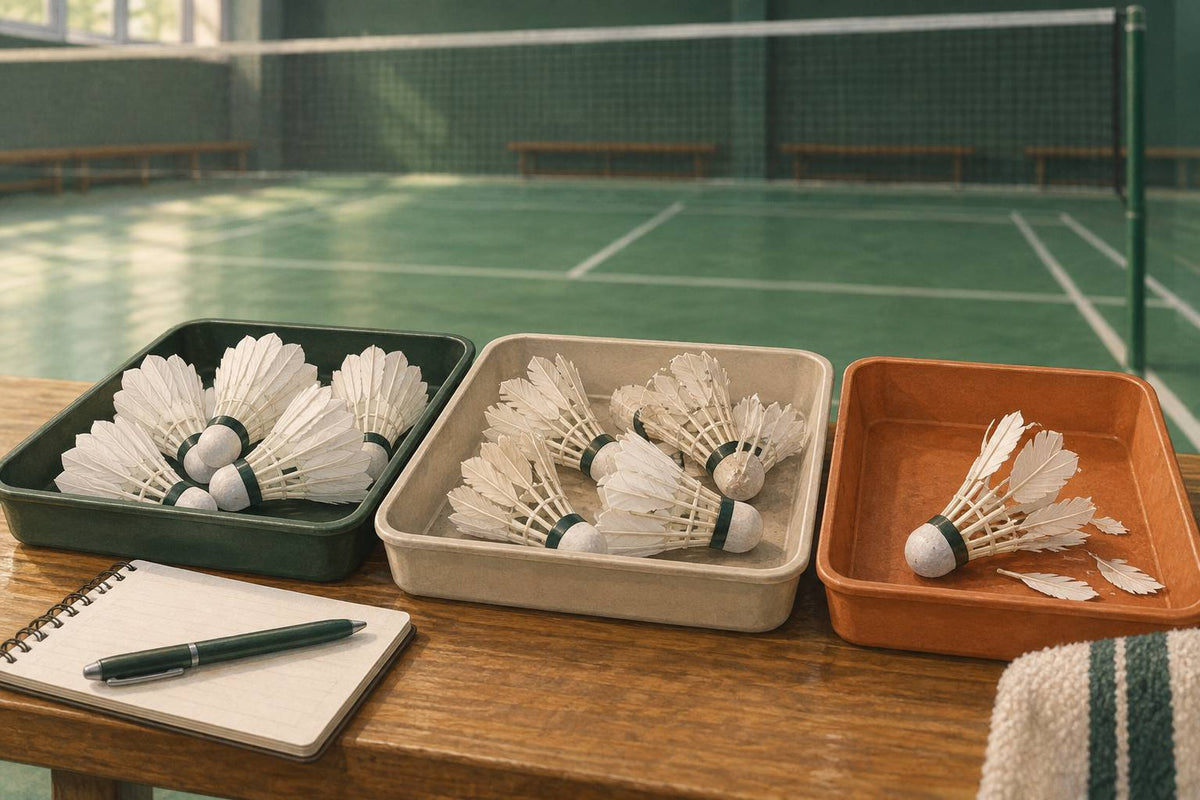
Sort the available shuttles into three working pools: match-flight for the game-like block, controlled-drill for cooperative work, and retire for anything you will not put back into play. These are planning labels, not official condition grades; the BWF speed test informs flight speed only.
Name the jobs before you count
Place three labels beside the unassigned set. Each label describes what you intend to do with that shuttle today. Use the same wording on your start sheet and finish sheet so movements between pools remain visible.
- Match-flight: use this label when the base and skirt are intact, the shuttle follows a repeatable path in your test hits, and its speed suits the planned game-like block.
- Controlled-drill: use this label when the shuttle remains predictable enough for a cooperative task but is not your choice for the game-like finish.
- Retire: use this label when damage or erratic flight changes the intended task enough that you will not put the shuttle back into play today.
Touch each shuttle once during the initial sort and make a provisional assignment. Count the two playable pools only after every shuttle has a label. Write those numbers down before anyone starts, because they are the baseline for the closing check.
Use the BWF test as a speed check only
When you want a speed reading, the official test requires you to strike the shuttle with a full underhand stroke from over the back boundary line, hitting it upward and parallel to the sidelines. A correct-speed shuttle lands 530–990 mm short of the opposite back boundary line, as set out in the BWF Laws of Badminton speed-test provisions.
Record the observation as “within range” or “outside range,” then combine it with your condition and repeatability checks before assigning the shuttle to a working pool.
- Start with one unassigned set and three clearly marked working areas.
- Give every shuttle one provisional label based on its intended job today.
- Use the official test only when a speed reading is useful for a match-flight candidate.
- Write the final starting counts on the worksheet before practice begins.

How can 12 playable shuttles cover a 60-minute practice?
With 12 playable shuttles and 60 minutes, reserve one pool for cooperative single-shuttle blocks, another for a short game-like block, and five minutes for collection and re-sorting. Treat the quantities and times as worksheet fields: change them to fit the set and court time you have.
Editable 12-shuttle, 60-minute worksheet
This example assumes one court, two players, one shuttle in play at a time, and the remaining assigned shuttles staged in a marked area beside the court, clear of the playing surface. It begins with eight controlled-drill shuttles and four match-flight shuttles. “Available” means reserved for that block.
| Editable clock | Working pool | Session job |
|---|---|---|
| 0–8 minutes | All 12 | Confirm the eight-and-four allocation, mark the working areas, and write the start counts. |
| 8–23 minutes | Controlled-drill: 8 available | Straight-clear rally: partners exchange high straight clears with one shuttle. Restart calmly after an error; leave the other seven staged. |
| 23–38 minutes | Controlled-drill: same 8 available | Straight drop-and-lift: Player A drops straight from the rear court to Player B near the front service line; Player B lifts straight back. Continue the two-shot loop, switch roles halfway through, and keep one shuttle active. |
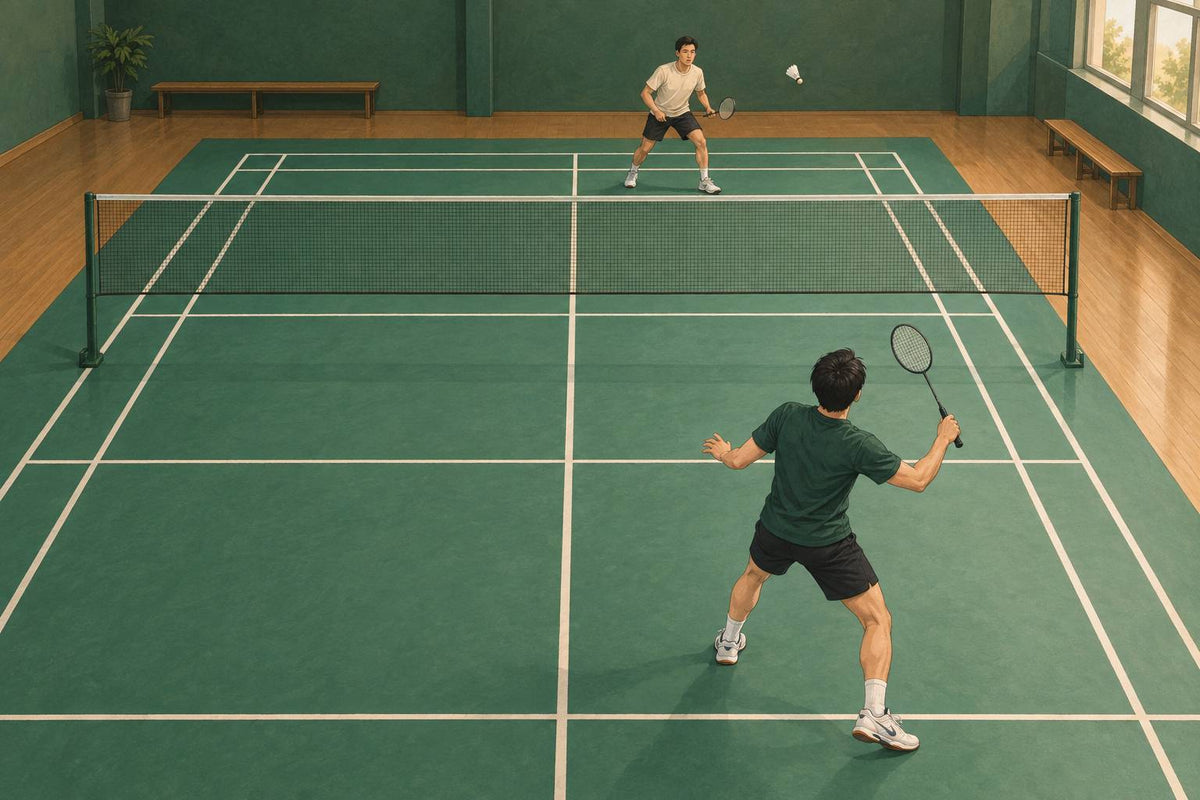
| 38–55 minutes | Match-flight: 4 available | Straight half-court singles: both players use the same chosen lengthwise half on opposite sides of the net. Play continuous points until the 55-minute signal; if a shuttle moves to review, replace it from the match-flight pool. |
| 55–60 minutes | Full set | Clear the playing area, return every shuttle to the sorting point, and record the finish counts. |
The allocation protects the purpose of each block. If the first cooperative block uses only one shuttle, the other seven remain controlled-drill shuttles. If the active shuttle leaves play, move it to the review spot described below, select another from the same pool, and continue.
Choose the scoring and shot constraints before the game-like block begins. Our guide to badminton conditioned games covers that separate planning decision; this worksheet simply gives the selected format a place in the hour.
Adapt the same worksheet without changing its order
- Fewer shuttles: keep one controlled-drill shuttle active and stage the rest. Reserve the best suitable flyer for the game-like block if you have one.
- More shuttles: add the extras to the relevant staged pool. Do not put more on court simply because they are available.
- No match-flight candidate: change or shorten the game-like task instead of forcing an erratic shuttle into it.
- Different clock: preserve the order (sort, two cooperative blocks, game-like block, collect) and write your chosen times before play.
Copy this start-and-finish record
| Local pool | Start | Moved to review | Finish |
|---|---|---|---|
| Match-flight | ___ | ___ | ___ |
| Controlled-drill | ___ | ___ | ___ |
| Retire | ___ | ___ | ___ |
Count check: start total ___ · finish total ___. One change for next time: ____________________. If the totals differ, find the missing or double-counted shuttle before using the record to plan another session.
How do you keep the fixed set orderly during practice?
Keep only the current working pool beside the playing area, move any shuttle removed from play to a clearly separate review spot, and collect before changing blocks. Those boundaries preserve the worksheet counts and keep loose shuttles off the floor; the exact court layout and rotation intervals remain adjustable.
The BWF Shuttle Time Teachers’ Manual explicitly treats loose shuttles on the floor as a safety concern. In its school-group guidance, it also recommends changing roles and positions after a set time. Those points support a clear sweep and clock signal; choose the interval that fits your block.
Use a four-rule court routine
- Stage one pool. Bring the assigned pool to its working area and leave the other playable pool separate.
- Mark one review spot. Put any shuttle removed from the current block there, away from both assigned pools.
- Sweep at the signal. Collect loose shuttles before people rotate or the next block starts.
- Update after collection. Record any pool changes once the playing area is clear, not during an exchange.
For partner or group rotations, write the role-change time on the worksheet before the block. Use one audible signal and make the change only after the loose-shuttle sweep.
Treat every pool movement as a decision
A shuttle can stay in its current pool, move to the review spot, or enter the retire group for the rest of the session. Do not casually mix it into the other playable pool. At the break, record the new assignment and update the counts of the affected pools.
This small rule keeps the record interpretable. “Four match-flight available” means four are still assigned to that block, not that four were consumed or guaranteed to remain there. The count describes this session’s plan at that moment and nothing more.
How do you close the session and improve the next worksheet?
End by clearing every shuttle from the playing area, re-sorting the full set with the same working labels, and recording the finish counts beside the start counts. The completed record shows what changed during this session and gives you a concrete starting point for the next allocation.
Complete the finish check in order
- Collect from the court and its edges before counting any pool.
- Return every shuttle to the sorting point and remove the temporary review label.
- Assign each shuttle a fresh match-flight, controlled-drill, or retire label for the completed worksheet.
- Write the finish counts directly beside the start counts.
- Add one short note naming the block that needs a different allocation or duration next time.
In the 12-shuttle example, the three finish counts should still account for all 12 shuttles: match-flight plus controlled-drill plus retire equals 12. If they do not, check the review spot, court edges, and staged pools before closing the record.
Build the next plan from a fresh sort
At the next practice, sort again before copying any allocation. Compare the new start counts with the previous finish counts, then adjust one or more worksheet fields to fit the session you intend to run. Keep the previous sheet as a record rather than treating it as a promise.
Budgeting belongs in a separate step. When that is your next question, continue to the badminton shuttlecock cost calculator. The fixed-set worksheet itself stays focused on roles, blocks, collection, and counts.

Leave a comment
This site is protected by hCaptcha and the hCaptcha Privacy Policy and Terms of Service apply.